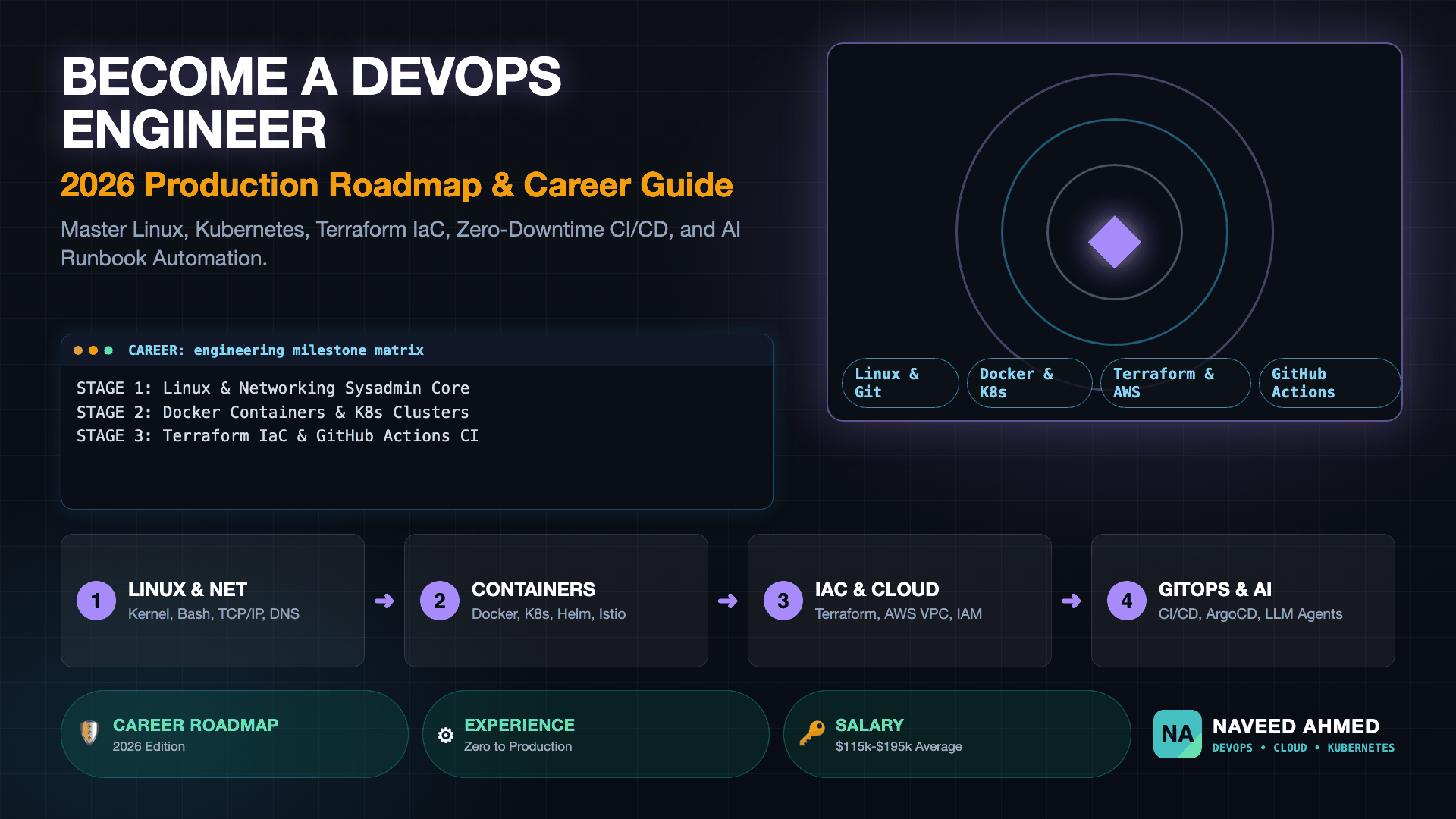
Learning how to become a DevOps engineer in 2026 can feel overwhelming when job postings demand mastery of fifty separate tools across Linux, cloud providers, container runtimes, and CI/CD pipelines. Many candidates spend months watching passive video courses, memorizing GUI clicks in the AWS console, only to struggle in practical technical interviews when asked to debug a Kubernetes CrashLoopBackOff or write a Terraform module from scratch. This comprehensive guide provides a practical, battle-tested roadmap based on ten years of production infrastructure engineering, showing you the exact competencies required to land your first role, build verifiable GitHub portfolio projects, and navigate the transition into modern platform engineering.
What Does a DevOps Engineer Actually Do in 2026?
A DevOps engineer designs, builds, and maintains the automated platform that software developers use to ship code to production safely and repeatedly. In earlier iterations of the industry, operations teams operated in isolated silos: developers wrote application code and threw it over the wall to sysadmins who manually configured bare-metal servers. Modern engineering organizations cannot afford the downtime, human errors, or deployment delays inherent in that approach.
In 2026, the day-to-day responsibilities of a DevOps engineer center around four operational areas:
- Infrastructure as Code (IaC) manages cloud networks, databases, and compute clusters declaratively using tools like Terraform and OpenTofu rather than clicking through cloud consoles.
- Continuous Integration and Continuous Delivery (CI/CD) pipelines in GitHub Actions or GitLab CI run automated test suites, scan container images for known vulnerabilities, and orchestrate zero-downtime rollouts.
- Cloud infrastructure and container platforms on AWS (EKS), Google Cloud (GKE), or Microsoft Azure (AKS) scale workloads under traffic surges while maintaining network isolation.
- Site reliability engineering and observability stacks with Prometheus, Grafana, and OpenTelemetry collect metrics and distributed traces so teams catch latency regressions before users report issues.
Hiring managers do not look for candidates who know every single tool listed on a roadmap. They look for engineers who understand operating system fundamentals, write maintainable automation scripts, and demonstrate calm, structured troubleshooting methodologies during live system failures.
The 970+ Incident Handbook & K8s Runbooks are exclusive to subscribers — unlock for FREE
Get battle-tested production runbooks, AWS architecture blueprints, and zero-downtime CI/CD post-mortems sent directly to your inbox. 100% free, no spam.
The 6-Stage Technical Roadmap: From Fundamentals to Production
To avoid tutorial paralysis, follow a sequential progression where each milestone directly reinforces the next layer of the stack. You can track this full progression alongside our visual architecture diagrams on the DevOps Roadmaps Portal.
Stage 1: Linux Operating Systems & Networking Core
Linux powers the vast majority of cloud servers and container runtimes. You cannot troubleshoot a failing Kubernetes pod or an unreachable cloud gateway without understanding operating system internals, process hierarchies, and network packet routing.
Focus on mastering these daily operational commands:
# Check active socket connections and listening ports
ss -tulpn

# Inspect open file descriptors and socket bindings for a process
lsof -i :8080

# Analyze live kernel logs and systemd service failures
journalctl -u nginx.service -f -n 100

# Trace DNS query resolution stages and authoritative nameservers
dig +trace api.naveedkumbhar.com

# Inspect HTTP response headers, SSL handshakes, and round-trip latency
curl -Iv https://blog.naveedkumbhar.com/healthz
Pay close attention to POSIX file permissions, user groups, and the umask mechanism. When managing configuration files or SSH key directories across shared worker nodes, improper permission bits will cause services to fail silently. You can quickly calculate and verify octal modes with our free Linux Chmod Calculator Utility. To practice real-world operating system failures under interview conditions, review scenario walkthroughs in the Linux and SRE Interview Questions Hub and test packet flow diagnoses in our Networking Protocols & DNS Troubleshooting Guide.
Stage 2: Containers & Kubernetes Orchestration
Containerization standardizes software delivery by bundling application runtimes, system dependencies, and configuration into immutable OCI images. Start by mastering Docker container builds, multi-stage compilation patterns, and non-root security contexts.
Here is an example of an enterprise-grade, secure multi-stage Dockerfile for a Go application that produces a minimal image under 25 megabytes:
# Build stage: compile binary with security flags
FROM golang:1.22-alpine AS builder
WORKDIR /app
COPY go.mod go.sum ./
RUN go mod download
COPY . .
RUN CGO_ENABLED=0 GOOS=linux go build -ldflags="-w -s" -o server ./cmd/server

# Final runtime stage: minimal distroless image running as non-root
FROM alpine:3.20
RUN addgroup -S appgroup && adduser -S appuser -G appgroup
USER appuser
WORKDIR /home/appuser
COPY --from=builder /app/server .
EXPOSE 8080
ENTRYPOINT ["./server"]
To speed up local development feedback loops, study our practical guide on Docker Build Speed and Layer Caching Optimization, or migrate legacy multi-container setups using the Docker Compose to Kubernetes Converter.
Once you understand containers, move to Kubernetes. Learn pod scheduling, ConfigMaps, Secrets, Ingress controllers, and how to restrict inter-pod communication using NetworkPolicies. For a structured, module-by-module curriculum covering all 24 production topics, explore the interactive Kubernetes Mastery Path. When generating boilerplate manifests for deployments and ingress objects, use the free Kubernetes YAML Generator, and lock down pod-to-pod traffic with the Kubernetes NetworkPolicy Generator.
Stage 3: Infrastructure as Code (IaC) with Terraform & AWS
Treating cloud resources as disposable, version-controlled code prevents configuration drift and allows entire environments to be recreated within minutes. In modern production environments, Terraform (and OpenTofu) paired with Amazon Web Services forms the industry benchmark for declarative cloud provisioning.
Focus on mastering these production Terraform and AWS patterns:
- Modular Architecture and Environment Isolation: Structuring separate root modules for
dev,staging, andprodenvironments with shared, versioned infrastructure modules. Follow our production blueprint on Terraform Architecture for Production AWS SaaS to design maintainable directory hierarchies and remote module registries. - State Locking and Plan Review Hygiene: Storing state files in encrypted Amazon S3 buckets with distributed locking managed by Amazon DynamoDB. To prevent state corruption or accidental database deletions during automated CI runs, study our operational runbook on Reviewing Terraform Plans Without Destroying Production.
- Cloud Networking and Subnet Math: Calculating non-overlapping IPv4 CIDR blocks for public ingress subnets, private worker nodes, and isolated database tiers across multiple Availability Zones. Validate subnet allocations pre-flight using the CIDR Subnet Calculator Utility.
- Production Reference Implementation: For an end-to-end runnable deployment, build the multi-AZ network, managed EKS cluster, and Amazon RDS database detailed in our step-by-step AWS Startup Reference Architecture Lab.
# Example remote state backend and AWS provider definition
terraform {
  required_version = ">= 1.8.0"
  required_providers {
    aws = {
      source  = "hashicorp/aws"
      version = "~> 5.50"
    }
  }
  backend "s3" {
    bucket         = "prod-terraform-state-2026"
    key            = "networking/vpc/terraform.tfstate"
    region         = "us-east-1"
    dynamodb_table = "terraform-locks"
    encrypt        = true
  }
}
When preparing for technical interviews, hiring teams evaluate how you handle AWS Transit Gateways, IAM cross-account trust boundaries, and disaster recovery scenarios. Review battle-tested architectural questions in our AWS DevOps Architecture Interview Guide, and test your command-line memory in the browser with the interactive Terraform Arcade Challenge.
Stage 4: CI/CD Pipeline Automation & GitOps
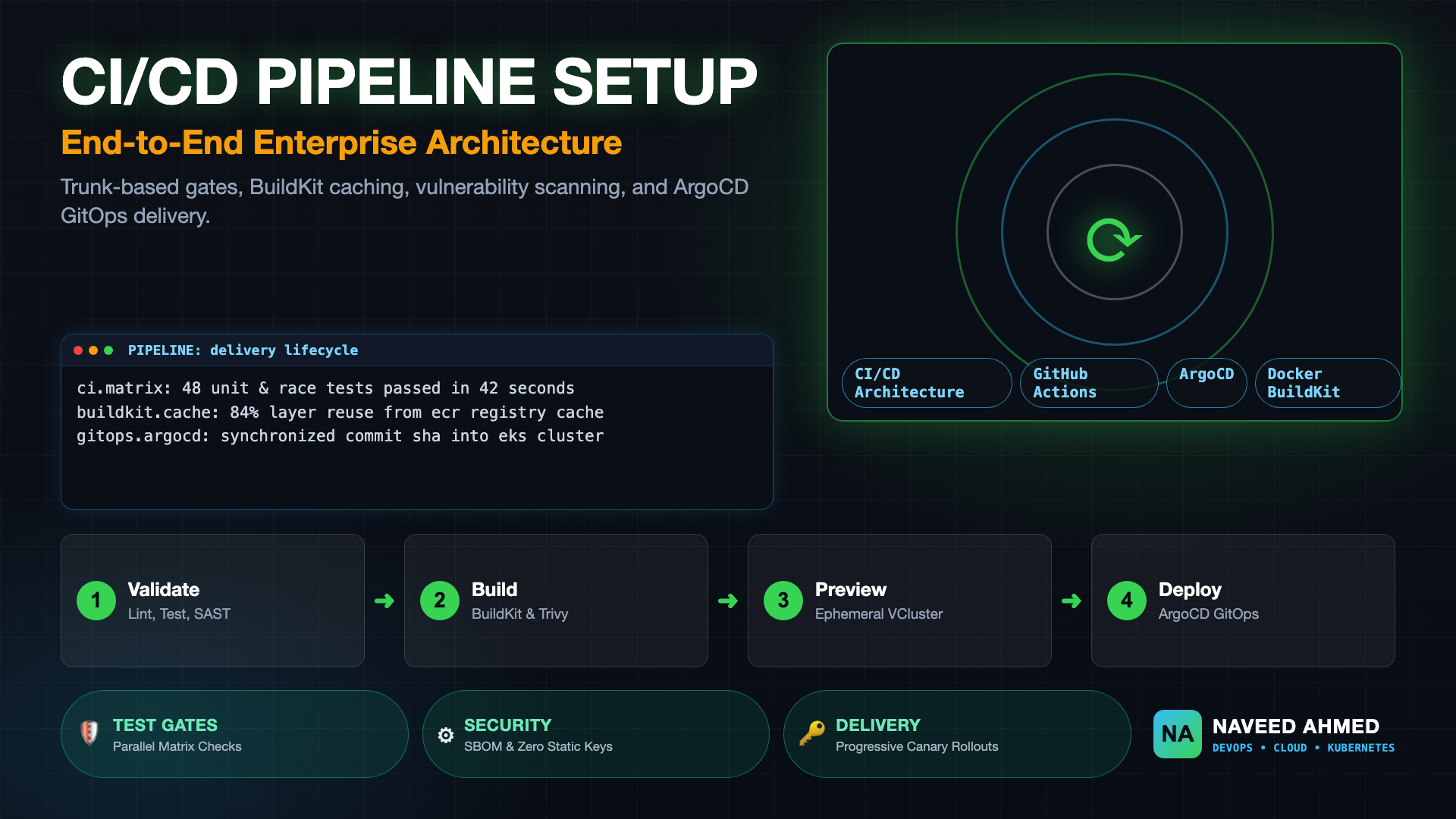
A continuous integration and delivery pipeline automates code validation, automated testing, container image builds, and deployment verification. In 2026, security is integrated directly into the pipeline rather than bolted on after deployment.
Key pipeline stages to build:
- Static Analysis & Linting: Running ShellCheck for shell scripts, yamllint for Kubernetes manifests, and tflint for Terraform modules.
- Vulnerability Scanning: Scanning container images during the build using Trivy or Grype to catch critical CVEs before pushing to registries.
- Secretless Authentication: Eliminating permanent AWS access keys on GitHub runners by configuring OpenID Connect (OIDC) to assume short-lived IAM roles. Follow our architectural walkthrough on GitHub Actions OIDC AWS IAM Integration.
- Automated Artifact Promotion: Building multi-architecture images and publishing to container registries with our complete guide on GitHub Actions to Amazon ECR and EKS Deployment.
- GitOps Delivery: Connecting an ArgoCD controller to your Git repository to automatically synchronize application manifests to your Kubernetes clusters upon commit approval. Follow our hands-on blueprint on GitOps ArgoCD: Eliminating Configuration Drift.
To inspect common pipeline bottlenecks and automated verification patterns, review realistic scenarios in the CI/CD Interview Questions and Answers Hub.
Stage 5: Observability, SRE Metrics & Incident Triage
Deploying software is only half the battle; maintaining availability under unexpected production stress is where senior engineers earn their stripes. Study the Four Golden Signals defined by Google Site Reliability Engineering: latency, traffic, errors, and saturation.
Learn how to query Prometheus metrics using PromQL, build dashboards in Grafana, and correlate application errors with distributed traces using OpenTelemetry. Practice writing clear postmortem analyses after simulated cluster failures to build the diagnostic mindset tested in technical interviews. For an end-to-end framework on diagnosing system degradation, study our architectural guide on Think Like an SRE: Troubleshoot Like a Pro, and explore real telemetry drills in the Observability and Incident Triage Scenarios.
Stage 6: Modern Agentic AI & Platform Automation
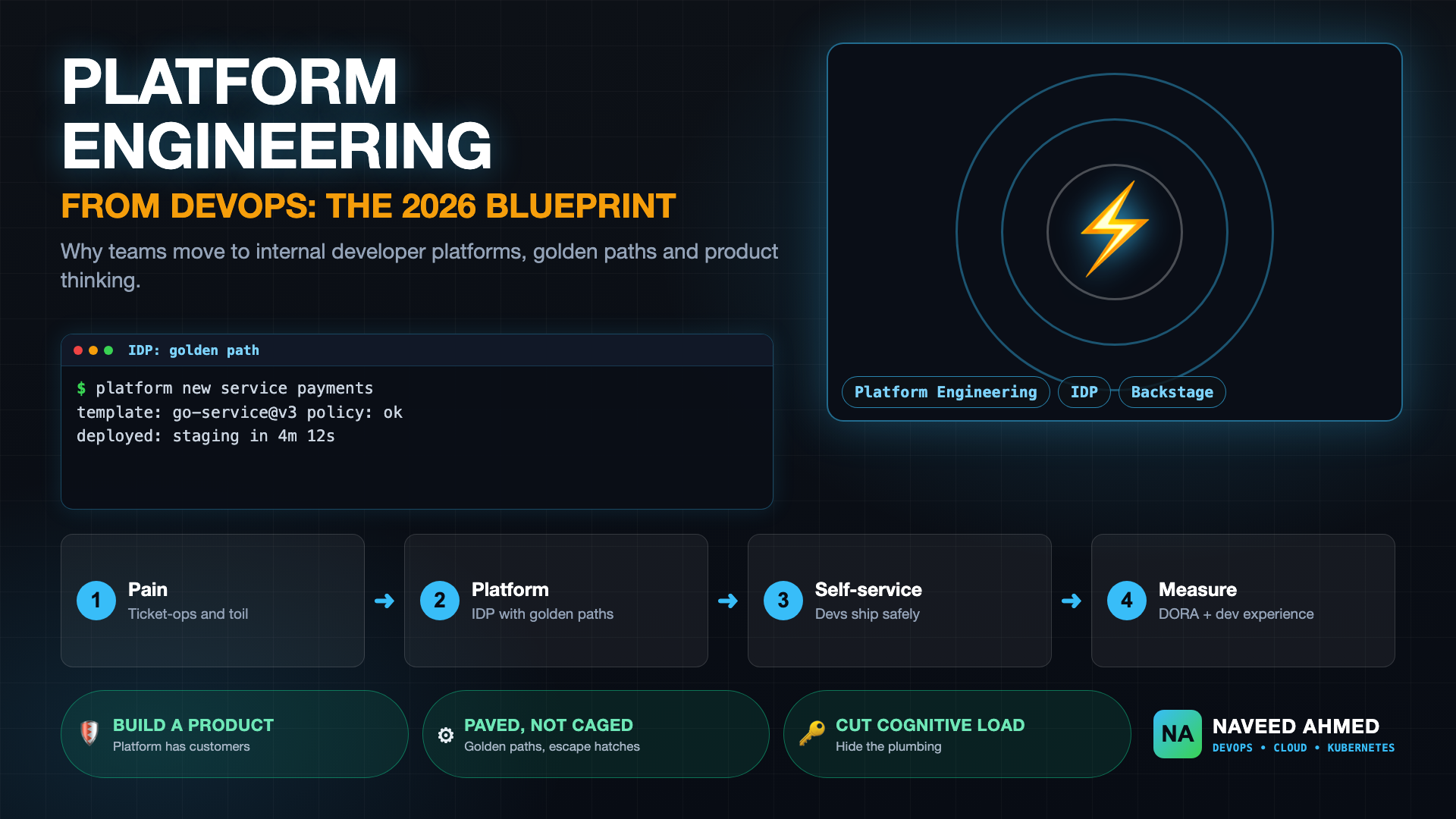
DevOps engineers in 2026 do not write every configuration manifest by hand. They leverage autonomous coding agents, LLM CLI utilities, and the Model Context Protocol (MCP) to automate repetitive triage workflows. The shift from manual ticket handling to self-service developer portals is detailed in our guide on DevOps to Platform Engineering Evolution.
To safely incorporate generative AI into your platform operations without risking production incidents, read our runbook automation framework on How AI Agents Automate DevOps Runbooks Safely, and explore private hosting patterns in our technical breakdown on Local LLM Architecture for DevOps and SRE.
Core Technical Skills Matrix: 2026 Production Standards
The following matrix outlines the foundational competencies expected across technical job interviews in 2026, comparing the primary tool of choice with its real-world production purpose and direct links to ecosystem hands-on practice:
| Engineering Domain | Primary Tooling | Required Competency | Real-World Production Impact | Ecosystem Labs, Tools & Drills |
|---|---|---|---|---|
| Operating Systems | Linux (Ubuntu, Debian, RHEL) | Kernel tuning, systemd unit files, Bash scripting, process scheduling | Isolating memory leaks, diagnosing I/O wait spikes, and managing system daemons without reboots. |
Linux Chmod Tool Linux SRE Runbook 100% Disk Full Triage Drill |
| Container Platforms | Docker & Containerd | Multi-stage builds, rootless execution, volume lifecycle, image layer caching | Minimizing container attack surfaces and accelerating CI pipeline image build times. |
Docker Compose to K8s BuildKit Cache Lab Docker Terminal Game Docker Interview Scenarios |
| Orchestration | Kubernetes (EKS, GKE, K3s) | Deployments, Services, Helm charts, Ingress, NetworkPolicies, RBAC | Ensuring zero-downtime rolling updates and automated pod healing during infrastructure degradation. |
K8s Mastery Curriculum K8s YAML Generator Kubectl Crash Simulator K8s Troubleshooting Lab |
| Infrastructure as Code | Terraform / OpenTofu | State locking, module composition, dynamic variables, plan review hygiene | Eliminating configuration drift and provisioning reproducible production environments across clouds. |
AWS Startup Reference Lab Terraform Guardrails Lab Terraform Arcade Game Terraform Interview Q&A |
| Continuous Delivery | GitHub Actions & ArgoCD | OIDC IAM federation, workflow matrices, GitOps pull-based reconciliation | Removing long-lived deployment credentials and automating canary release verification. |
GitHub Actions OIDC AWS IAM Pipeline Setup Tutorial GitOps ArgoCD Guide DevOps Support Loop |
| Observability | Prometheus, Grafana, OpenTelemetry | PromQL query design, SLI/SLO definition, alert threshold routing, trace correlation | Slashing Mean Time to Detection (MTTD) and Mean Time to Resolution (MTTR) during outages. |
Think Like an SRE Google SRE Triage Loop SLO Burn Rate Alerting |
How to Become a DevOps Engineer Without Prior Experience
One of the most frequent search queries is whether it is possible to break into DevOps without direct professional experience. The short answer is yes, but the path depends heavily on your current technical background.
Path A: For Software Developers
If you already write Python, Go, Java, or JavaScript, you possess strong algorithmic reasoning and Git familiarity. Focus your efforts on the infrastructure side: Linux kernel commands, TCP/IP networking, Docker internals, Terraform, and Kubernetes cluster setup. Frame your developer background as an asset for building internal developer platforms and automating testing pipelines. To understand how microservices run reliably at scale on cloud compute, review our guide on Deploying Production Kubernetes on AWS, and prepare for architectural rounds with System Design Scenarios for Platform Engineers.
Path B: For Systems Administrators & IT Support Specialists
If you come from helpdesk, network administration, or traditional Linux/Windows sysadmin roles, you already grasp IP routing, DNS, firewall rules, and user permissions. Your priority is learning modern software development practices: version control with Git, writing modular code in Python or Go, building declarative CI/CD pipelines, and shifting away from manual GUI configuration toward Infrastructure as Code. Practice declarative configuration management using our Ansible Commands Cheat Sheet, and practice behavioral scenario framing with our DevOps Situational Interview Questions Guide.
Path C: For Absolute Beginners (From Scratch)
If you have no prior IT background, avoid jumping directly into complex Kubernetes operators or microservice service meshes. Spend your first two months exclusively on Linux commands, Bash scripting, and Git version control. Once comfortable on the terminal, introduce Docker, deploy your first containerized web application, and write Terraform scripts to host it on an AWS EC2 instance behind an Application Load Balancer. Sharpen your cloud IP calculation instincts using the interactive Subnetting Mental Math Arcade Game, and walk through foundational cloud setup using our AWS Startup Infrastructure Setup Guide.
3 Real-World Portfolio Projects That Get You Hired
A resume that lists twenty technical keywords without proof gets ignored. A GitHub repository containing clean Terraform code, an automated GitHub Actions pipeline with green status badges, and an architectural README immediately stands out to engineering managers. Build these three projects to prove your production readiness:
Project 1: Highly Available Cloud Infrastructure with Terraform & AWS
Create a public GitHub repository that provisions a multi-AZ AWS VPC containing public and private subnets, an Internet Gateway, NAT Gateways, and an Application Load Balancer. Deploy an auto-scaling group of EC2 instances running a containerized API that connects to a managed Amazon RDS PostgreSQL database in private subnets. Include automated terraform-docs documentation and pre-commit security hooks with tfsec. To model enterprise standards, reference our architectural blueprint on AWS Architecture for Startups and incorporate budget optimization practices from Reducing AWS Costs Without Breaking Production.
Project 2: End-to-End GitOps Microservice Pipeline
Build an end-to-end delivery pipeline using GitHub Actions and ArgoCD. When code is pushed to the main branch, your GitHub Action runs automated linting, builds a minimal Docker container, scans the image with Trivy for vulnerabilities, and updates a separate GitOps configuration repository with the new image tag. ArgoCD then detects the commit and synchronizes the application to a local Minikube or cloud Kubernetes cluster. Compare workflow design patterns in our breakdown on GitHub Actions vs Jenkins Pipeline Architecture, and follow the hands-on walkthrough in the DevOps Pipeline Setup Lab Tutorial.
Project 3: Production SRE Observability & Outage Drill
Instrument a sample microservice with Prometheus metrics and OpenTelemetry traces. Deploy Grafana with pre-configured dashboard JSON files displaying request rates, error rates (HTTP 5xx), and 99th-percentile latency. Use a chaos engineering tool or custom shell script to simulate high latency or database connection pool exhaustion, and document the triage runbook step-by-step in your repository's markdown files. To structure your troubleshooting runbook around common real-world failures, study our checklist on 10 Kubernetes Production Problems I Check First and review the emergency response actions analyzed in the Google Staff SRE Outage Drill Experience.
How to Prepare for DevOps Technical Interviews (Scenarios, Live Loops & Behavioral)
Technical interviews for DevOps and platform engineering roles assess systematic troubleshooting under pressure rather than textbook memorization. Senior hiring teams structure their interview loops into three distinct rounds: live terminal debugging, infrastructure system design, and behavioral scenario assessments.
To master each phase of the evaluation process, utilize these dedicated ecosystem preparation resources:
- Live System Triage and Outage Simulation: Practice answering open-ended incident scenarios under time constraints by reviewing our comprehensive guide to The Top 10 Toughest DevOps Interview Questions and the curated DevOps Interview Questions 2026 Edition.
- FAANG and Tier-1 Company Interview Loops: Study real candidates' step-by-step interview debriefs, including the Stripe Senior Platform Engineer Interview Loop, the Amazon L6 Senior DevOps SRE Loop, and the NVIDIA Senior DevOps GPU Infrastructure Loop.
- Behavioral Structure and Communication: Formulate your past operational wins, incident postmortems, and on-call war stories using the structured STAR Framework Interview Strategy Guide, while steering clear of common pitfalls detailed in DevOps Interview Mistakes to Avoid.
Certifications vs Portfolio: What Actually Lands Interviews?
Candidates frequently waste thousands of dollars collecting introductory multiple-choice certificates that hiring teams ignore. Certifications are valuable only when they test hands-on, live-terminal competence or broad architectural principles.
| Certification | Issuing Organization | Exam Format | Realistic Hiring Impact & Prep Resources |
|---|---|---|---|
| Certified Kubernetes Administrator (CKA) | Cloud Native Computing Foundation (CNCF) | 100% Performance-Based (Live Terminal) |
Highest: Proves you can configure, debug, and troubleshoot real Kubernetes clusters under timed pressure. Prep: Study our Kubernetes SRE Preparation Guide and train on the Kubectl Practice Game. |
| AWS Certified Solutions Architect - Associate | Amazon Web Services (AWS) | Scenario-Based Multiple Choice |
High: Validates foundational cloud architecture, VPC networking, security boundaries, and storage services. Prep: Review architectural patterns in our AWS DevOps Architecture Guide. |
| HashiCorp Certified: Terraform Associate | HashiCorp / IBM | Multiple Choice & Syntax Matching |
Moderate: Helpful for demonstrating familiarity with HCL syntax, modules, and state file management. Prep: Explore the Terraform Interview Q&A Hub and review the IaC Tool Comparison Matrix. |
| Generic Cloud Practitioner Certificates | Various Cloud Vendors | Basic Multiple Choice | Low: Demonstrates high-level sales vocabulary but provides zero signal regarding hands-on engineering ability. |
DevOps Engineer Salary Benchmarks Across Experience Levels
Compensation in DevOps and platform engineering reflects the significant business impact of maintaining system reliability and automated software delivery. The following compensation figures reflect current 2026 United States enterprise market medians (base salary plus performance bonus):
| Career Level | Years of Experience | US Compensation Range | Primary Production Responsibility |
|---|---|---|---|
| Associate / Junior Engineer | 0–2 years | $95,000 – $125,000 | Maintaining existing CI/CD pipelines, writing basic Terraform modules, resolving tier-1 alerts. |
| Mid-Level Cloud / DevOps Engineer | 2–5 years | $130,000 – $165,000 | Designing cloud networks, containerizing microservices on Kubernetes, enforcing deployment security. |
| Senior DevOps / Platform Engineer | 5–8 years | $170,000 – $215,000 | Architecting self-service internal developer platforms, setting observability standards, leading triage. |
| Staff / Lead Platform Architect | 8+ years | $220,000 – $280,000+ | Multi-cloud governance, cross-organization infrastructure strategy, reliability engineering leadership. |
Key Takeaways: Your Action Plan for 2026
Breaking into DevOps requires deliberate focus on foundational engineering competencies rather than superficial tool memorization. Follow this structured roadmap to build verifiable skills, showcase production-ready artifacts, and stand out in competitive hiring loops:
- Ground your learning in Linux file systems, process signals, and network sockets rather than chasing cloud vendor dashboards.
- Replace passive video consumption with public GitHub repositories containing modular Terraform and working CI/CD workflows.
- Target hands-on terminal exams like the CKA that prove operational competence to hiring managers.
- Practice diagnosing simulated cluster failures and writing structured, blame-free postmortem analyses.
- Work through real engineering interview loops like the Stripe Senior Platform Engineer Loop and the Amazon L6 Senior DevOps SRE Loop.
- Make use of the interactive roadmaps, scenario-based interview drills, and practical calculators available throughout this ecosystem.
Frequently Asked Questions
How can I become a DevOps engineer without prior experience?
Build a publicly verifiable GitHub portfolio demonstrating end-to-end infrastructure automation instead of watching passive video tutorials. Deploy a multi-tier microservice on AWS or local Kubernetes using Terraform, configure automated GitHub Actions CI/CD with security scanning, implement Prometheus and Grafana observability, and document your architecture decisions in clear runbooks.
How long does it take to become a DevOps engineer from scratch?
For someone with zero programming or IT background, reaching job readiness typically requires 6 to 9 months of consistent, daily hands-on practice (15-20 hours per week). Software engineers or systems administrators transitioning to DevOps can reach production competency in 3 to 4 months by focusing on Infrastructure as Code, Kubernetes, and cloud architecture.
Do you need a computer science degree to become a DevOps engineer?
No. The majority of hiring managers in DevOps and Platform Engineering prioritize demonstrable operational problem-solving over formal credentials. Production-grade GitHub repositories, practical certifications like the Certified Kubernetes Administrator (CKA) or AWS Solutions Architect Associate, and the ability to troubleshoot live production outages carry significantly more weight in technical interviews.
What certifications actually help you get hired in 2026?
The top three high-yield certifications are the Certified Kubernetes Administrator (CKA), AWS Certified Solutions Architect - Associate (SAA-C03), and HashiCorp Certified: Terraform Associate (003). These validate hands-on command-line competence and cloud systems architecture rather than rote multiple-choice memorization.
What is the average salary for a DevOps engineer in 2026?
In the United States, entry-level DevOps engineers typically earn between $95,000 and $125,000 per year, mid-level engineers earn $130,000 to $165,000, and senior platform/DevOps engineers command $175,000 to $225,000+ plus equity. Remote and international roles vary by market tier, with European mid-level salaries averaging €70,000 to €95,000.