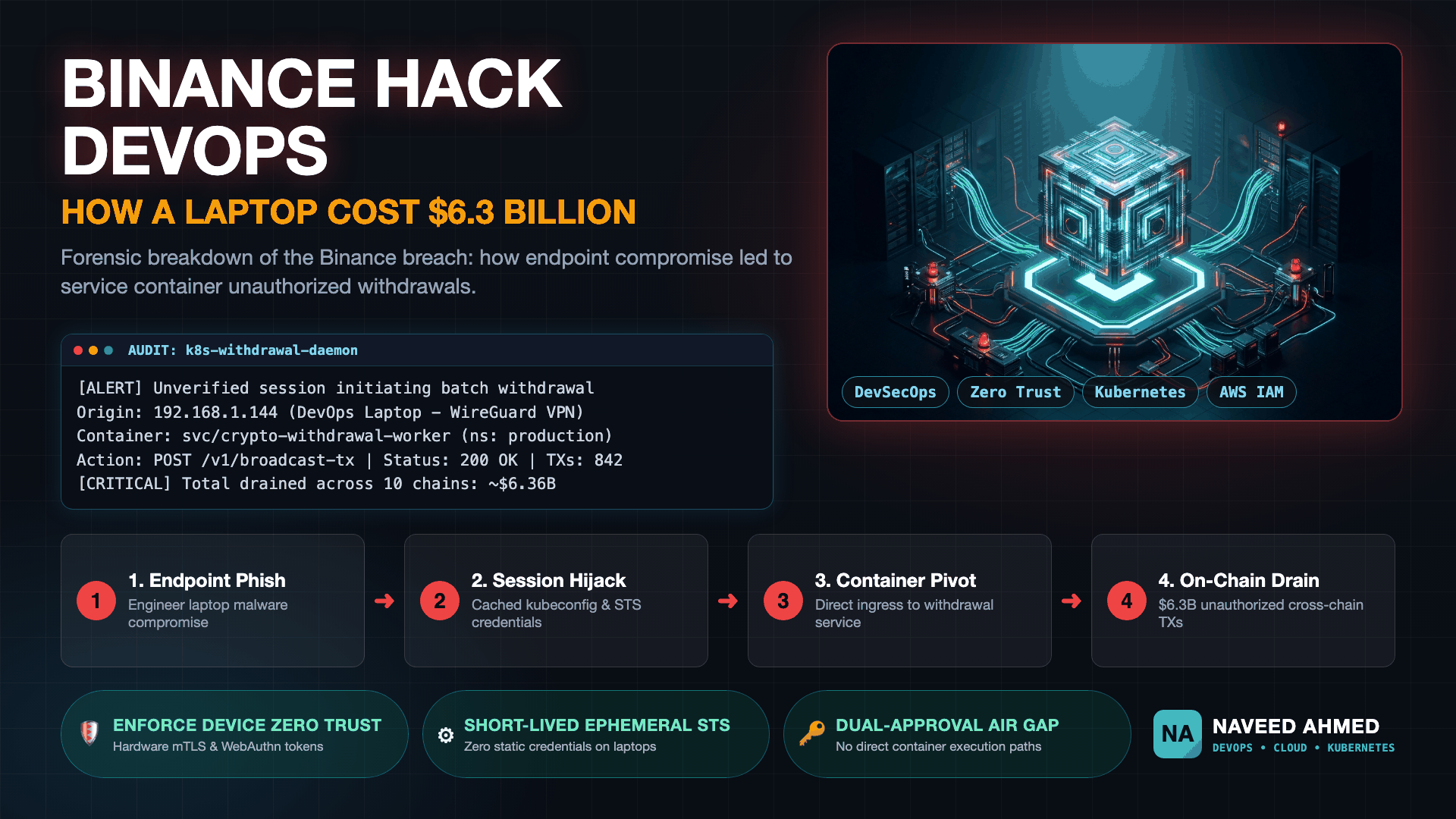
When news broke that the Binance hack DevOps laptop incident led to an estimated $6.3 billion drain across multiple blockchains, it sent shockwaves through the cloud engineering community. The disclosure that an attacker compromised an engineer's personal or company-issued workstation, pivoted into an internal service container, and dispatched unauthorized withdrawal transactions exposed the fragile perimeter assumptions still running in enterprise environments. While subsequent disclosures confirmed additional breach points and sophisticated multi-chain laundering pipelines, the central lesson remains unshakeable: treating developer endpoints as trusted perimeter gateways turns every engineer's laptop into a multi-billion-dollar single point of failure.
DevOps and Platform teams regularly hold the keys to the kingdom. A typical infrastructure engineer's laptop carries persistent cloud session tokens, cached cluster certificates, administrative VPN tunnels, Git repository write permissions, and direct access to deployment automation. In this technical post-mortem and hardening guide, we break down the anatomy of workstation-to-cloud lateral movement, examine why traditional container isolation failed to halt the exploit, and walk through six non-negotiable DevSecOps controls required to protect modern production platforms.
According to preliminary disclosures and ongoing forensic reporting tracked across our DevOps News breach coverage and independent analyses from blockchain intelligence firms detailed in the TRM Labs TraderTraitor forensic attribution, threat actors initiated unauthorized transfers across 10 distinct blockchains within a 20-to-30 minute window. While stablecoin issuers swiftly froze approximately $3 billion on-chain and corporate SAFU reserves were allocated to cover user balances, the initial attack path demonstrated how fast endpoint access translates into container-level execution.
Binance Hack DevOps Analysis: What an Engineer's Laptop Actually Holds
A DevOps engineer's workstation typically stores active cloud session profiles, Kubernetes cluster certificates, SSH keys, and administrative VPN configurations. In the Binance hack DevOps incident, compromising this single endpoint provided direct network line-of-sight into internal orchestration environments, bypassing external firewalls.
~/.kube/config containing client certificates, static Bearer tokens, or SSO-derived tokens with cluster-admin RBAC bindings.~/.aws/credentials or cached gcloud OAuth tokens granting access to IAM roles, KMS keys, and infrastructure provisioning APIs.~/.ssh/id_ed25519 and loaded ssh-agent daemons that enable access to bastion hosts and source repositories.When an attacker compromises a laptop via targeted spear-phishing, trojaned open-source packages, or drive-by browser exploits, they do not just steal files. They inherit the engineer's active identity, authenticated network routes, and access to internal orchestration APIs. If internal services rely on network perimeter placement rather than continuous cryptographic attestation, the attacker gains direct line-of-sight to sensitive service endpoints.
The 970+ Incident Handbook & K8s Runbooks are exclusive to subscribers — unlock for FREE
Get battle-tested production runbooks, AWS architecture blueprints, and zero-downtime CI/CD post-mortems sent directly to your inbox. 100% free, no spam.
The Lateral Movement Path: From Compromised Endpoint to Service Container
Lateral movement from a laptop to a service container succeeds when internal networks lack mutual TLS and identity attestation. Once an attacker breaches the workstation, they leverage persistent VPN tunnels or direct API access to dispatch commands to automated withdrawal microservices that lack secondary human approval.
In containerized environments, internal service containers often run daemons configured to accept commands from internal network ranges without mutual TLS (mTLS) or caller identity verification. If an internal transaction worker accepts HTTP POST /v1/broadcast-tx requests originating from any IP inside the cluster VPC, any compromised workstation with a VPN connection or kubectl port-forward privilege can command that container to transfer funds. Analyzing the blast radius of the Binance hack DevOps incident requires inspecting how easily an internal container accepted commands without cryptographic proof of originator identity.
This illustrates the danger of the castle-and-moat security model. Even when wallet private keys remain securely stored in hardware security modules (HSMs) or multi-party computation (MPC) nodes, an attacker does not need to extract the private key if they can compromise the authorized software container that commands the HSM to sign transactions.
Six Zero Trust DevSecOps Controls Every Engineering Team Must Enforce
Zero Trust DevSecOps eliminates implicit perimeter trust by mandating layer-7 identity verification, ephemeral short-lived tokens, strict Kubernetes RBAC, eBPF microsegmentation, multi-party computation for high-value actions, and real-time behavioral runtime detection across both workstations and clusters.
Preventing an endpoint breach from cascading into a cloud disaster requires assuming that developer laptops will inevitably be targeted and compromised. Security architectures must be designed so that a compromised endpoint yields zero direct access to production execution environments. Applying Binance hack DevOps lessons across infrastructure engineering leads to six architectural controls that implement true defense-in-depth.
1. Enforce Zero Trust Network Access (ZTNA) with Device Attestation
Traditional VPNs grant layer-3 IP-level access to internal subnets. Once an attacker controls a laptop connected to a corporate VPN, they can run port scans against internal cluster nodes and database endpoints. Replace legacy VPNs with Zero Trust Network Access (ZTNA) brokers such as Cloudflare Access, Teleport, or AWS Verified Access.
Under a ZTNA model, access is granted at layer 7 per application, never at layer 3. Furthermore, the identity broker enforces device posture checks before establishing a connection. If the workstation does not present an enrolled hardware certificate, an active CrowdStrike/SentinelOne agent, disk encryption, and OS patch compliance, the gateway drops the connection regardless of valid credentials.
2. Eliminate Static Long-Lived Credentials on Workstations
Static API keys and IAM credentials in ~/.aws/credentials or local dotfiles are the easiest targets for malware. Engineers should never store persistent AWS, GCP, or Azure access keys on their physical machines. Instead, implement OpenID Connect (OIDC) identity federation and short-lived STS tokens governed by identity providers like Okta or Azure AD.
We covered the mechanics of removing static secrets across pipelines in our guide to configuring GitHub Actions OIDC with AWS IAM roles. The exact same pattern applies to developer workstations: use tools like aws-vault or IAM Identity Center (AWS SSO) with session limits capped at 1 hour and mandatory FIDO2 hardware token prompts for role assumption.
# ~/.aws/config - Enforce short-lived IAM Identity Center sessions with MFA
[profile production-admin]
sso_session = secure-corp-sso
sso_account_id = 123456789012
sso_role_name = EphemeralPlatformOps
region = us-east-1

[sso-session secure-corp-sso]
sso_start_url = https://corp-auth.awsapps.com/start
sso_region = us-east-1
sso_registration_scopes = sso:account:access
# Session duration strictly capped at 60 minutes
session_duration = 3600
3. Restrict Kubernetes RBAC and Block Direct Pod Execution
Allowing platform engineers to run arbitrary kubectl exec or kubectl port-forward against production workloads violates least-privilege principles. When a laptop is compromised, an attacker running kubectl exec -it <withdrawal-worker> -- sh gains the full pod identity and network capability of that service.
In production clusters, production debugging should occur through read-only telemetry, structured logging, and ephemeral debug containers managed by rigorous admission webhooks. Reference the production Kubernetes troubleshooting runbook for non-intrusive diagnostic patterns that avoid running raw shells inside live workloads.
# Kubernetes RBAC: Deny exec and port-forward to production pods
apiVersion: rbac.authorization.k8s.io/v1
kind: ClusterRole
metadata:
  name: platform-engineer-readonly
rules:
- apiGroups: [""]
  resources: ["pods", "services", "configmaps", "namespaces"]
  verbs: ["get", "list", "watch"]
- apiGroups: ["apps"]
  resources: ["deployments", "statefulsets", "daemonsets"]
  verbs: ["get", "list", "watch"]
- apiGroups: [""]
  resources: ["pods/log"]
  verbs: ["get", "list"]
# Explicitly omit pods/exec, pods/portforward, and secrets
4. Enforce Microsegmentation and Egress Filtering with eBPF
Even if an attacker gains access to an internal service container, network microsegmentation can prevent them from transmitting unauthorized transactions or connecting to external command-and-control hosts. By default, Kubernetes pods can establish network connections to any IP address inside or outside the cluster.
Using Cilium or Calico, enforce default-deny egress policies. A withdrawal worker container should only be permitted to resolve specific internal DNS names and connect strictly to designated database ports and internal message brokers. All arbitrary outbound internet connections must be dropped.
apiVersion: "cilium.io/v2"
kind: CiliumNetworkPolicy
metadata:
  name: restrict-withdrawal-egress
  namespace: financial-services
spec:
  endpointSelector:
    matchLabels:
      app: withdrawal-processor
  egress:
  # Allow egress ONLY to authorized ledger database
  - toEndpoints:
    - matchLabels:
        app: postgres-ledger
    toPorts:
    - ports:
      - port: "5432"
        protocol: TCP
  # Allow egress ONLY to internal MPC signing enclave
  - toEndpoints:
    - matchLabels:
        app: mpc-sign-service
    toPorts:
    - ports:
      - port: "8443"
        protocol: TCP
  # Drop all other egress traffic (blocks external C2 or unauthorized node gateways)
For network engineers validating subnet isolation and perimeter CIDR boundaries across cloud accounts, utilize our suite of developer networking and CIDR calculation tools to avoid overlapping route tables and accidental VPC peering bridges.
5. Implement Multi-Party Approval (Quorum) for Sensitive Workflows
No single developer, laptop, or automated container should possess the standalone authority to authorize or execute high-impact financial transactions, database drops, or production infrastructure destructions. All privileged actions must require multi-party consensus.
In financial systems, withdrawal processing requires Multi-Party Computation (MPC) or Hardware Security Module (HSM) threshold signatures, where multiple independent key shards held across distinct physical and cloud environments must sign a payload before the transaction can be broadcast to the blockchain. Furthermore, unexpected withdrawal spikes should trigger automatic velocity circuit breakers that suspend processing before funds leave the ecosystem.
Review your platform against our comprehensive DevOps infrastructure audit guide. If a single compromised identity or stolen laptop can trigger an irrevocable production state change without peer approval, your architecture does not possess defense-in-depth.
6. Deploy Runtime Behavioral Detection and File Integrity Monitoring
Endpoint Detection and Response (EDR) software on developer laptops must be complemented by runtime container security tooling inside the Kubernetes cluster. Tools like Falco monitor system calls at the Linux kernel level via eBPF, alerting platform operators the moment an abnormal process spawns inside a production container.
# Falco rule: Detect interactive shell execution inside withdrawal workloads
- rule: Shell in Production Withdrawal Pod
  desc: Detect when a shell or interpreter is launched inside the withdrawal daemon
  condition: >
    container.on_host = false and
    k8s.ns.name = "financial-services" and
    k8s.pod.label.app = "withdrawal-processor" and
    proc.name in (bash, sh, zsh, python, perl, nc, curl, wget)
  output: >
    CRITICAL: Unauthorized process spawned in withdrawal pod
    (user=%user.name pod=%k8s.pod.name container=%container.name cmd=%proc.cmdline)
  priority: CRITICAL
  tags: [security, container, mitre_execution]
Comparing Architectures: Traditional DevOps vs. Zero Trust DevSecOps
Traditional DevOps relies on perimeter VPNs and long-lived cloud keys, exposing internal workloads to compromised laptops. In contrast, Zero Trust DevSecOps enforces device attestation, hardware-bound WebAuthn tokens, ephemeral access gateways, and default-deny egress network policies.
The differences between perimeter-based infrastructure design and modern Zero Trust DevSecOps are summarized in the comparative architecture matrix below:
| Security Dimension | Vulnerable Traditional DevOps Pattern | Hardened Zero Trust DevSecOps Pattern |
|---|---|---|
| Workstation Access | Full layer-3 corporate VPN into production VPC. | Layer-7 ZTNA with device attestation and WebAuthn MFA. |
| Cloud Credentials | Long-lived static access keys in ~/.aws/credentials. |
Ephemeral, 60-minute STS tokens via OIDC/IdP federation. |
| Cluster Access | Direct kubectl exec with shared cluster-admin role. |
JIT break-glass access broker with command recording; no raw exec. |
| Container Networking | Open inter-pod routing and unrestricted outbound internet. | Default-deny Cilium eBPF network policies and mTLS. |
| Sensitive Execution | Single-node automated daemons triggering actions directly. | Threshold multi-signature (MPC/HSM) and velocity circuit breakers. |
| Runtime Visibility | Periodic log scraping; no kernel-level anomaly alerts. | Real-time eBPF runtime detection (Falco) with automated pod isolation. |
Incident Triage Playbook: What to Do When a DevOps Laptop is Compromised
When an engineer's workstation is compromised, responders must immediately attach an explicit AWS DenyAll policy, revoke active STS sessions, terminate VPN peer keys, invalidate OIDC sessions, and quarantine affected Kubernetes deployment pods to sever live attacker sessions.
If an engineer reports a phishing link click, an anomalous malware alert, or a stolen machine, platform teams must execute an immediate containment procedure within minutes. Waiting for forensic completion before revoking access is the primary cause of multi-million-dollar escalations.
# 1. Immediately revoke active AWS STS sessions for the compromised user
aws iam attach-user-policy \
  --user-name compromised-engineer \
  --policy-arn arn:aws:iam::aws:policy/AWSDenyAll

# 2. Invalidate all active IAM sessions issued before the incident timestamp
aws iam put-user-policy \
  --user-name compromised-engineer \
  --policy-name RevokeOlderSessions \
  --policy-document '{
    "Version": "2012-10-17",
    "Statement": [{
      "Effect": "Deny",
      "Action": "*",
      "Resource": "*",
      "Condition": {"DateLessThan": {"aws:TokenIssueTime": "2026-10-31T12:00:00Z"}}
    }]
  }'

# 3. Terminate active WireGuard/VPN client sessions and revoke device certificates
wg set wg0 peer <PEER_PUBLIC_KEY> remove

# 4. Invalidate OIDC and GitHub tokens across corporate identity providers
# (Trigger via Okta/Google Workspace Admin API or identity console)

# 5. Quarantine targeted Kubernetes pods to sever live attacker sessions
kubectl label pod -n financial-services -l app=withdrawal-processor quarantine=true
kubectl rollout restart deployment/withdrawal-processor -n financial-services
For engineers preparing for incident management and infrastructure defense interviews, explore real-world triage scenarios across the Kubernetes Production Scenario Handbook and sharpen your system design principles with the Kubernetes interactive learning roadmap.
Binance Hack DevOps Lessons: Hardening Cloud Infrastructure Against Compromise
Hardening cloud infrastructure against workstation compromise requires removing static credentials, air-gapping financial pipelines behind multi-signature quorums, and ensuring that no single employee's laptop carries the unilateral capability to execute or broadcast irreversible transactions.
Post-incident audits following the Binance hack DevOps disclosure revealed that the highest risk vector in distributed teams is not a zero-day exploit in container runtimes, but the over-provisioning of operational reach on developer laptops. When an engineer can reach production databases, deployment clusters, and payment containers directly from their desk without intermediate authentication gates, any endpoint breach becomes a catastrophic business event.
Teams building on public cloud providers should establish strict boundary separation. Management planes, CI/CD runners, and production execution workloads must reside in isolated virtual private clouds with zero shared credentials. By introducing mandatory multi-party approvals for high-value actions and enforcing continuous runtime monitoring, organizations neutralize the threat of compromised endpoints before unauthorized transactions can be submitted.
Key Takeaways for Platform and Security Leaders
Modern platform security requires assuming endpoint breach. Protecting production environments demands eliminating local static credentials, enforcing eBPF container microsegmentation, and implementing multi-party approval barriers for all critical financial and administrative workflows.
- Never treat developer laptops as trusted nodes: Any endpoint can fall to sophisticated social engineering, phishing, or software supply chain attacks. Enforce continuous device attestation and layer-7 ZTNA.
- Eliminate persistent credentials on local disks: Ban static AWS keys, long-lived API tokens, and permanent cluster-admin kubeconfigs. Mandate ephemeral, session-bound OIDC authentication.
- Enforce microsegmentation inside clusters: Use eBPF-driven network policies to ensure that compromised containers cannot make arbitrary outbound calls or communicate with unauthorized internal peers.
- Air-gap high-value financial and destructive operations: Require multi-party consensus, hardware security modules, and automated circuit breakers before executing sensitive batch transactions.
- Audit before an incident occurs: Run regular privilege audits and ensure that the primary Binance hack DevOps lesson is realized in your own environment: no single compromised laptop should ever hold the blast radius to endanger company survival.
Frequently Asked Questions
How did a compromised DevOps engineer's laptop lead to the Binance breach?
Attackers gained initial access to a DevOps engineer's workstation, likely through targeted spear-phishing or malicious dependencies. From the compromised endpoint, the threat actor pivoted through persistent administrative VPN or internal networking routes into a production service container, enabling them to dispatch unauthorized withdrawal transactions.
Were Binance wallet private keys exposed during the hack?
No evidence was found indicating that core cold or warm wallet private keys were leaked. Instead, the attackers abused authenticated service interfaces and internal execution containers that already had programmatic authority to trigger automated transaction processing.
Why didn't traditional perimeter firewalls stop the container access?
Perimeter firewalls trust traffic once an attacker authenticates via corporate VPN or developer credentials. Without Zero Trust device attestation, microsegmentation, and ephemeral authorization gates, any compromised laptop inside the network perimeter can communicate directly with internal API containers.
What DevSecOps controls stop developer laptops from exposing cloud infrastructure?
Teams must enforce hardware-bound WebAuthn/FIDO2 MFA, short-lived OIDC tokens instead of static credentials, just-in-time (JIT) access broker gateways like Teleport or AWS IAM Identity Center, strict Kubernetes RBAC, and egress container network policies with eBPF tools like Cilium.
How can multi-signature and dual-custody controls mitigate unauthorized withdrawals?
Critical financial or administrative transactions should never execute via single-node automated pipelines. By enforcing multi-party computation (MPC), hardware security modules (HSMs), and out-of-band human approvals for high-value operations, an attacker cannot drain assets even if an internal service container is compromised.