The rise of generative AI has fundamentally altered software development velocity, sparking the phenomenon known as "vibe coding." For weekend hackathons and prototype scripts, speaking a loose idea into an AI chat window and letting an LLM spit out executable code feels like magic. However, as engineering organizations attempt to transition these ad-hoc workflows into distributed architectures, microservices, and regulated cloud environments, the cracks immediately widen. When evaluating vibe coding vs spec driven development, enterprise teams quickly realize that prompt-heavy iteration lacks persistent memory, introduces hallucinated dependencies, and trades short-term speed for compounding technical debt.
The Failure Modes of Unstructured AI Generation
Vibe coding operates on an unstated gamble: that natural language prompts convey sufficient context for a language model to infer software architecture, edge cases, error handling, and security boundaries. In non-trivial systems, this assumption fails consistently.
Vibe coding fails in production because LLMs are non-deterministic and lack durable state across sessions. Without explicit architectural boundaries, coding models guess unstated assumptions, invent non-existent APIs, and introduce silent security flaws that require costly human refactoring later in the development cycle.
When engineering teams rely purely on conversational prompts without formal specifications, four systemic failure modes emerge:
- Context Amnesia and Ephemeral State: Chat sessions in IDE extensions are inherently disposable. Once a context window fills or a new session begins, the model forgets previously agreed-upon architectural patterns, leading to fragmented implementations across adjacent microservices. Furthermore, repeatedly prompting the model to re-ingest entire files creates massive resource waste, a phenomenon analyzed in our investigation into the hidden cost of AI wasted tokens.
- The Hallucinated API Trap: When prompted to build integrations quickly, AI models frequently invent configuration flags, misquote SDK parameters, or invoke deprecated APIs. In cloud-native stacks, this results in runtime failures that evade initial compiler passes.
- Unstated Assumption Cascades: A prompt like "add OAuth2 authentication" leaves dozens of architectural decisions unspecified. The AI chooses session storage, token refresh strategies, database schema conventions, and error responses at random, frequently violating company standards.
- The Refactoring Quicksand: Attempting to fix a bug in vibe-coded software via subsequent prompts often causes the model to rewrite unrelated blocks, creating silent regressions in untouched modules.
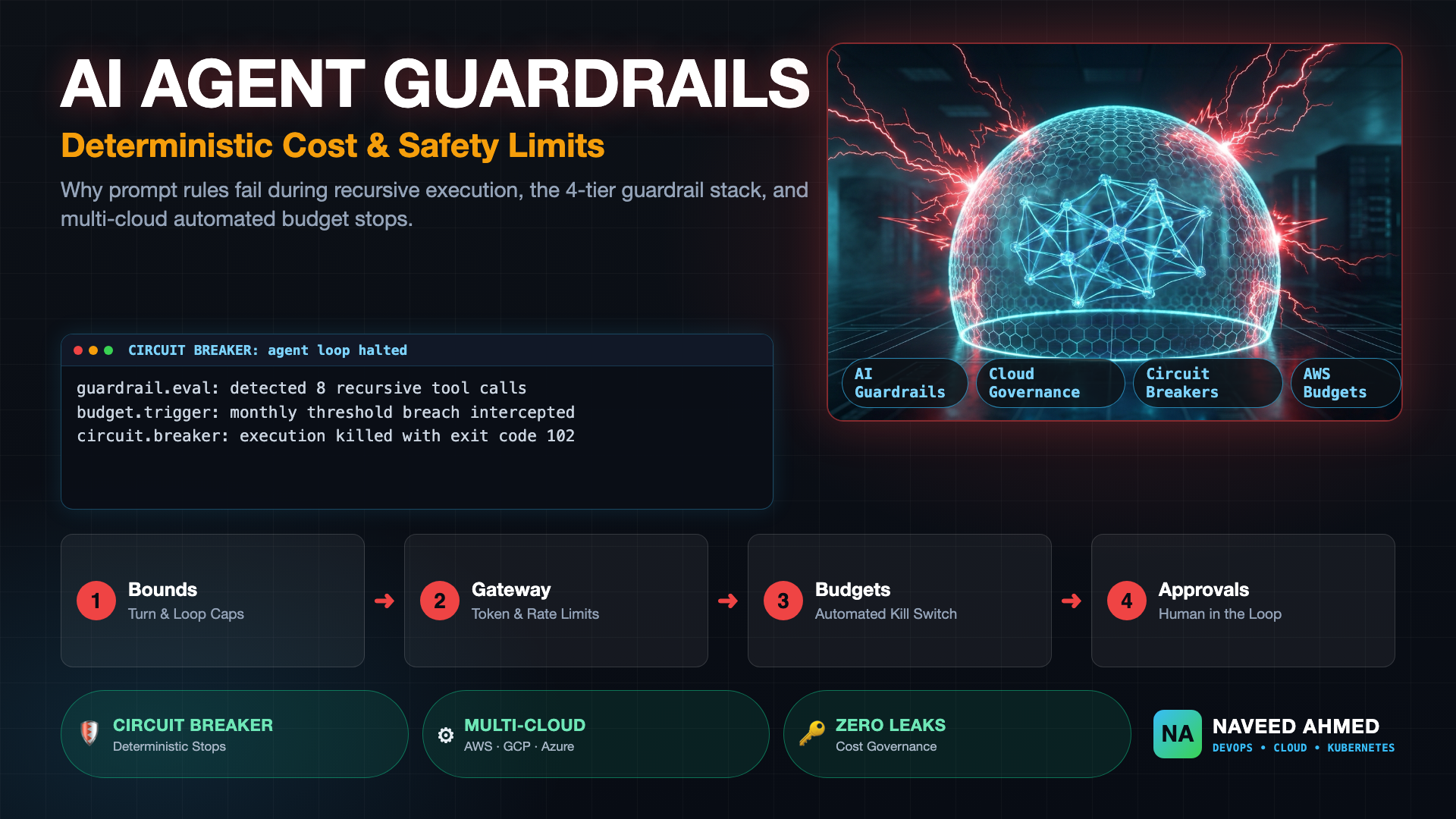
To prevent these failures, organizations must implement deterministic boundaries. As detailed in our analysis of AI agent guardrails in production, autonomous coding assistants require structured validation gates rather than blind trust, ensuring that the question of whether software engineering is dead is answered by elevating architectural rigor rather than surrendering to prompt roulette.
The 970+ Incident Handbook & K8s Runbooks are exclusive to subscribers — unlock for FREE
Get battle-tested production runbooks, AWS architecture blueprints, and zero-downtime CI/CD post-mortems sent directly to your inbox. 100% free, no spam.
Vibe Coding vs Spec Driven Development: Architectural Comparison
To understand why engineering leaders are shifting toward vibe coding vs spec driven development, we must contrast their foundational architectures. Where vibe coding treats code as the primary conversational medium, Spec-Driven Development (SDD) establishes versioned Markdown specifications as the immutable source of truth before any implementation begins. This paradigm shift forms the backbone of the modern Agentic SDLC architecture, where human engineers manage intent while machines handle execution.
| Dimension | Vibe Coding (Prompt-First) | Spec-Driven Development (SDD) |
|---|---|---|
| Source of Truth | Ephemeral chat history and raw source files | Version-controlled Markdown specifications (.specify/) |
| Architectural Definition | Implicit; guessed by the model on the fly | Explicit; defined in a Project Constitution and Technical Plan |
| Error Detection Point | Runtime execution, QA failures, or production outages | Specification and planning phase (prior to code generation) |
| Refactoring Cost | Exponential; high risk of regression cascades | Linear; isolated tasks executed against clear interface contracts |
| Team Scalability | Poor; individual developers generate incompatible silos | High; auditable contracts reviewable via standard Pull Requests |
| Production Readiness | Fragile; lacks compliance and security guardrails | Enterprise-grade; enforces testing matrices and policy gates |
SDD formalizes the relationship between the human engineer and the AI assistant. The human developer acts as the system architect—defining goals, non-negotiable constraints, and verification criteria—while the AI operates as an implementation engine executing constrained, discrete tasks.
GitHub Spec-Kit: The 4-Phase Pipeline Explained
To eliminate ad-hoc prompting and operationalize Spec-Driven Development, GitHub launched Spec-Kit (github/spec-kit), an open-source, agent-agnostic toolkit designed to bring structure to AI coding agents such as Claude Code, GitHub Copilot, and Gemini CLI. Whether running against hosted frontier models or privacy-preserving on-premise clusters using local LLMs for DevOps, Spec-Kit standardizes how agents parse project context.
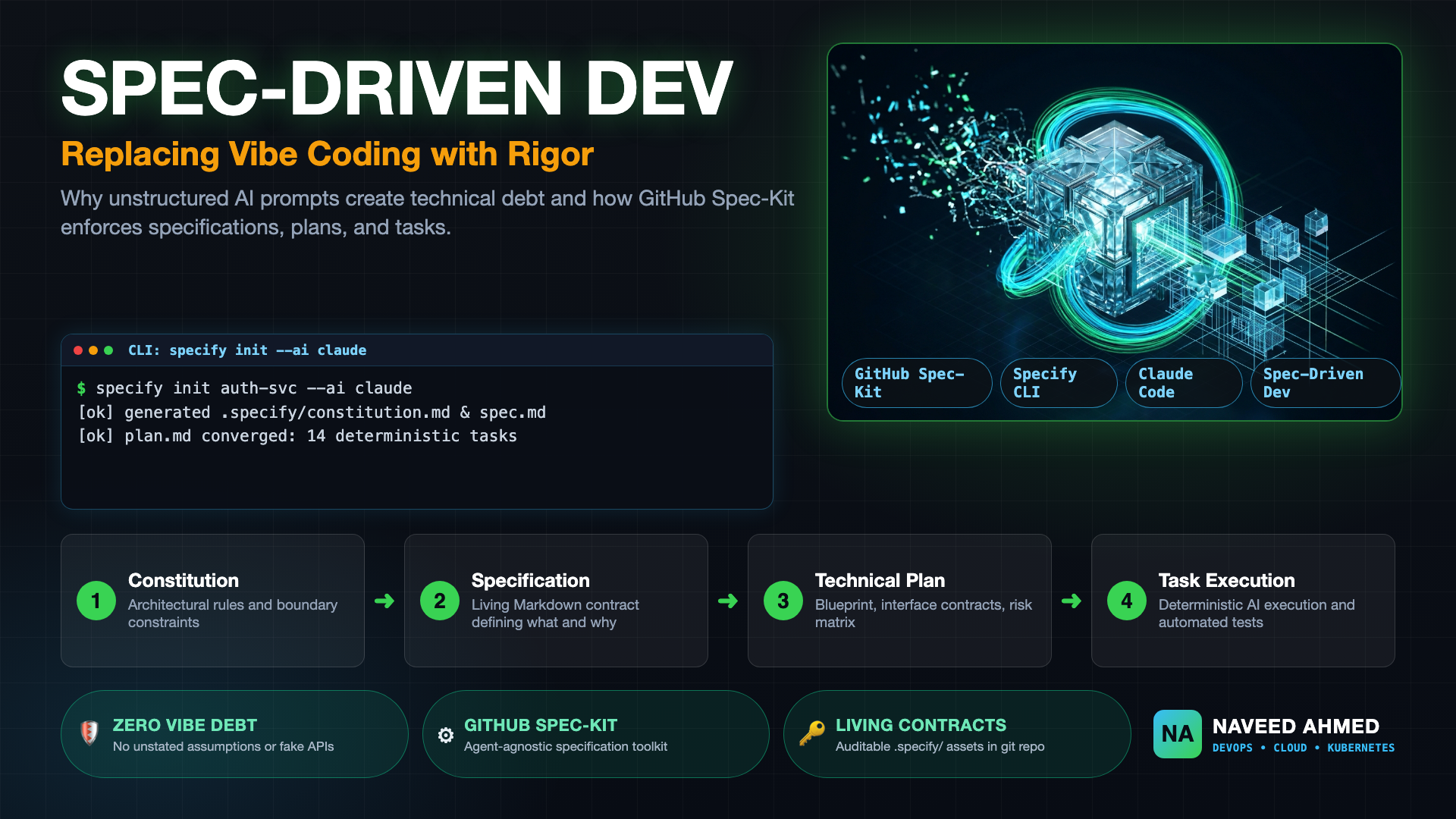
GitHub Spec-Kit is an open-source framework and CLI (specify) that standardizes Spec-Driven Development. It organizes project requirements into four version-controlled phases—Constitution, Specify, Plan, and Tasks—forcing AI coding agents to converge deterministically against verifiable contracts.
Spec-Kit divides development into four rigorous, sequential phases:
Global rules, architectural patterns, tech stack limitations, and compliance guardrails codified once per repository.
A declarative description of what needs to be built and why, deliberately avoiding premature technical details.
The architectural blueprint detailing database schemas, API contracts, dependency versions, and security models.
A granular, logical checklist executed step-by-step by AI agents against automated test suites and validation gates.
By enforcing this pipeline, Spec-Kit ensures that code generation is the final step rather than the first. If an ambiguity arises, the engineer clarifies the specification artifact, preventing the AI from making unvetted assumptions.
Hands-On Implementation: Using Specify CLI with AI Agents
Getting started with GitHub Spec-Kit requires minimal overhead. It integrates directly into developer terminals and pairs with major coding assistants. In this hands-on walkthrough, we bootstrap an authentication service using specify-cli and Claude Code.
1. Installing the Specify CLI
The specify CLI can be installed globally using uv, the ultra-fast Python package and project manager:
# Install specify-cli globally via uv
uv tool install specify-cli --from git+https://github.com/github/spec-kit.git

# Verify CLI availability
specify --version
Alternatively, you can run the CLI without permanent installation using uvx:
# Run specify on-demand
uvx --from git+https://github.com/github/spec-kit.git specify --help
2. Initializing a Spec-Kit Project
To initialize a project configured for an AI coding assistant (such as Claude Code, GitHub Copilot, or Gemini), execute the init command inside your target directory:
# Initialize project with Claude Code preset
specify init auth-service --ai claude

cd auth-service
ls -la .specify/
The initialization creates a .specify/ directory containing core prompt templates and configuration primitives:
.specify/
├── constitution.md    # Repository-wide engineering standards
├── memory/            # Persistent agent context across sessions
├── templates/         # Spec, plan, and task templates
└── extensions/        # Custom validation hooks and linters
3. Defining the Project Constitution
The constitution.md file defines non-negotiable engineering standards. Any code generated by an AI agent must comply with these guidelines. Here is a production-grade constitution for a containerized backend service:
# Project Constitution: Auth Microservice

## 1. Architectural Standards
- Framework: Go 1.24 with Standard Library HTTP routing (no gin/echo).
- Storage: PostgreSQL 16 accessed strictly via pgxpool and parameterized queries.
- Authentication: JWT tokens signed with Ed25519; short-lived access tokens (15m), refresh tokens stored in secure HttpOnly cookies.

## 2. Reliability & SRE Non-Negotiables
- Every HTTP route must export Prometheus metrics (latency histogram, error counters).
- Graceful shutdown handling must drain connections within a 15-second timeout window.
- All outbound network calls must enforce explicit context timeouts (default: 3000ms).

## 3. Security & Testing Gates
- Zero third-party packages with unvetted CVEs (enforced via govulncheck).
- Minimum 85% unit test code coverage before merging.
- No raw secrets, API tokens, or hardcoded credentials permitted.
4. Generating the Specification and Technical Plan
With the constitution established, you instruct your AI agent to generate the feature specification using Spec-Kit's built-in slash commands:
# Step 1: Draft the functional specification
/speckit-specify Add rate-limited magic-link authentication with Redis token revocation

# Step 2: Interrogate ambiguities and generate the technical plan
/speckit-plan

# Step 3: Break down the plan into granular execution tasks
/speckit-tasks
The agent outputs a deterministic tasks.md checklist that breaks the feature down into bite-sized units:
## Execution Tasks: Magic-Link Auth

- [ ] Task 1.1: Create Redis schema and TTL configuration for temporary auth tokens.
- [ ] Task 1.2: Implement Ed25519 token signing utility and cryptographic verification.
- [ ] Task 1.3: Build HTTP handler for POST /v1/auth/magic-link with sliding window rate limiting.
- [ ] Task 1.4: Implement mock email dispatch service and integration tests.
- [ ] Task 1.5: Verify test coverage and validate zero CVEs via govulncheck.
The AI coding assistant executes these tasks sequentially. If a test fails, the agent fixes the failure against the plan instead of hallucinating architectural modifications. This disciplined execution mirrors how engineering teams structure automation when AI agents automate DevOps runbooks safely, ensuring every state transition is traceable and reversible. Once committed, specifications can be reconciled continuously with cluster state using GitOps and ArgoCD to eliminate configuration drift.
Spec-Driven Infrastructure: Applying SDD to DevOps & Kubernetes
While vibe coding in application code produces annoying bugs, vibe coding in cloud infrastructure causes multi-million-dollar outages. When developers prompt AI models to write Terraform modules or Kubernetes YAML manifests without specifications, models frequently omit resource quotas, configure insecure permissions, or deploy broken ingress rules.
In cloud-native operations, prompt-generated infrastructure manifests often omit liveness/readiness probes, request limits, and read-only filesystems. Without explicit specifications, an AI agent will generate manifests that pass syntax checks but crash clusters under real production traffic.
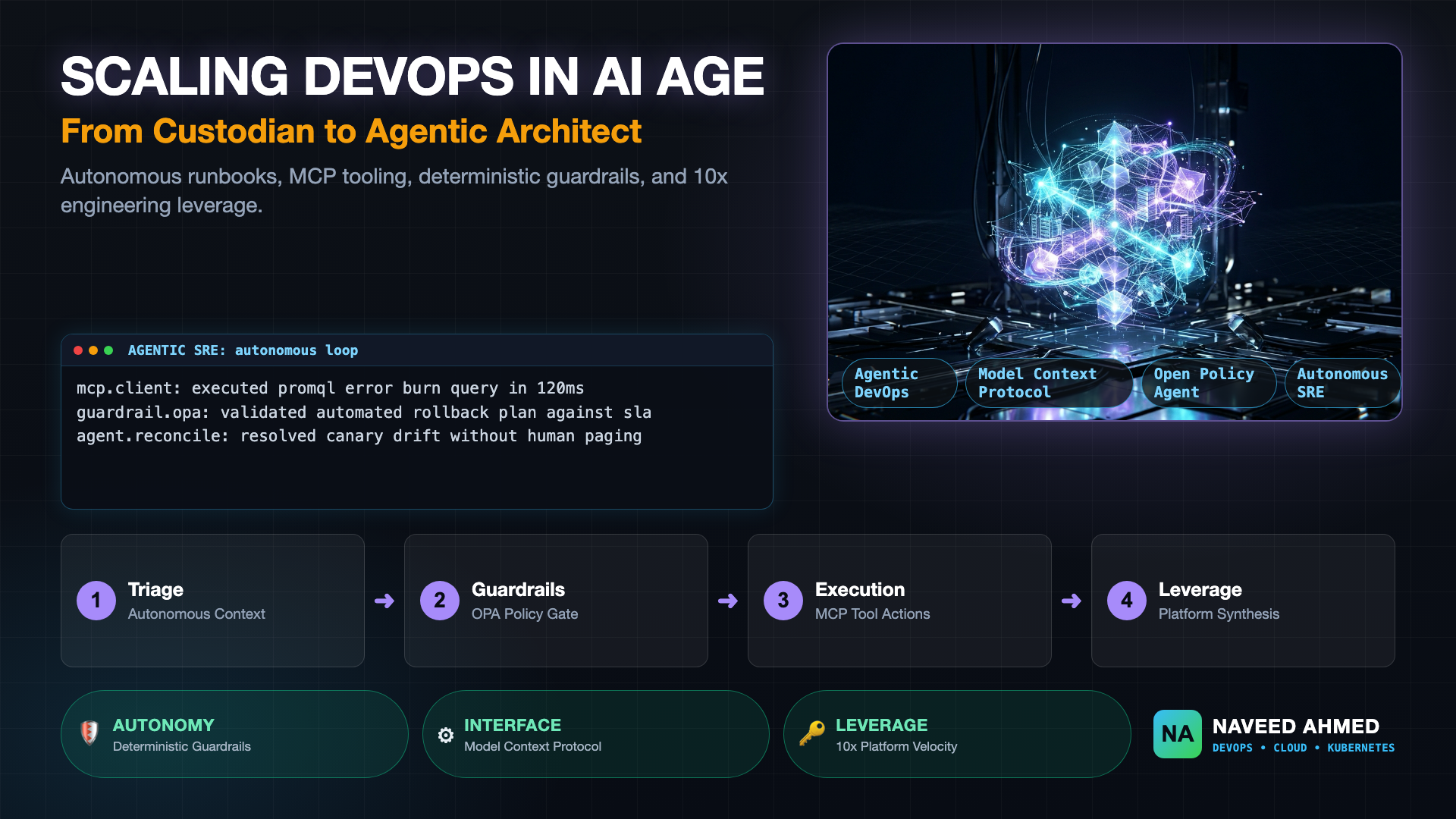
Spec-Driven Development mitigates infrastructure disasters by codifying cloud constraints before manifest generation. For teams managing production deployments, integrating SDD with automated policy gates ensures that infrastructure remains resilient and cost-effective, aligning with the principles discussed in our guide on scaling DevOps in the age of AI. Just as senior engineers must know how to review Terraform plans without destroying production, AI models must be bounded by immutable infrastructure specifications.
To validate infrastructure configurations before rollout, platform engineers frequently leverage specialized tooling. For instance, testing network CIDR allocations via our free DevOps tools hub and mastering real-world deployment failures through the CI/CD scenario triage handbook prevents silent misconfigurations from reaching cluster nodes.
Here is an example of a Spec-Kit infrastructure specification for a production Kubernetes deployment incorporating best-practice Kubernetes deployment strategies:
# Infrastructure Spec: Production Ingress & Deployment Guardrails

## Deployment Constraints
- Replicas: Minimum 3, managed by HorizontalPodAutoscaler (HPA) targeting 70% CPU utilization.
- Pod Security: runAsNonRoot=true, allowPrivilegeEscalation=false, readOnlyRootFilesystem=true.
- Resource Limits:
    requests: { cpu: "250m", memory: "512Mi" }
    limits:   { cpu: "1000m", memory: "1Gi" }

## Networking & Verification
- Probes: HTTP GET /healthz on port 8080; initialDelaySeconds=10, periodSeconds=5.
- Zero downtime rolling updates: maxSurge=25%, maxUnavailable=0.
When an AI agent generates the Kubernetes manifests from this specification, the output is strictly bounded, predictable, and compliant with enterprise security standards from day one. If a generated pod triggers an unexpected runtime failure, engineers can cross-reference the failure against our Kubernetes CrashLoopBackOff troubleshooting guide or test their debugging intuition on the Kubernetes interactive mastery lab, while preparing for high-stakes interviews with the 180+ Kubernetes scenario interview handbook.
Future Roadmap: Autonomous Agent Ecosystems
As AI software engineering matures, the combination of Spec-Driven Development and autonomous multi-agent systems will become the default industry paradigm. Rather than individual developers interacting with single chat windows, coordinated agent clusters will intake human-authored specifications, generate competing technical blueprints, cross-review code quality, and trigger continuous delivery pipelines. This evolution accelerates the broader industry migration from traditional DevOps to platform engineering in 2026.
Experimental autonomous architectures, such as the agent workflows documented in our Morpheus autonomous research laboratory, demonstrate that complex multi-step systems succeed only when governed by rigid, machine-readable specifications. Without explicit specs, multi-agent collaboration quickly degenerates into hallucination feedback loops.
Key Takeaways for Engineering Teams
- Vibe coding is for exploration, not production: Ad-hoc prompt engineering is effective for disposable prototypes and single-script experiments, but unviable for mission-critical microservices and cloud infrastructure.
- Specifications are the real source of truth: Writing durable Markdown contracts under
.specify/decouples business intent from ephemeral LLM model context, eliminating unstated assumptions and context amnesia. - GitHub Spec-Kit establishes repeatable rigor: By breaking workflows into Constitution, Specification, Technical Plan, and Task phases, Spec-Kit converts non-deterministic AI models into reliable, pair-programming partners.
- Automated verification completes the loop: AI generation must always be paired with automated testing, linting, and policy-as-code gates to ensure code converges strictly against the original specification.
Frequently Asked Questions
What is the core difference in vibe coding vs spec driven development?
Vibe coding is an exploratory, prompt-heavy approach where code is generated ad-hoc from natural language prompts without persistent specifications. In contrast, Spec-Driven Development (SDD) requires developers to define non-negotiable constraints (the Constitution), formal requirements (the Spec), and an architectural blueprint (the Plan) before the AI agent writes a single line of executable code.
What is GitHub Spec-Kit and how does it work?
GitHub Spec-Kit is an open-source toolkit and CLI tool (specify-cli) that streamlines Spec-Driven Development across major AI coding agents like Claude Code, GitHub Copilot, and Gemini CLI. It structures projects into Markdown-based artifacts under a .specify/ directory, enforcing a workflow that progresses from Constitution to Spec, Technical Plan, and Task execution.
Can GitHub Spec-Kit be used with AI coding tools other than GitHub Copilot?
Yes. Spec-Kit is agent-agnostic. It features built-in presets and integrations for Claude Code, Gemini CLI, Cursor, Windsurf, Zed, and generic terminal-based coding agents via the specify CLI.
Why does vibe coding fail for production software and infrastructure?
Vibe coding fails at scale because LLMs lack persistent shared memory across separate sessions. Without explicit architectural boundaries, models make arbitrary decisions about dependencies, security policies, and error handling. As the codebase grows, AI refactorings introduce regression cascades because the original business intent was never captured in a durable, version-controlled specification.