GitOps with ArgoCD: Eliminating Configuration Drift
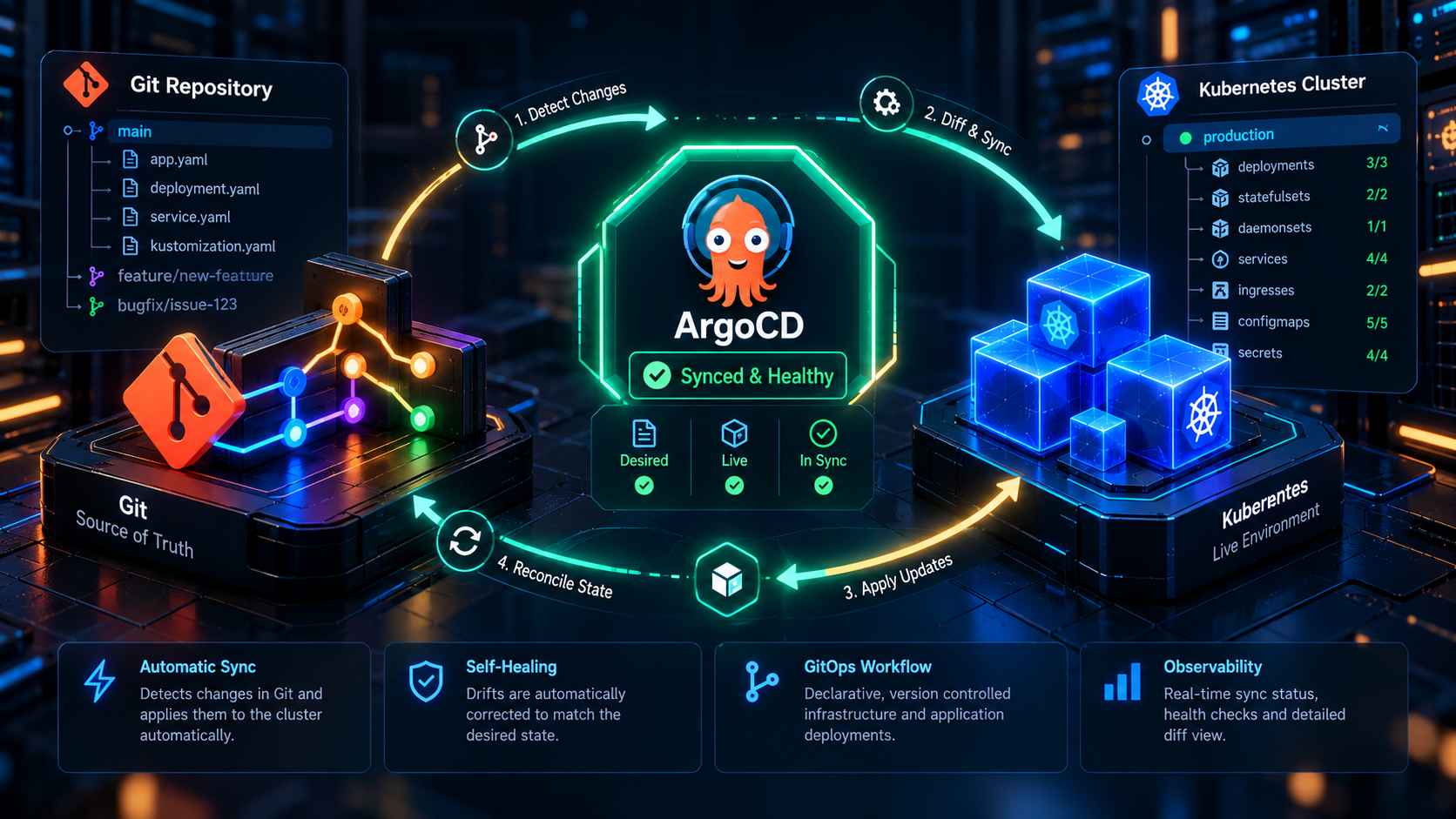
kubectl edit during an outage, an ad-hoc Helm upgrade is run from a local laptop, or a rogue controller alters resource requests. Days or weeks later, the next pipeline deployment wipes out the fix, triggering a catastrophic repeat incident. Here is the comprehensive architectural blueprint for eliminating drift entirely using ArgoCD and strict GitOps principles.
1. The Anatomy of Configuration Drift in Kubernetes
In traditional software delivery models, continuous deployment systems push changes into the cluster: a Jenkins runner, a GitHub Actions workflow, or an engineer running kubectl apply -f manifest.yaml from their terminal.
This imperative, push-based model inevitably causes Configuration Drift: the state of the live running resources inside your Kubernetes cluster deviates from the version-controlled manifests declared in your Git repository.
How Drift Sneaks into Production Environments
- Emergency Midnight Hotfixes: An engineer on on-call triage runs
kubectl edit deployment payment-apito increase memory limits from1Gito4Gior change an environment variable. The fix works, the alert resolves, but nobody ever commits the change back to the Git repository. - Imperative CLI Operations: Running
kubectl scale --replicas=10 deployment checkoutorkubectl rollout restart. - Laptop Deployments: A team member runs
helm upgrade --installwith local, uncommitted values files, bypassing CI/CD checks. - Controller & Webhook Mutations: Mutating admission controllers (e.g. Istio sidecar injectors, Datadog admission webhooks) inject annotations and sidecars into live pods that do not exist in Git manifests.
- Autoscaling Clashes: Horizontal Pod Autoscalers (HPA) scale the replica count dynamically, while the Git manifest declares a static
replicas: 3, creating an infinite thrashing cycle.
2. Declarative GitOps Principles: Git as the Single Source of Truth
GitOps is not merely using Git for storing YAML files. It is an operational model defined by four foundational OpenGitOps principles:
- Declarative: The entire system desired state (Deployments, Services, Ingress, NetworkPolicies, RBAC, CRDs) must be described declaratively.
- Versioned and Immutable: The desired state is stored in Git, serving as an immutable, audited change ledger. Every change is a Git commit with an author, timestamp, and review trail.
- Pulled Automatically: Software agents running inside the target cluster pull the desired state from Git, eliminating the need to expose cluster API endpoints or give CI runners cluster-admin credentials.
- Continuously Reconciled: The agent continuously monitors both the desired state in Git and the actual runtime state in the cluster, detecting drift and enforcing convergence.
| Layer / Component | Desired State (Git) | Live Cluster State | ArgoCD Self-Healing Action |
|---|---|---|---|
| Deployment Replicas | replicas: 3 (or managed by HPA) |
Dynamic HPA scaling (3 → 15) | Preserved via ignoreDifferences |
| Container Memory Limits | limits.memory: 2Gi |
Ad-hoc kubectl edit (4Gi) |
Reverted to 2Gi (or PR merged) |
| Environment Variables | LOG_LEVEL: info |
Manual change in dashboard | Immediate GitOps overwrite |
| Orphaned ConfigMaps | Removed in latest Git commit | Existing in namespace | Pruned automatically (prune: true) |
3. The ArgoCD Architecture & Continuous Reconciliation Engine
ArgoCD implements the GitOps model through three primary control plane components running natively inside Kubernetes:
- argocd-server: The API and Web UI server, handling authentication (OIDC, SSO), RBAC, and client requests from the ArgoCD CLI.
- argocd-repo-server: Maintains local Git repository caches and executes manifest rendering tools (Kustomize, Helm, Jsonnet, or custom plugins).
- argocd-application-controller: The heart of ArgoCD. It continuously compares the live state of Kubernetes resources against the manifests generated by the repo-server.
The 3-Way Merge Diff Algorithm
How does ArgoCD determine whether a resource has drifted? It does not perform a naive text comparison. Instead, it utilizes a three-way merge calculation:
- Desired State: The rendered output from your Git repository (target branch/tag/commit).
- Live State: The current resource manifest retrieved via the Kubernetes API server (
GET /apis/...). - Last Applied State: The configuration recorded in the
kubectl.kubernetes.io/last-applied-configurationannotation or Server-Side Apply managed fields.
If the live state deviates from the desired state in fields not explicitly marked to be ignored, ArgoCD flags the resource status as OutOfSync.
4. Production ArgoCD Application: Enabling Automated Drift Elimination
To eliminate configuration drift, an ArgoCD Application must be configured with both prune: true and selfHeal: true.
Declarative ArgoCD Application with Auto-Sync & Self-Healing
apiVersion: argoproj.io/v1alpha1
kind: Application
metadata:
  name: payment-service-production
  namespace: argocd
  finalizers:
    - resources-finalizer.argocd.argoproj.io
spec:
  project: production-platform
  source:
    repoURL: https://github.com/naveedkumbhar/production-gitops.git
    targetRevision: main
    path: environments/production/payment-service
  destination:
    server: https://kubernetes.default.svc
    namespace: payments

  syncPolicy:
    automated:
      prune: true     # Deletes resources removed from Git
      selfHeal: true  # Overwrites manual cluster changes immediately
      allowEmpty: false
    syncOptions:
      - CreateNamespace=true
      - ApplyOutOfSyncOnly=true
      - PruneLast=true
      - ServerSideApply=true
      - RespectIgnoreDifferences=true
    retry:
      limit: 5
      backoff:
        duration: 5s
        factor: 2
        maxDuration: 3m

  ignoreDifferences:
    # 1. HPA Replicas Exception
    - group: apps
      kind: Deployment
      jsonPointers:
        - /spec/replicas
    # 2. Mutating Webhooks / Certificate Managers
    - group: ""
      kind: Secret
      jsonPointers:
        - /data/tls.crt
        - /data/tls.key
Detailed Breakdown of Critical Sync Options
| Directive | Impact on Configuration Drift | Production Recommendation |
|---|---|---|
prune: true |
Automatically deletes resources in the cluster that were deleted from the Git repository. Prevents zombie resources and dangling ingress rules. | Mandatory. Without this, deleted microservices or old configmaps persist forever. |
selfHeal: true |
Whenever an out-of-band change occurs in Kubernetes (e.g. kubectl edit), ArgoCD instantly overwrites the live state back to Git state. |
Mandatory for Staging & Production. Completely eliminates imperative human drift. |
ServerSideApply=true |
Leverages Kubernetes Server-Side Apply (SSA) instead of client-side kubectl.kubernetes.io/last-applied-configuration. Avoids 256KB annotation limits on large CRDs. |
Highly Recommended. Modern standard for Kubernetes 1.25+. |
ApplyOutOfSyncOnly=true |
Only issues PATCH requests for resources that have drifted, avoiding unnecessary API hammering across hundreds of unchanged resources. | Critical for scale. Dramatically reduces API server CPU load. |
RespectIgnoreDifferences=true |
Ensures that fields configured under ignoreDifferences are NOT overwritten during automated syncs. |
Mandatory when using HPA or dynamic controllers. |
5. The HPA & Webhook Conflict Storm: Mastering ignoreDifferences
The single most common mistake teams make when enabling selfHeal: true is triggering a reconciliation conflict storm with Kubernetes controllers.
The HPA vs ArgoCD Death Spiral
- Git manifest declares
replicas: 3for your API Deployment. - Traffic spikes. The Horizontal Pod Autoscaler (HPA) scales the Deployment to
15replicas. - ArgoCD application controller runs its reconciliation loop, observes 15 live replicas vs 3 desired replicas in Git, and flags the Deployment as
OutOfSync. - With
selfHeal: trueenabled, ArgoCD immediately applies the Git manifest, scaling the Deployment down to3replicas! - Your pods terminate under peak traffic, CPU spikes to 100%, requests time out, and users see HTTP 504 errors.
- HPA detects 100% CPU again and immediately scales to 15. ArgoCD immediately scales back to 3. The cluster burns CPU cycling pods endlessly.
The Bulletproof Solution: JSON Pointers & ManagedFields
To resolve this, tell ArgoCD to ignore the replica count during state comparison, and use RespectIgnoreDifferences=true to keep it from applying the Git replica value during syncs:
spec:
  syncPolicy:
    syncOptions:
      - RespectIgnoreDifferences=true
  ignoreDifferences:
    # Option A: JSON Pointer targeting Deployment replicas
    - group: apps
      kind: Deployment
      jsonPointers:
        - /spec/replicas

    # Option B: Ignore changes made by kube-controller-manager
    - group: apps
      kind: Deployment
      managedFieldsManagers:
        - kube-controller-manager

    # Option C: JQ Path Expression for dynamic annotations
    - group: apps
      kind: Deployment
      jqPathExpressions:
        - .metadata.annotations["deployment.kubernetes.io/revision"]
Additionally, in your Git repository manifests, omit the spec.replicas field entirely from the Deployment YAML once an HPA is attached. Kubernetes will retain the live replica count while HPA manages it dynamically.
6. Locking Down Cluster RBAC: Removing the Human Root Cause
Self-healing catches drift, but the root cause of human-induced drift is overly permissive cluster access. If developers have cluster-admin or namespace write privileges in production, configuration drift will persist.
The 3-Tier Production Access Model
- ArgoCD ServiceAccount: The only identity with write/apply permissions to application namespaces.
- Human Engineers (Daily Operations): Read-only access via OIDC / SSO. Engineers can run
kubectl get,kubectl describe,kubectl logs, but cannot runapply,edit,delete, orscale. - Break-Glass Emergency Access: Temporary, short-lived elevated access (e.g. via Teleport, AWS IAM Identity Center, or boundary agents) with automatic expiration after 60 minutes and full session recording.
# Read-Only RBAC Role for Production Engineers
apiVersion: rbac.authorization.k8s.io/v1
kind: ClusterRole
metadata:
  name: sre-developer-readonly
rules:
  - apiGroups: ["", "apps", "batch", "networking.k8s.io"]
    resources:
      - pods
      - pods/log
      - services
      - deployments
      - statefulsets
      - cronjobs
      - configmaps
      - ingresses
    verbs: ["get", "list", "watch"]
  - apiGroups: [""]
    resources: ["pods/exec"]  # Blocked in production; use ephemeral debug pods if needed
    verbs: []
7. Secrets Management Without Drift: External Secrets Operator
One of the biggest excuses engineers offer for manually editing Kubernetes clusters is secrets rotation: "We needed to update an API key in a hurry!"
Committing plain text secrets to Git violates compliance and security standards. Managing secrets imperatively with kubectl create secret creates catastrophic drift.
The industry standard solution is the External Secrets Operator (ESO):
- Secrets are securely stored in a centralized vault (AWS Secrets Manager, HashiCorp Vault, or Google Secret Manager).
- Declarative
ExternalSecretandSecretStoremanifests are committed to your Git repository. - The External Secrets Operator synchronizes secret values into native Kubernetes
Secretobjects periodically (e.g.refreshInterval: 1h). - ArgoCD manages the declarative
ExternalSecretobject, while ESO handles secret hydration—eliminating both secret drift and security compromises.
apiVersion: external-secrets.io/v1beta1
kind: ExternalSecret
metadata:
  name: payment-gateway-credentials
  namespace: payments
spec:
  refreshInterval: "1h"
  secretStoreRef:
    name: aws-secrets-manager
    kind: ClusterSecretStore
  target:
    name: payment-gateway-secret
    creationPolicy: Owner
  data:
    - secretKey: STRIPE_API_KEY
      remoteRef:
        key: production/payments/stripe
        property: api_key
8. Observability & Alerting: Catching Drift Before It Impacts Revenue
Do not wait for a failed deployment to discover that someone tampered with cluster resources. Monitor ArgoCD Prometheus metrics to trigger immediate alerts whenever an application enters an OutOfSync state.
Alerting on OutOfSync Drift in Production
apiVersion: monitoring.coreos.com/v1
kind: PrometheusRule
metadata:
  name: argocd-drift-alerts
  namespace: monitoring
spec:
  groups:
    - name: ArgoCDDrift
      rules:
        - alert: ArgoCDApplicationOutOfSync
          expr: |
            argocd_app_info{sync_status="OutOfSync",project="production-platform"} == 1
          for: 10m
          labels:
            severity: warning
            team: platform-sre
          annotations:
            summary: "Configuration drift detected on {{ $labels.name }}"
            description: "Application {{ $labels.name }} in namespace {{ $labels.dest_namespace }} has been OutOfSync for over 10 minutes. Live state differs from Git source."
9. Production Incident Runbook: Triaging OutOfSync Applications
When an application flags OutOfSync or fails to sync in production, follow this standardized SRE triage workflow:
Step-by-Step Drift Resolution Protocol
-
Inspect the Visual Diff:
Identify whether the discrepancy is in user-defined business logic, an unexpected environment variable, or controller-injected metadata.argocd app diff payment-service-production --local environments/production/payment-service -
Check Resource Sync Status:
Determine which exact sub-resource (Deployment, Service, Ingress) is failing to converge.argocd app get payment-service-production --show-params -
Verify Managed Fields Conflicts:
Check if another manager (e.g.kubectl get deployment payment-service -n payments -o yaml | grep -A 20 "managedFields:"kustomize-controller,helm, or an admission webhook) has claimed ownership of conflicting fields. -
Force Server-Side Re-sync (If Safe):
argocd app sync payment-service-production --force --server-side - Adopt or Revert: If the drift represents a valid emergency change made during an outage, immediately open a Git Pull Request to commit the change into the repository. Once merged, ArgoCD marks the cluster as synced.
Frequently Asked Questions
How does ArgoCD detect configuration drift in Kubernetes?
ArgoCD continuously runs a three-way reconciliation algorithm (every 180 seconds by default, or immediately when triggered via Git webhooks). It compares the desired state from Git against the live cluster state and the resource's last-applied configuration or managed fields. Any deviation marks the application as OutOfSync.
What is the difference between ArgoCD auto-sync and self-healing?
Auto-sync reconciles changes pushed to Git into the cluster. Self-healing (selfHeal: true) actively watches the cluster: if an engineer runs kubectl edit or an imperative command altering live resources, ArgoCD detects the runtime drift and overwrites the cluster back to the state in Git.
How do you prevent ArgoCD from fighting Horizontal Pod Autoscaler (HPA)?
Configure ignoreDifferences for /spec/replicas on Deployments in your ArgoCD Application manifest, and set RespectIgnoreDifferences=true in syncOptions. Additionally, omit the replicas field from your base Deployment manifests in Git once an HPA is attached.
Why is RespectIgnoreDifferences=true mandatory in syncOptions?
By default, ignoreDifferences only suppresses the visual diff warning in the ArgoCD UI. During an automated sync or self-heal, ArgoCD will still try to enforce the Git value unless RespectIgnoreDifferences=true is explicitly enabled in syncOptions.
What is the difference between OutOfSync and Degraded status in ArgoCD?
OutOfSync indicates a configuration discrepancy between Git and the live cluster state. Degraded indicates that the runtime workload is failing or unhealthy (e.g. pods in CrashLoopBackOff, missing PVCs, or failing readiness probes), regardless of whether manifests match Git.
Ready to Modernize Your Kubernetes Delivery Architecture?
Building zero-drift, highly resilient GitOps pipelines across multi-tenant AWS EKS clusters requires deep architectural precision. Explore over 970 battle-tested production scenarios or dive into the complete curriculum.