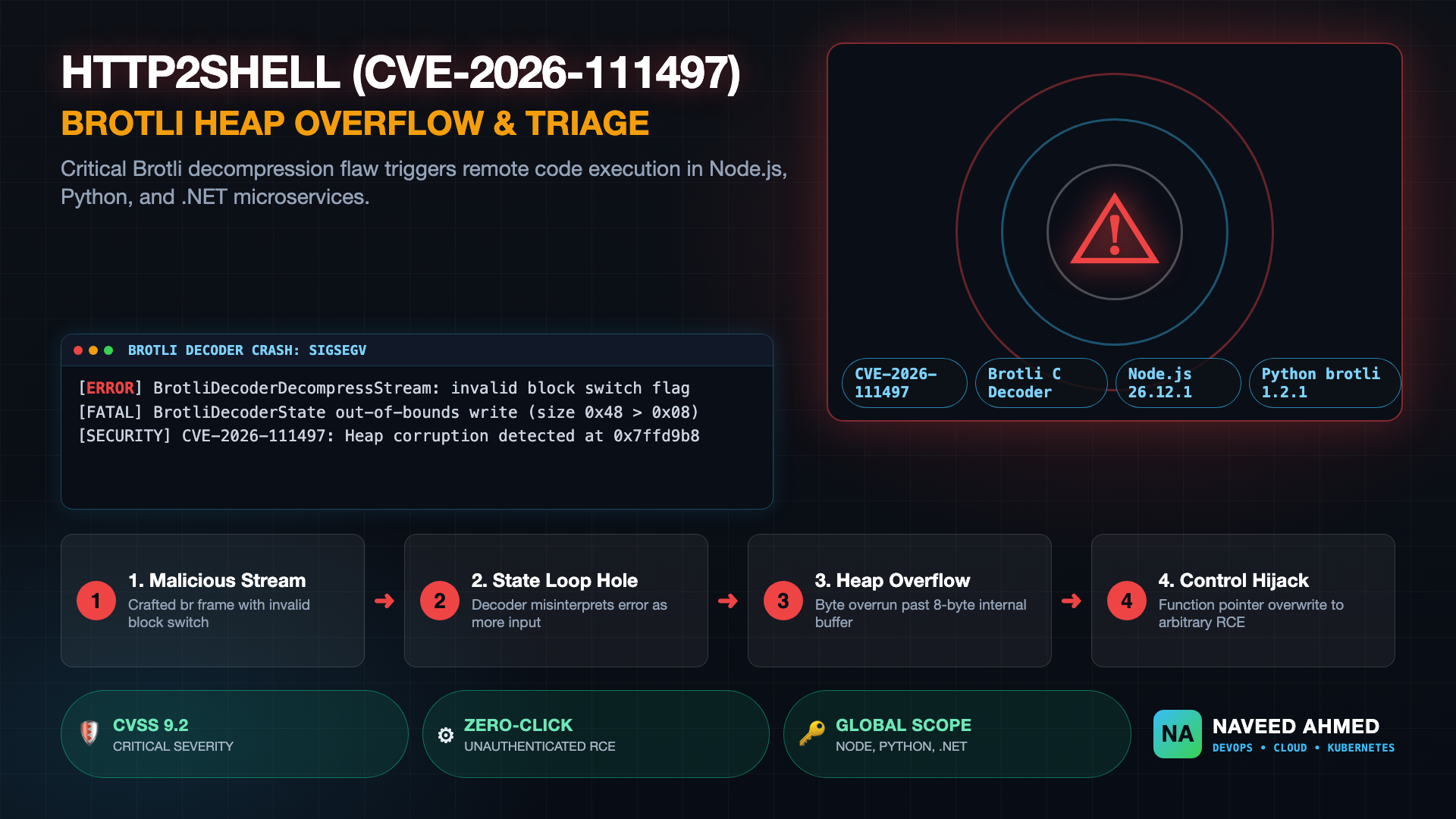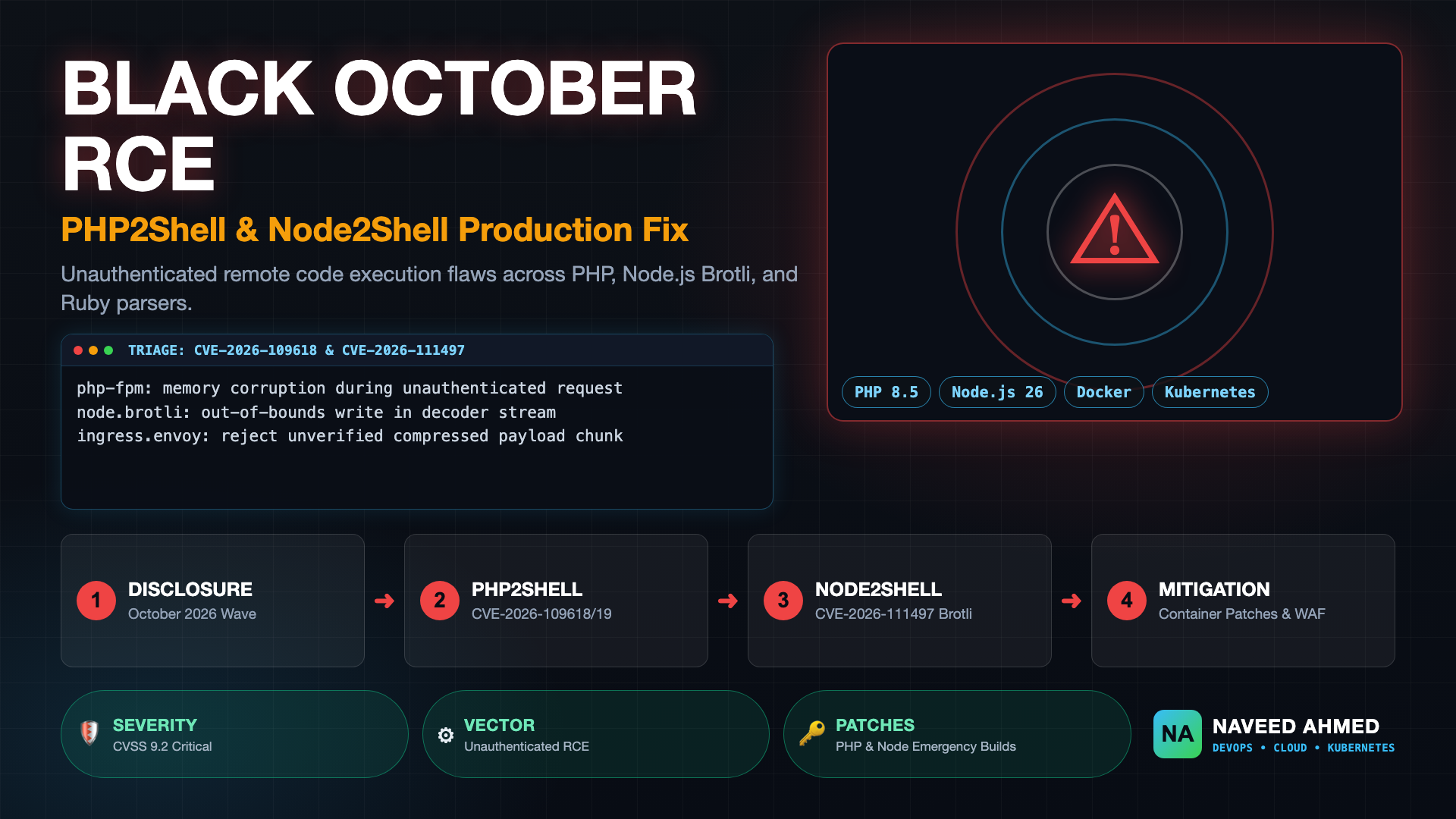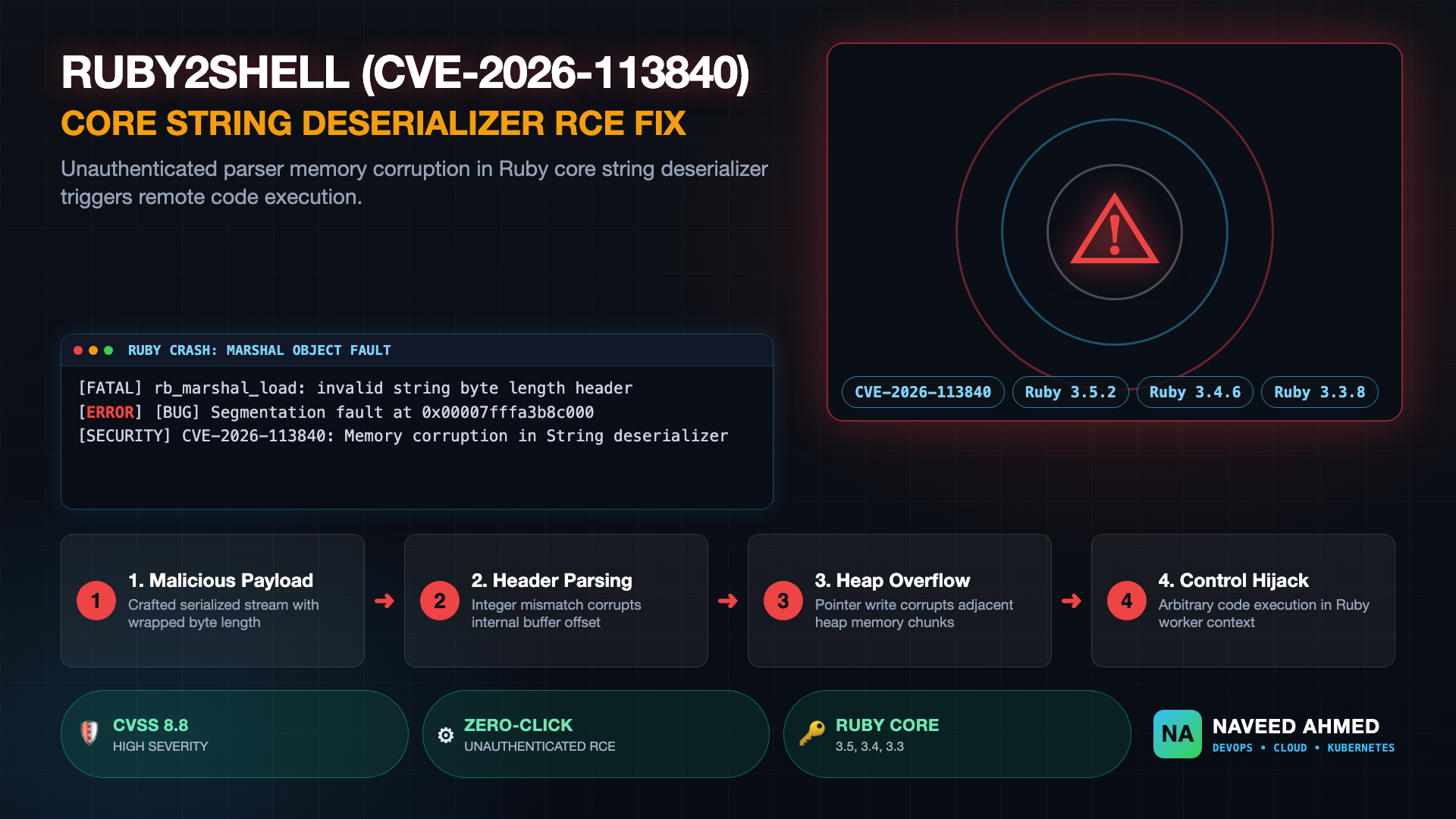
During the widespread runtime security crisis dubbed Black October, infrastructure teams faced emergency patch cycles across foundational language engines. Following disclosures in PHP and Node.js, security researchers unveiled Ruby2Shell (officially tracked as CVE-2026-113840), a high-severity remote code execution flaw in Ruby's native core string deserializer and object header parsing logic. Carrying a CVSS score of 8.8, this flaw allows unauthenticated attackers to corrupt process memory and hijack execution threads in backend application servers. Like the companion HTTP2Shell Brotli buffer overflow and broader Black October vulnerabilities, Ruby2Shell targets the compiled C internals of the language interpreter itself.
This operational guide breaks down the architectural root cause of Ruby2Shell, maps vulnerable Ruby version branches, provides runnable triage sweeps for Kubernetes clusters, and delivers edge WAF mitigations to protect production fleets.
What Is Ruby2Shell and How Does the Deserializer Flaw Work?
Ruby2Shell (CVE-2026-113840) is an out-of-bounds pointer write vulnerability within Ruby's core string deserializer affecting versions prior to 3.5.2, 3.4.6, and 3.3.8. It occurs when parsing maliciously crafted serialized object headers, causing an integer wrap in buffer length calculations that corrupts internal memory offsets and allows arbitrary code execution.
To grasp the technical mechanism of ruby2shell, we must inspect how Ruby reconstructs strings and symbols from serialized byte streams. In Ruby's native C implementation (`marshal.c`), the deserializer function `r_string()` reads length prefixes to allocate heap memory buffers for string instances:
/* Vulnerable pattern in Ruby core string deserializer */
static VALUE
r_string(struct parse_arg *arg)
{
    long len = r_long(arg);  /* Malicious integer wrap */
    VALUE str = rb_str_buf_new(len);
    r_byte(arg);
    r_bytes(RSTRING_PTR(str), len, arg);  /* Memory corruption */
    return str;
}
When an attacker supplies a negative or wrapped 32-bit integer length inside a serialized object header, the buffer allocation logic calculates an undersized memory chunk. However, the subsequent byte ingestion routine `r_bytes()` interprets the original length as an unsigned value. This causes incoming packet data to write directly past the allocated heap boundary into neighboring heap slots, overwriting object virtual method tables (`RBasic` class pointers) and instruction pointers.
Serialized Stream
Attacker delivers HTTP request or background job payload containing crafted Marshal object headers.
Integer Mismatch
The parser calculates an undersized buffer allocation while decoding negative length markers.
Boundary Violation
Data ingestion writes raw stream bytes past the undersized chunk, corrupting adjacent heap arenas.
Arbitrary RCE
Corrupted function pointers and method dispatch tables grant arbitrary shell execution in worker context.
Because object deserialization is frequently invoked across background job processors (Sidekiq, Resque), cache layers (Redis object caches), and session stores, a ruby2shell payload can compromise backend workers even if edge HTTP endpoints reject raw binary payloads.
The 970+ Incident Handbook & K8s Runbooks are exclusive to subscribers — unlock for FREE
Get battle-tested production runbooks, AWS architecture blueprints, and zero-downtime CI/CD post-mortems sent directly to your inbox. 100% free, no spam.
Which Ruby Runtimes and Application Stacks Are Vulnerable?
All applications running Ruby versions prior to 3.5.2, 3.4.6, and 3.3.8 are vulnerable to Ruby2Shell if they deserialize untrusted streams. The vulnerability affects Rails, Sinatra, Hanami, and standalone background processors regardless of underlying web framework or operating system distribution.
The table below provides the operational impact matrix across standard enterprise Ruby production deployments:
| Ruby Release Branch | Vulnerable Versions | Patched Release | Vulnerability Surface | Verification Command |
|---|---|---|---|---|
| Ruby 3.5 (Preview / Active) | 3.5.0 through 3.5.1 | 3.5.2 |
String deserialization & Symbol table parsing | ruby -v |
| Ruby 3.4 (Stable Current) | 3.4.0 through 3.4.5 | 3.4.6 |
Core Marshal stream ingestion in web workers | ruby -e "puts RUBY_VERSION" |
| Ruby 3.3 (LTS Maintenance) | 3.3.0 through 3.3.7 | 3.3.8 |
Session store decoding, Redis cache objects | ruby -v |
| Ruby 3.2 & Earlier (Legacy) | All versions (<= 3.2.7) | End-of-Life (Migrate to 3.3.8+) | Unpatched core C deserializer routines | ruby -v |
Step-by-Step Triage: Detecting Ruby2Shell Across Kubernetes Fleets
Defenders can detect vulnerable Ruby workloads across production clusters using kubectl runtime inspection sweeps and automated CI/CD container scanners. Running image SBOM checks with Trivy and inspecting running pod environments identifies vulnerable Ruby base layers before attackers initiate exploitation.
Follow this structured checklist to triage your running services and container registries:
1. Cluster-Wide Ruby Runtime Sweep with Kubectl
Execute a diagnostic one-liner across candidate namespaces to inspect the exact patch level of running Ruby pods:
# Query all running Ruby deployment pods across production
kubectl get pods -n production -l app.kubernetes.io/component=backend \
  -o jsonpath='{range .items[*]}{.metadata.name}{"\t"}{range .spec.containers[*]}{.image}{"\n"}{end}{end}'

# Run in-container version verification probe
kubectl exec -n production deploy/rails-api -c web -- ruby -e '
  ver = RUBY_VERSION
  patch = RUBY_PATCHLEVEL
  puts "[AUDIT] Running Ruby #{ver} (patchlevel #{patch})"
  if (ver.start_with?("3.4.") && ver < "3.4.6") ||
     (ver.start_with?("3.3.") && ver < "3.3.8") ||
     (ver.start_with?("3.5.") && ver < "3.5.2")
    $stderr.puts "[CRITICAL] Vulnerable to Ruby2Shell (CVE-2026-113840)"
    exit 1
  end
'
When an unpatched container runs in your cluster, the probe flags the vulnerability immediately:
[AUDIT] Running Ruby 3.4.2 (patchlevel 28)
[CRITICAL] Vulnerable to Ruby2Shell (CVE-2026-113840)
command terminated with exit code 1
2. Automated Container Registry Audit with Trivy
Integrate automated container security scanning into your deployment pipelines following standard practices for CI/CD Trivy vulnerability blocking. Scan base images for the specific CVE:
# Scan candidate container image for CVE-2026-113840
trivy image \
  --severity HIGH,CRITICAL \
  --vuln-type os,library \
  --select-policy "cve == 'CVE-2026-113840'" \
  production-registry.internal/apps/ecommerce-api:v4.12.0
The scanner outputs the detected vulnerable package and the required target version:
2026-10-29T04:15:00Z INFO Scanning image production-registry.internal/apps/ecommerce-api:v4.12.0
ecommerce-api:v4.12.0 (debian 12.7)
===================================
Total: 1 (HIGH: 1)

Vulnerability: CVE-2026-113840
Package:       ruby3.4 (installed: 3.4.5-1~deb12u1, fixed: 3.4.6-1~deb12u1)
Severity:      HIGH
Title:         ruby: Out-of-bounds pointer write in core string deserializer
Status:        fixed
Enforce continuous repository hygiene by pairing local scans with centralized Docker image security and ECR governance policies.
Immediate Production Mitigations: Ingress, WAF, and Network Policies
Platform teams can block Ruby2Shell exploitation immediately by deploying WAF signature filters and strict Kubernetes egress NetworkPolicies. Dropping requests containing Ruby serialization magic bytes at ingress controllers prevents malicious streams from reaching backend application workers.
Because compiling and deploying updated base images across hundreds of microservices takes time, apply these virtual patching strategies at the perimeter:
Option A: Block Serialized Headers in NGINX Ingress Controller
Ruby serialized objects always commence with the two-byte header `\x04\x08`. Configure your Kubernetes NGINX Ingress Controller to reject incoming request bodies advertising or containing raw binary serialization headers:
apiVersion: networking.k8s.io/v1
kind: Ingress
metadata:
  name: rails-api-ingress
  namespace: production
  annotations:
    kubernetes.io/ingress.class: "nginx"
    # Inspect inbound requests and reject serialized Ruby binary headers
    nginx.ingress.kubernetes.io/server-snippet: |
      if ($request_body ~* "^\x04\x08") {
          return 403 "Forbidden: Serialized Ruby binary payloads disallowed (CVE-2026-113840)\n";
      }
spec:
  rules:
  - host: api.company.internal
    http:
      paths:
      - path: /
        pathType: Prefix
        backend:
          service:
            name: rails-api-svc
            port:
              number: 3000
Option B: Egress Isolation via Kubernetes NetworkPolicy
To thwart reverse shells in the event of memory corruption, configure strict egress boundaries. An unprivileged worker that cannot initiate outbound connections to arbitrary Internet IPs cannot establish an interactive command-and-control (C2) shell:
apiVersion: networking.k8s.io/v1
kind: NetworkPolicy
metadata:
  name: isolate-ruby-egress
  namespace: production
spec:
  podSelector:
    matchLabels:
      app.kubernetes.io/component: backend
  policyTypes:
  - Egress
  egress:
  # Allow internal DNS resolution
  - to:
    - namespaceSelector: {}
      podSelector:
        matchLabels:
          k8s-app: kube-dns
    ports:
    - protocol: UDP
      port: 53
  # Allow connections strictly to internal database cluster
  - to:
    - podSelector:
        matchLabels:
          app.kubernetes.io/name: postgresql
    ports:
    - protocol: TCP
      port: 5432
  # Deny all external outbound Internet traffic (blocks C2 reverse shells)
Permanent Remediation: Base Image Upgrades and CI/CD Security Automation
Permanent resolution of Ruby2Shell requires rebuilding OCI container images with patched Ruby runtimes (3.5.2, 3.4.6, or 3.3.8). Updating Dockerfile base layers, re-locking gems, and verifying builds through automated CI pipelines permanently eliminates the memory vulnerability.
Follow these steps to remediate container Dockerfiles across your microservice repositories:
1. Update Dockerfile Base Images
Update base image references to point to verified patch releases on Debian Bookworm or Alpine Linux:
# Production Dockerfile with patched Ruby 3.4.6 runtime
FROM ruby:3.4.6-slim-bookworm AS base
WORKDIR /rails

# Install security updates for native system libraries
RUN apt-get update -qq && \
    apt-get install -y --no-install-recommends build-essential libpq-dev curl && \
    rm -rf /var/lib/apt/lists/*

ENV RAILS_ENV="production" \
    BUNDLE_WITHOUT="development:test" \
    BUNDLE_DEPLOYMENT="1"

COPY Gemfile Gemfile.lock ./
RUN bundle install

COPY . .

# Enforce non-root execution
USER 1000:1000
EXPOSE 3000
CMD ["bundle", "exec", "puma", "-C", "config/puma.rb"]
2. Enforce CI/CD Security Gates
Incorporate automated security regression testing into your deployment workflows following our runbook on DevOps CI/CD pipeline setup. Require clean vulnerability audits before container promotion.
Architectural Takeaways & Defense-in-Depth Lessons for Platform Teams
The disclosure of Ruby2Shell underscores the fundamental dangers of relying on native language object deserialization in distributed web applications. Engineering teams must transition to schema-enforced serialization protocols and enforce minimal container attack surfaces.
To eliminate deserialization vulnerability classes permanently across your organization, adopt these architectural standards:
- Eliminate Binary Deserialization: Replace `Marshal.load()` and untrusted object serialization across internal queues and caches with typed JSON, MessagePack, or Protocol Buffers. Never accept raw serialized language objects across service boundaries.
- Minimal Base Images: Build images using distroless or minimal slim containers. Omitting interactive shell binaries (`/bin/sh`, `/bin/bash`) and package managers severely constrains what attackers can execute even during memory corruption events.
- Read-Only File Systems: Enforce `readOnlyRootFilesystem: true` in your Kubernetes pod security contexts. Preventing local disk writes stops attackers from dropping backdoor scripts or altering application source code.
- Least Privilege IAM Roles: Attach tightly scoped AWS IAM Roles for Service Accounts (IRSA) or GCP Workload Identity to ensure compromised pods cannot escalate privileges to cloud storage buckets or infrastructure APIs.
By pairing immediate edge ingress filtering with automated container rebuilds and strict egress network policies, platform teams can eliminate the risk posed by ruby2shell and maintain resilient, hardened cloud infrastructure.
Frequently Asked Questions
What is Ruby2Shell (CVE-2026-113840)?
Ruby2Shell is a high-severity security vulnerability (CVSS 8.8) in Ruby's core string deserializer and object header parser. When an application processes untrusted serialized streams (such as through Marshal.load or malformed object headers), an integer wrap and pointer allocation mismatch triggers out-of-bounds memory writes, enabling remote code execution.
Which versions of Ruby are vulnerable to Ruby2Shell?
Affected versions include Ruby 3.5 branches prior to 3.5.2, Ruby 3.4 branches prior to 3.4.6, Ruby 3.3 branches prior to 3.3.8, and all legacy unsupported versions (such as Ruby 3.2, 3.1, and 3.0). Patches have been backported to versions 3.5.2, 3.4.6, and 3.3.8.
Does Ruby2Shell require Rails or specific gems to be exploitable?
No. Ruby2Shell resides directly in the Ruby language core (C implementation of the string deserializer and object header parsing routines). Any Ruby application—including Sinatra, Hanami, Rails, Sidekiq workers, or custom daemons—that accepts or deserializes untrusted serialized payloads is vulnerable.
How can platform engineers mitigate Ruby2Shell before container images are rebuilt?
Defenders can deploy WAF inspection rules to block binary payloads matching Ruby serialization magic headers (0x04 0x08), configure ingress reverse proxies to restrict unauthenticated uploads, and enforce strict egress NetworkPolicies in Kubernetes to prevent reverse shells from connecting to external C2 listeners.