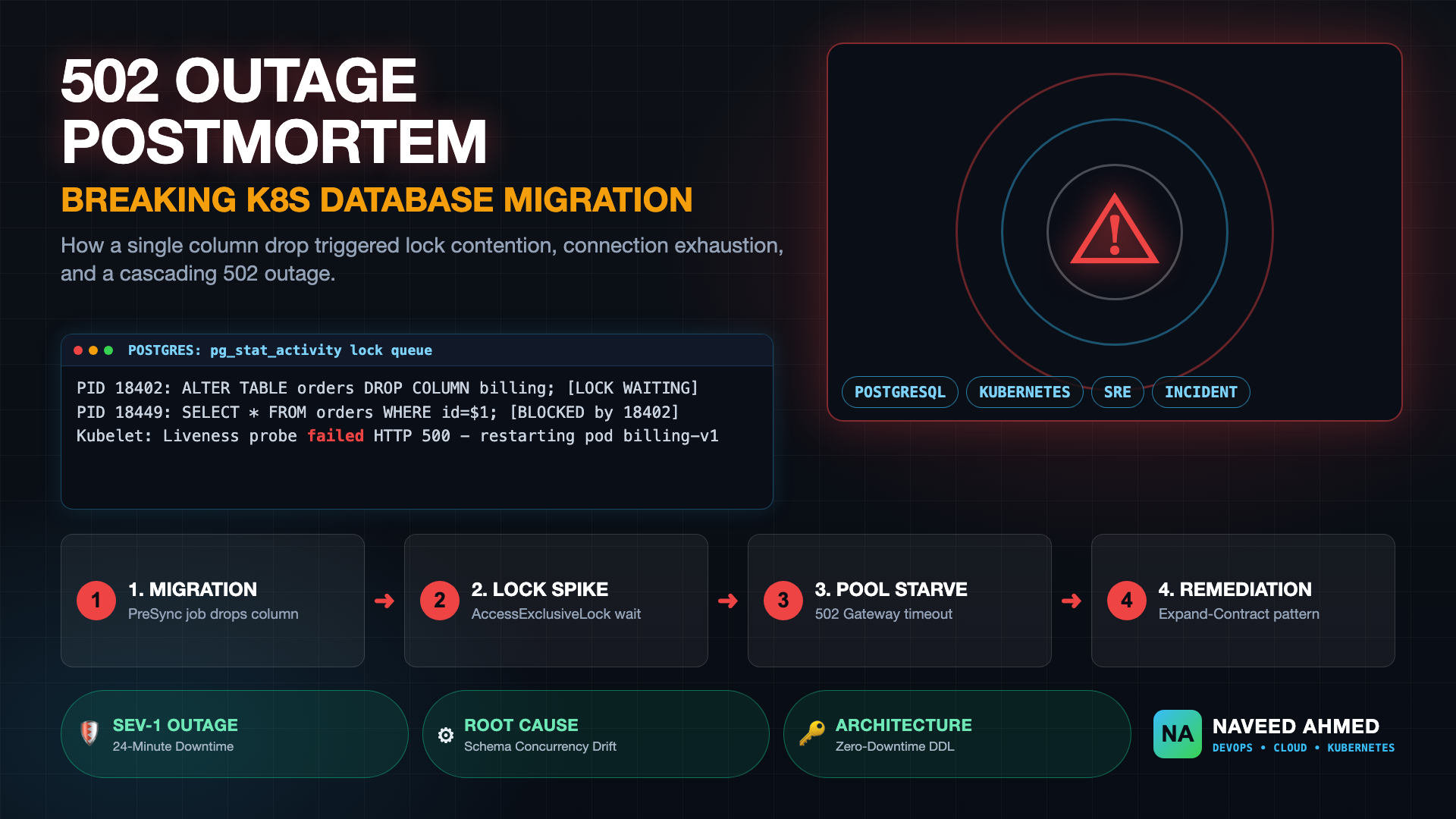
At 2:15 AM on a high-volume shopping weekend, an automated GitOps pipeline triggered what seemed like a routine microservice deployment. Twelve minutes later, our primary e-commerce cluster was engulfed in a SEV-1 outage: API latencies spiked past ten seconds, ingress gateways returned continuous 502 Bad Gateway responses, and database connection pools collapsed. Executing an emergency kubernetes database migration alongside application pod updates without strict schema backward compatibility is one of the most destructive reliability hazards in cloud-native platforms. While engineers often assume that kubernetes deployment strategies like Rolling Updates provide automatic zero downtime, improper schema evolution converts standard rollouts into catastrophic cascading failures.
In this postmortem, we deconstruct the exact mechanics of how a seemingly harmless column removal locked PostgreSQL, starved application connection pools, and blinded Kubernetes health probes. We then detail the architectural guardrails, diagnostic queries, and the four-phase Expand and Contract pattern required to execute every kubernetes database migration safely in production.
Incident Timeline: The Kubernetes Database Migration 502 Outage
The outage unfolded across 24 minutes when an automated pipeline deployed an API update containing a database schema migration. Because the migration removed an active column, running version 1 pods threw database errors while PostgreSQL lock queues rapidly saturated all available worker connections.
| Timestamp (UTC) | Cluster & Database State | User Impact & Observability Signals | SRE Diagnostic Action |
|---|---|---|---|
| 02:15:00 | ArgoCD triggers deployment; pre-sync migration Job executes DDL against primary RDS PostgreSQL instance | Normal traffic flow; HTTP error rate baseline at 0.02% | Automated CD pipeline reports migration step completed successfully |
| 02:16:30 | Migration Job issues ALTER TABLE orders DROP COLUMN billing_address; and blocks waiting for locks |
P95 latency rises from 65ms to 850ms; connection pool usage climbs to 80% | Postgres lock queue begins accumulating blocked read queries behind the DDL statement |
| 02:18:00 | DDL lock acquires and drops column; active v1 pods attempt to query billing_address and throw unhandled SQL exceptions |
HTTP 500 error rate spikes to 42%; Ingress controller begins emitting HTTP 502 Bad Gateway | On-call engineer paged by automated PagerDuty SEV-1 latency and error budget alerts |
| 02:21:00 | Application threads freeze waiting on dead connections; Kubelet liveness probes fail across v1 pods | Cluster experiences rolling pod restarts; 502 Bad Gateway reaches 78% of incoming traffic | Engineer checks pod logs, observes column orders.billing_address does not exist exceptions |
| 02:26:00 | Engineer initiates emergency kubectl rollout undo back to version 1 |
Outage worsens; rolled-back v1 pods immediately crash upon boot due to missing schema column | SRE realizes rollback is blocked because schema mutation is non-backward-compatible |
| 02:32:00 | SRE hotfixes database schema by adding nullable billing_address column back to the table |
Database errors cease immediately; connection pool queues drain | Emergency DDL succeeds; application threads resume normal query execution |
| 02:39:00 | Pod restart churn stabilizes; Ingress error rate drops below 0.05% | All services operational; end-to-end checkout transactions restored | Incident closed; postmortem and preventive guardrail review scheduled |
The 970+ Incident Handbook & K8s Runbooks are exclusive to subscribers — unlock for FREE
Get battle-tested production runbooks, AWS architecture blueprints, and zero-downtime CI/CD post-mortems sent directly to your inbox. 100% free, no spam.
Root Cause Analysis: Dual-Version Concurrency During Rolling Updates
The root cause of the incident was a violation of dual-version schema concurrency. During a rolling rollout in Kubernetes, pods running the previous version and the incoming version process live traffic concurrently. Any destructive schema migration executed before old pods terminate causes immediate runtime query crashes.
When the deployment began, the cluster had 12 healthy pods running v1.4.0. The deployment spec specified standard rolling update parameters:
spec:
  replicas: 12
  strategy:
    type: RollingUpdate
    rollingUpdate:
      maxSurge: 25%
      maxUnavailable: 0
With maxUnavailable: 0, all 12 original pods continued receiving client traffic through the Service load balancer while the first 3 new pods running v1.5.0 were scheduled. However, before creating those new pods, the CI/CD pipeline ran the database migration script. That script dropped the column:
-- Destructive DDL migration executed while v1.4.0 pods were actively serving traffic:
ALTER TABLE orders DROP COLUMN billing_address;Kubernetes Service
Distributing requests across all active pod endpoints
Version 1.4.0 (Active)
Executes: SELECT id, billing_address FROM orders; → SQL Crash!
PostgreSQL Primary
Column billing_address deleted by pre-sync migration Job
Because the application ORM mapped billing_address in its query model, every single read request handled by the 12 active v1.4.0 pods failed instantly with fatal database errors. Even worse, attempting a rapid kubectl rollout undo failed completely: version 1 code was hardcoded to expect that column, meaning neither version 1 nor version 2 could run cleanly until the database schema was manually restored.
The PostgreSQL Lock Contention Cascade: How AccessExclusiveLock Strangled Traffic
The second operational failure mode was severe lock contention on PostgreSQL. Modifying a table structure requires an AccessExclusiveLock, which conflicts with every other lock mode, including simple background SELECT queries. This lock queue starved the connection pool and triggered cascading gateway timeouts.
Many engineers assume that dropping a column in modern PostgreSQL is instantaneous because it simply marks the column as hidden in system catalogs. While the catalog update takes less than 5 milliseconds of CPU time, PostgreSQL must acquire an AccessExclusiveLock on the table before it can perform the operation.
Here is how the cascading thread lock unfolded:
- Long-Running Reader: An analytics worker was executing a reporting query on the
orderstable, holding anAccessShareLock. - DDL Enters Queue: The migration Job executed
ALTER TABLE orders DROP COLUMN billing_address;. It requested anAccessExclusiveLock. Because of the active reader, PostgreSQL placed the migration in a waiting queue. - The Head-of-Line Blocking Trap: In PostgreSQL, once an exclusive lock request enters the queue, all subsequent incoming read and write queries are blocked behind it to prevent transaction starvation.
- Connection Pool Depletion: Within 45 seconds, over 300 application threads were waiting on the database. The HikariCP connection pool on the API pods exhausted all connections, causing health check endpoints to time out.
- Cascading Ingress 502s: The ALB Ingress controller received connection timeouts from backend pods and responded to end-users with
502 Bad Gateway.
During incident triage, running the following diagnostic query immediately exposes blocked processes and waiting DDL statements:
-- Identify queries blocked by exclusive table locks
SELECT
  blocked_locks.pid     AS blocked_pid,
  blocked_activity.usename  AS blocked_user,
  blocking_locks.pid    AS blocking_pid,
  blocking_activity.usename AS blocking_user,
  blocked_activity.query    AS blocked_statement,
  blocking_activity.query   AS blocking_statement
FROM  pg_catalog.pg_locks         blocked_locks
JOIN pg_catalog.pg_stat_activity blocked_activity ON blocked_activity.pid = blocked_locks.pid
JOIN pg_catalog.pg_locks         blocking_locks
    ON blocking_locks.locktype = blocked_locks.locktype
    AND blocking_locks.database IS NOT DISTINCT FROM blocked_locks.database
    AND blocking_locks.relation IS NOT DISTINCT FROM blocked_locks.relation
    AND blocking_locks.page IS NOT DISTINCT FROM blocked_locks.page
    AND blocking_locks.tuple IS NOT DISTINCT FROM blocked_locks.tuple
    AND blocking_locks.virtualxid IS NOT DISTINCT FROM blocked_locks.virtualxid
    AND blocking_locks.transactionid IS NOT DISTINCT FROM blocked_locks.transactionid
    AND blocking_locks.classid IS NOT DISTINCT FROM blocked_locks.classid
    AND blocking_locks.objid IS NOT DISTINCT FROM blocked_locks.objid
    AND blocking_locks.objsubid IS NOT DISTINCT FROM blocked_locks.objsubid
    AND blocking_locks.pid != blocked_locks.pid
JOIN pg_catalog.pg_stat_activity blocking_activity ON blocking_activity.pid = blocking_locks.pid
WHERE NOT blocked_locks.granted;
Kubernetes Migration Anti-Patterns vs Production Solutions
Engineering teams frequently adopt migration deployment patterns that function in local development but fail under production concurrency. Evaluating these deployment architectures reveals why decoupled, backward-compatible patterns are mandatory for high-availability systems.
| Migration Pattern | Operational Mechanism | Failure Mode Under High Traffic | Production Verdict |
|---|---|---|---|
| 1. In-App Startup Migration | Application framework (e.g. Django, Spring, Prisma) runs DDL in main container boot command | When 10 pods scale simultaneously, 10 processes execute migrations concurrently, causing lock contention, deadlocks, and duplicate DDL errors | Anti-Pattern: Prohibited in multi-replica production environments |
| 2. InitContainer Migration | Kubernetes initContainers block pod startup until migration command completes |
Same race condition: multiple pods spinning up concurrently run duplicate DDL; slow migrations breach pod startup probes and trigger crash loops | Anti-Pattern: Dangerous under horizontal autoscaling (HPA) |
| 3. Direct CI/CD Pipeline Exec | GitHub Actions or Jenkins runner runs migration script before triggering Kubernetes rollout | Breaks dual-version concurrency: if schema change is non-backward-compatible, running v1 pods immediately fail before v2 even starts scheduling | Anti-Pattern: Invariably causes downtime on destructive changes |
| 4. Decoupled K8s Job + Expand & Contract | Dedicated single-replica Kubernetes Job with explicit timeouts, combined with backward-compatible schema phases | Zero race conditions; v1 and v2 pods operate simultaneously on the shared database without exceptions; instant rollback preserved | Production Standard: Safe for zero-downtime microservices |
For scenario-based interview exercises on schema drift and API synchronization, review our SRE drills on database migration succeeds but API deployment fails and zero-downtime breaking database schema migration triage.
The 4-Phase Expand and Contract Migration Pattern (Zero-Downtime Blueprint)
The Expand and Contract pattern (also known as Parallel Run) decomposes a breaking schema change into four non-breaking release phases. By separating database expansion, dual-writing, data backfilling, and schema contraction across separate releases, applications achieve seamless rolling updates.
Expand Schema
Add new nullable column or table; old code ignores it, database supports both
Deploy App v2
Writes to both old and new columns; reads from old column with fallback
Backfill Data
Batched background job syncs historical data from old column to new column
Contract Schema
Switch app reads to new column only; drop old column in off-peak maintenance
To illustrate this pattern concretely, consider renaming billing_address to invoice_address. Instead of executing an instantaneous RENAME COLUMN, follow this four-phase sequence:
Phase 1: Expand (Release 1 - Additive Only)
Create the new column as nullable. Do not remove or alter the old column:
-- Phase 1 Migration: Additive only
ALTER TABLE orders ADD COLUMN invoice_address text;
Because the column is nullable, running v1 pods continue inserting records with only billing_address populated. No locking contention or ORM mapping exceptions occur.
Phase 2: Dual-Writing Application Logic (Release 2)
Deploy application version 2. The code is programmed to write to both columns simultaneously and read with a fallback:
# Application v2 Data Access Logic
def save_order(order_data):
    # Dual-write to both legacy and modern columns
    db.execute("""
        INSERT INTO orders (id, billing_address, invoice_address, amount)
        VALUES (%s, %s, %s, %s)
    """, (order_data.id, order_data.address, order_data.address, order_data.amount))

def get_order_address(order_id):
    row = db.query_one("SELECT billing_address, invoice_address FROM orders WHERE id = %s", order_id)
    # Read from new column if populated, fallback to legacy column
    return row.invoice_address if row.invoice_address is not None else row.billing_address
Phase 3: Asynchronous Data Backfill
Execute an offline, batched worker script to populate invoice_address for all historical records where it remains null. Use small batches to avoid lock escalation:
-- Safe batched backfill query executed in chunks of 5,000 rows
UPDATE orders
SET invoice_address = billing_address
WHERE id IN (
    SELECT id FROM orders
    WHERE invoice_address IS NULL
    LIMIT 5000
);
Phase 4: Contract (Release 3 - Deprecation & Cleanup)
Once all historical records are backfilled and verified, deploy application version 3 (which only references invoice_address). Finally, during an off-peak maintenance window, drop the legacy column:
-- Phase 4 Migration: Safe drop after application code is completely detached
ALTER TABLE orders DROP COLUMN billing_address;
Because no running pods in the cluster reference billing_address, dropping it is completely safe and rollback-tolerant.
Kubernetes Implementation: Decoupling Schema Migrations via ArgoCD Sync Waves
To operationalize database migrations safely in Kubernetes, run migrations inside a standalone Kubernetes Job managed by GitOps sync waves or Helm hooks. This ensures single-execution semantics before pod updates begin.
By assigning the migration Job to SyncWave 0 and the application Deployment to SyncWave 1, ArgoCD ensures that the schema expansion completes successfully before initiating the rolling replacement of application pods.
apiVersion: batch/v1
kind: Job
metadata:
  name: schema-migration-v1-5-0
  namespace: production
  annotations:
    argocd.argoproj.io/hook: PreSync
    argocd.argoproj.io/hook-delete-policy: HookSucceeded
    argocd.argoproj.io/sync-wave: "0"
spec:
  backoffLimit: 2
  activeDeadlineSeconds: 300
  template:
    metadata:
      name: schema-migration
    spec:
      restartPolicy: OnFailure
      containers:
      - name: migrator
        image: registry.example.com/ecommerce-migrator:v1.5.0
        command: ["flyway", "migrate"]
        env:
        - name: FLYWAY_URL
          valueFrom:
            secretKeyRef:
              name: db-credentials
              key: jdbc_url
        - name: FLYWAY_USER
          valueFrom:
            secretKeyRef:
              name: db-credentials
              key: username
        - name: FLYWAY_PASSWORD
          valueFrom:
            secretKeyRef:
              name: db-credentials
              key: password
        resources:
          requests:
            cpu: 250m
            memory: 256Mi
          limits:
            cpu: 500m
            memory: 512Mi
Notice two critical defensive configurations in the Job spec:
activeDeadlineSeconds: 300: If the migration Job encounters a lock wait or stall, Kubernetes forcibly terminates the job after 5 minutes, preventing the CI/CD pipeline from hanging indefinitely.backoffLimit: 2: Prevents runaway restart loops if the migration script fails due to syntax errors or connection timeouts.
SRE Production Runbook: 5 Mandatory CI/CD Schema Guardrails
To eliminate database migration outages across production environments, platform engineering teams must enforce defensive policies directly in their automated pipelines before code reaches clusters.
| Guardrail Rule | Technical Enforcement Mechanism | Production Protection |
|---|---|---|
| 1. Enforce DDL Lock Timeouts | Prepend SET lock_timeout = '2s'; to every migration transaction |
Prevents DDL from hanging indefinitely in PostgreSQL lock queues and causing head-of-line blocking |
| 2. Automated DDL Linting | Integrate linters like strong_migrations or sqlfluff in pull request CI checks |
Automatically blocks dangerous operations such as adding non-null columns without defaults or renaming active columns |
| 3. Statement Timeout Safeguards | Configure database connection parameters with SET statement_timeout = '15s'; |
Prevents accidental full-table scans or unindexed locks from saturating database CPU |
| 4. Health Probe Decoupling | Never make pod readiness probes depend on deep database queries (e.g. SELECT 1 FROM orders) |
Prevents transient database blips from causing kubelet to restart healthy application pods. See our triage guide on readiness probe execution order and failure modes |
| 5. Shadow Traffic Verification | Replay real production traffic against staging databases prior to release | Validates that ORM queries from new versions run smoothly without lock escalations under real concurrency |
To build diagnostic intuition for identifying hung pods, failing probes, and broken deployments in real time, test your incident triage speed on our interactive Kubectl outage simulator or review container orchestration internals in the Kubernetes Mastery Hub.
Key Postmortem Takeaways for Platform Architects
Executing an enterprise kubernetes database migration requires recognizing that deployment strategies and data layer migrations are inextricably coupled. Platform teams must enforce backward-compatible schemas, decouple DDL into isolated Kubernetes Jobs, and cap lock timeouts under three seconds to eliminate outage risks.
- Never Trust Native Rollouts for Data Safety: A Kubernetes Rolling Update only ensures pod availability; it provides zero protection against destructive, non-backward-compatible database mutations.
- Embrace the Expand and Contract Rhythm: Multi-phase migrations may require multiple PRs, but they convert high-risk midnight deployments into routine, zero-downtime releases.
- Isolate Migrations in Kubernetes Jobs: Decouple migration logic from application container lifecycles to prevent autoscaling race conditions and duplicate execution.
- Cap Lock Wait Latency: Always set aggressive lock timeouts (under 3 seconds) on DDL statements so that database migrations abort quickly rather than taking down your entire API platform.
Frequently Asked Questions
What is the Expand and Contract pattern in Kubernetes database migrations?
The Expand and Contract (Parallel Run) pattern decouples database schema changes from application deployments. In the Expand phase, new nullable columns or tables are created without touching old schemas, allowing v1 and v2 application pods to run simultaneously. Once all pods run v2 and background jobs sync data, the Contract phase drops deprecated columns in an isolated, non-peak release.
Why should you avoid running database migrations in Kubernetes initContainers?
Running migrations inside initContainers causes race conditions when multiple application replicas scale out concurrently. Multiple pods attempt to acquire migration advisory locks simultaneously, risking deadlocks, duplicate execution, or pod startup timeouts. Migrations should always be decoupled into a dedicated, one-off Kubernetes Job with activeDeadlineSeconds and backoffLimits.
How does an ALTER TABLE statement cause a cascading 502 outage in PostgreSQL?
Even if an ALTER TABLE statement takes milliseconds to execute, PostgreSQL must acquire an AccessExclusiveLock. If a long-running SELECT query is currently executing on that table, the ALTER statement queues behind it. Crucially, all subsequent incoming SELECT and write queries queue behind the ALTER statement, starving the connection pool and causing HTTP 502/504 gateway timeouts.
How can you safely roll back a Kubernetes release if the database migration already ran?
If a database migration is non-backward-compatible (destructive), rolling back the Kubernetes Deployment to version 1 will fail immediately because version 1 code cannot interact with the altered schema. To ensure safe rollback, migrations must never rename or drop columns in the same release as code changes; all changes must remain backward-compatible with the previous revision.