It is 10:45 AM on a Tuesday. You are three levels deep into debugging an intermittent race condition in a distributed worker pool. In your head, you hold a fragile mental model: goroutine concurrency states, Redis lock expiration timers, edge proxy connection resets, and the exact four lines of code needed to fix the issue. Then, a Slack notification dings with a red badge: "Hey, quick question—do you know why deployment #412 in staging failed on the database migration?"
You spend four minutes checking staging logs, answer with a one-line explanation, and turn back to your editor. But the mental model is gone. The concurrency states are gone. The Redis lock timing is gone. You stare blankly at your screen for fifteen minutes trying to reconstruct where you were. Just as the picture starts to form, a calendar reminder pops up: "Sprint Backlog Grooming in 5 minutes." This cycle of context switching software engineering teams endure every day is one of the single biggest productivity killers in modern tech organizations.
Context switching is rarely treated as a catastrophic engineering issue because it does not trigger an immediate PagerDuty alert. Yet its cumulative effect silently destroys developer morale, drags sprint velocity to a crawl, and causes preventable production outages. To build sustainable systems and healthy developer cultures, engineering leaders must understand the cognitive mechanics behind context switching, calculate its true organizational tax, and implement structural guardrails that protect deep, uninterrupted work.
What Is Context Switching in Software Engineering?
In computer operating systems, a context switch happens when the CPU scheduler pauses an executing process, saves its registers and state to memory, and loads another process's state into the hardware registers. The hardware does this in microseconds. Because the machine executes billions of instructions per second, you barely notice the overhead.
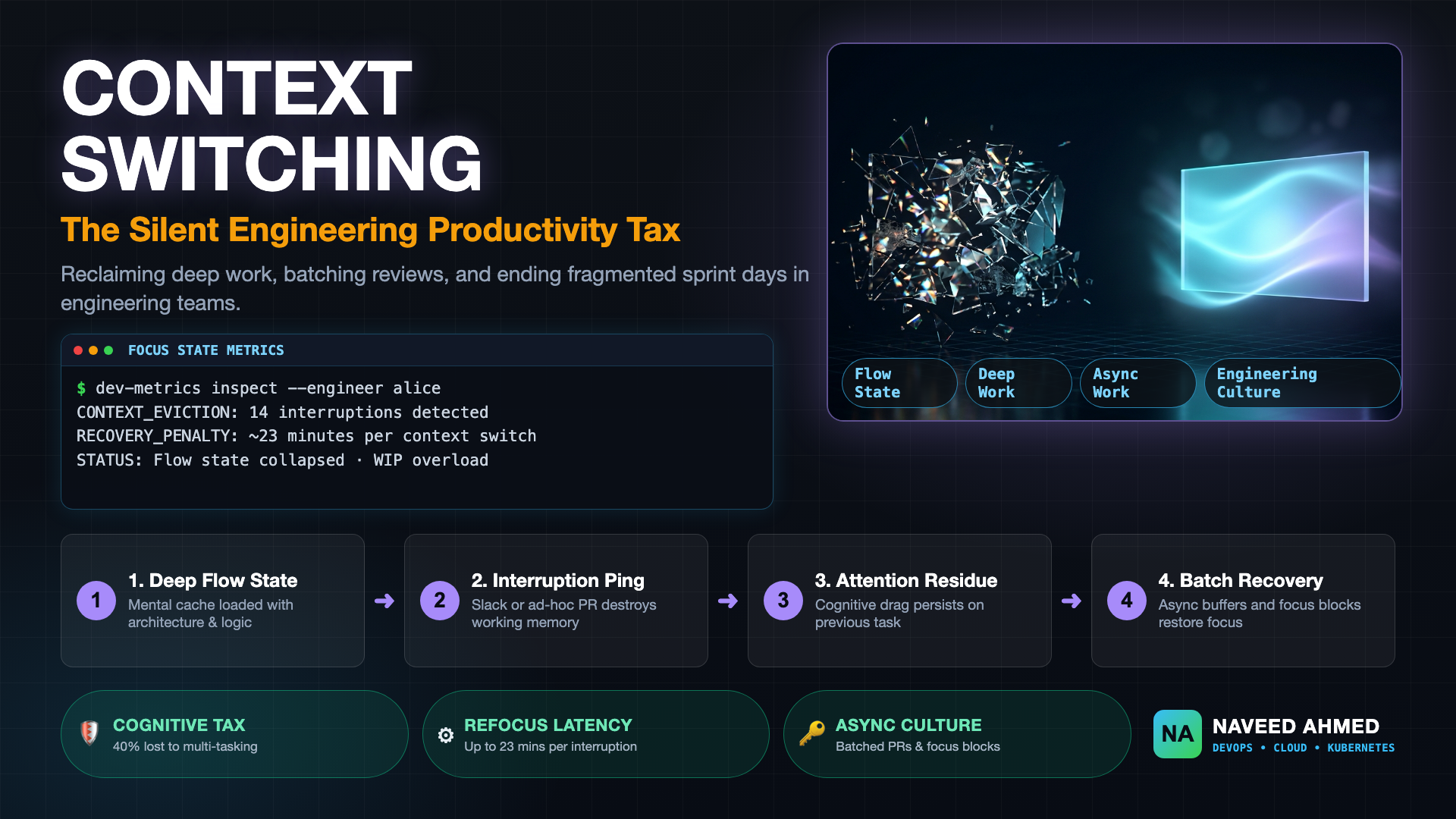
Human brains do not have hardware registers. In context switching software engineering environments, shifting cognitive focus is not a harmless pointer re-assignment. When an engineer writes complex code or traces an architecture defect, they are loading an intricate mental graph into their working memory—variables, function call stacks, invariants, edge cases, domain rules, and potential failure modes. This fragile construct is known in cognitive science as a mental cache.
A computer saves its program counter and resumes in nanoseconds. A human engineer requires 15 to 25 minutes of deep immersion just to rebuild their mental cache after an interruption. If you interrupt a developer four times a day, you have effectively eliminated half of their engineering capacity.
When an interruption forces an engineer out of that mental state, the brain cannot simply "save" that high-dimensional mental graph to disk. Instead, the working memory is evicted. Worse, the human brain suffers from attention residue—a concept coined by organizational psychologist Dr. Sophie Leroy. When you transition from Task A (debugging an edge gateway) to Task B (answering a Slack thread about release dates), your cognitive processing does not switch cleanly. A significant portion of your mental bandwidth remains tethered to Task A, wondering how to resolve the previous problem, while Task B receives only partial focus.
The 970+ Incident Handbook & K8s Runbooks are exclusive to subscribers — unlock for FREE
Get battle-tested production runbooks, AWS architecture blueprints, and zero-downtime CI/CD post-mortems sent directly to your inbox. 100% free, no spam.
The 5 Systemic Causes of Context Switching in Engineering Teams
Engineering leaders often view distraction as an individual discipline problem, telling developers to "turn off notifications" or "focus better." In reality, context switching is almost always the symptom of broken organizational workflows and misaligned communication habits. Here are the five root causes driving chronic context fragmentation across engineering organizations:
1. The "Quick Question" Trap and Asynchronous Misalignment
Modern remote and hybrid teams rely on Slack, Microsoft Teams, and Discord. While these tools were designed to enable asynchronous collaboration, many organizations operate them as synchronous intercoms. When an engineer asks a teammate a "quick question," they offload their own mental blockage onto someone else. The requester saves five minutes of reading documentation, but the responder loses forty minutes of flow state.
2. Ad-Hoc Pull Request Demands
Pull requests are the lifeblood of team delivery, but unmanaged review workflows turn into constant context evictions. When developers submit massive multi-file pull requests and immediately ping channels asking for an immediate review, their teammates are forced to stop their current tasks, switch branches locally, parse a completely different domain problem, and leave comments before returning to their own work. This dynamic creates high cognitive friction for both the author and the reviewer.
3. "Swiss-Cheese" Calendars (Maker vs. Manager Schedules)
In his famous 2009 essay, Paul Graham distinguished between the manager schedule and the maker schedule. Managers operate in 30-minute and 60-minute blocks; changing meetings every hour is simply part of their job. Makers—developers, system architects, SREs—need large, contiguous blocks of 3 to 4 hours to accomplish meaningful work. When meetings are peppered across the day at 10:00 AM, 1:30 PM, and 3:30 PM, the fragmented 45-minute gaps in between are completely unusable for complex engineering tasks.
4. Alert Fatigue and Non-Actionable Production Spikes
When telemetry systems emit constant warnings that do not require immediate intervention, engineers become conditioned to glance at monitoring channels dozens of times per shift. An engineer in the middle of a migration should never be pulled into investigating transient minor CPU warning blips. For true incidents, teams need rigorous escalation ladders, such as structured SRE incident response protocols for live production outages, keeping general channels free from panics and noisy alerts.
5. Uncontrolled Work-In-Progress (WIP) Limits
When an engineer hits a roadblock—a waiting QA build, an unanswered API specification question, or a pending database migration—they often pick up a second or third ticket from the backlog. By midweek, an engineer has three half-completed branches in flight. Every daily standup becomes a confusing mental inventory of partially done tasks, maximizing the context switching software development penalty.
The Multi-Tasking Illusion: Calculating the Gerald Weinberg Tax
Human beings cannot multitask cognitive work. What people call "multitasking" is merely rapid, chaotic sequential switching between different mental states. Computer scientist Gerald Weinberg quantified this phenomenon in his foundational work Quality Software Management. Weinberg demonstrated that adding concurrent projects causes an exponential loss of productive capacity:
| Concurrent Projects | Usable Focus Time | Context-Switching Penalty | Engineering Impact |
|---|---|---|---|
| 1 Project | Full Focus | Zero Penalty | Peak flow state and minimal defect injection |
| 2 Projects | Fragmented Focus | One-Fifth of Capacity Lost | Major slowdown: equivalent to losing one full workday every week |
| 3 Projects | Severely Divided | Two-Fifths of Capacity Lost | Chronic delay: over two full workdays per week lost to switching |
| 4 Projects | Near Total Thrashing | Three-Fifths of Capacity Lost | Stalled delivery: developers spend more time reading tickets than coding |
| 5 or more Projects | Complete Gridlock | Over Three-Quarters Lost | Organizational burnout: almost all working hours spent juggling state |
Notice the steep cliff: when an engineer is assigned to three simultaneous projects, they do not deliver equal progress on each. They spend roughly two full days of their entire working week merely transitioning between the mental contexts of those projects—re-reading tickets, navigating different codebases, checking branch statuses, and remembering where they left off. Only a small fraction of their actual working hours is spent advancing each project.
This dynamic explains why teams that reduce their active sprint commitments often deliver software significantly faster. By eliminating the multi-tasking tax, the team recaptures dozens of lost engineering hours without working overtime.
The Cognitive Cascade: What Happens During an Interruption
To understand why recovery takes so long, consider the lifecycle of an engineering session. When an engineer sits down to build a new microservice or refactor a critical system, their cognitive state goes through five distinct phases:
When this cycle repeats multiple times throughout a day, the engineer never reaches Phase 2. They spend their entire 8-hour shift bouncing between Phase 1 and Phase 4. At the end of the day, they feel exhausted despite having pushed only a handful of lines of code.
Practical Framework: How High-Performing Teams Kill Context Switching
Eliminating context switching software engineering bottlenecks requires systemic changes in how engineering teams collaborate, review code, and structure their working hours. Here are six battle-tested practices implemented by elite engineering teams:
1. Implement Protected Focus Blocks (The 4-Hour Rule)
Engineers need contiguous blocks of uninterrupted time. Top engineering organizations implement company-wide or team-wide "Focus Mornings" or "No-Meeting Wednesdays." For example, designating 9:00 AM to 1:00 PM as quiet focus time allows every engineer to sink into deep architectural problems without anticipating meetings or instant messages.
2. Batch Pull Request Reviews
Instead of reviewing PRs instantaneously as notifications roll in, treat code reviews as batched, scheduled activities. Establish a team convention: reviews happen twice a day—once in the morning before starting active development (e.g., 9:00 AM) and once in the late afternoon (e.g., 4:00 PM). To make reviews smoother, teams can adopt automated agentic SDLC workflows that pre-triage pull requests, ensuring linters, unit tests, and security scans run automatically before any human reviewer is tagged.
3. Practice "Micro-Checkpointing" Before Any Interruption
When an interruption is unavoidable—such as an urgent on-call triage request or a scheduled all-hands call—train yourself to take 60 seconds before leaving your code. Do not switch tabs immediately. Run a quick mental snapshot command and write down your immediate state:
# The 60-Second Micro-Checkpoint Protocol
# 1. Leave an intentionally failing unit test or compiler error
# 2. Drop a temporary git commit or working note in scratchpad:
$ git status
$ cat << 'EOF' >> .focus_checkpoint.txt
CURRENT_HYPOTHESIS: The worker pool drops connections because keep-alive timeout is too short.
LAST_FILE_TOUCHED: pkg/worker/pool.go line 142
NEXT_ACTION: Inspect proxy upstream idle timeout in config/envoy.yaml and verify with local test.
EOF
When you return to your workstation thirty minutes later, you do not have to guess what you were thinking. The text file or failing test acts as a restored hardware register, cutting your re-warming time from twenty minutes down to two minutes.
4. Enforce Strict Work-In-Progress (WIP) Limits
Set a hard limit on your team's Kanban board: a maximum of 1 active ticket in progress per engineer. If a developer gets blocked waiting on code review or external feedback, their first priority must be to review an open PR from a teammate or assist in unblocking someone else's work, rather than pulling a new feature ticket into the sprint. Finishing existing work always takes precedence over starting new work.
5. Replace Walkie-Talkie Slack with Asynchronous SLAs
Establish written communication agreements within the team. For non-incident discussions, set an explicit expectation that responses are expected within 90 to 120 minutes, not within 90 seconds. If a real production outage occurs, use PagerDuty or designated critical escalation channels. This distinction frees engineers from the anxiety of monitoring chat channels every three minutes.
6. Shorten Feedback Loops with Local Validation Tools
Developers often context-switch while waiting for distant CI/CD pipelines to build and test their changes. When a build takes 15 minutes, the temptation to check email or social media is irresistible. Teams can keep developers in the flow by providing fast local feedback tooling, such as a fast online Kubernetes YAML validator or containerized staging emulators, catching configuration errors before committing code.
Comparing the Workdays: Fragmented vs. Focus-Optimized
To see the tangible difference these organizational practices make, let us examine how the same software engineer experiences two different operational environments:
| Dimension | The Fragmented Day (Reactive) | The Focus-Optimized Day (Proactive) |
|---|---|---|
| Calendar Structure | Four 30-minute meetings scattered throughout the morning and afternoon. | Meetings consolidated into afternoons (1:30 PM - 3:00 PM). Mornings fully protected. |
| Communication Norms | Expected to reply to Slack pings within 5 minutes. Constant notification banners. | Async by default. Slack checked during scheduled review windows between tasks. |
| Pull Request Review | Interrupted repeatedly throughout the day by direct messages asking for urgent code reviews. | Reviews batched into two dedicated 30-minute windows (morning and late afternoon). |
| Deep Work Achieved | ~45 minutes of real flow state across the entire working day. | 3.5 to 4.5 hours of uninterrupted, high-energy deep flow state. |
| End-of-Day Sensation | Exhausted, anxious, feeling behind on deliverables despite working hard. | Accomplished, clear progress on complex problems, low mental fatigue. |
The Leadership Imperative: Protecting Engineering Focus
As modern software engineering adopts generative AI tools and automated infrastructure, raw code production speed is no longer the bottleneck. As discussed in our analysis on the evolving role of software engineering and developer leverage, the most valuable contributions of senior engineers and architects are high-level problem formulation, deep system design, fault analysis, and evaluating complex operational tradeoffs. For those pursuing rigorous distributed systems mastery, following a structured Kubernetes production engineering roadmap demands sustained cognitive concentration that cannot be squeezed into ten-minute calendar scraps.
Engineering leaders who genuinely want higher velocity should not pressure developers to write code faster. Instead, they should ruthlessly remove the friction, interruptions, and fragmented rituals that pull developers out of their flow. Protecting your team's mental cache is the highest-leverage productivity investment you will ever make.
Summary & Team Focus Checklist
Audit your engineering team's context-switching overhead this week using this simple 5-step checklist:
- Audit Calendars: Are meetings clustered together, leaving at least one 3-to-4 hour contiguous focus block every day?
- Establish Async SLAs: Does your team have an agreed-upon guideline that non-urgent Slack threads do not require instant replies?
- Batch Code Reviews: Are PR reviews reviewed in designated morning and afternoon windows rather than interrupting active coding?
- Enforce WIP Limits: Does your team cap in-progress tasks to 1 per engineer to prevent half-finished work accumulation?
- Adopt Micro-Checkpointing: Do developers jot down their working memory state before stepping away to meetings or interruptions?
Frequently Asked Questions
What is context switching in software engineering?
Context switching in software engineering occurs when a developer is forced to pause their active cognitive task—such as debugging a distributed race condition or architecting an API—to address an unrelated demand like a Slack ping, an urgent PR review, or a sprint ceremony. Unlike computers that swap thread registers in nanoseconds, human developers must rebuild a delicate mental graph of code logic, data structures, and invariants, which takes upwards of 15 to 25 minutes after each disruption.
Why is context switching so damaging to developer productivity?
Writing software requires holding complex state in human working memory. Interruptions evict that working memory, leaving behind cognitive drag known as attention residue. Research by Gerald Weinberg in systems thinking demonstrates that working on two concurrent projects forfeits roughly one-fifth of productive time purely to context switching overhead; juggling three projects burns nearly two full workdays per week on switching penalties alone.
How long does it take a developer to refocus after an interruption?
Studies from the University of California, Irvine indicate that after a significant interruption, an engineer takes an average of 23 minutes and 15 seconds to return to their original task. Even worse, many interruptions trigger a cascade of secondary distractions, such as checking emails or triage channels, extending recovery time further.
How can engineering teams reduce context switching without slowing down communication?
High-performing engineering teams establish clear asynchronous communication norms, implement 3-to-4 hour protected focus blocks, batch code reviews into designated morning and afternoon windows, enforce strict Work-In-Progress (WIP) limits on Kanban boards, and route non-urgent alerts into batch digests rather than interrupting active developer channels.
What is attention residue in software development?
Attention residue is a psychological phenomenon coined by Dr. Sophie Leroy. When an engineer shifts from Task A to Task B, their attention does not immediately transition completely. A portion of their cognitive processing remains stuck on Task A, impairing cognitive performance, slowing down problem-solving, and increasing bug injection rates on Task B.