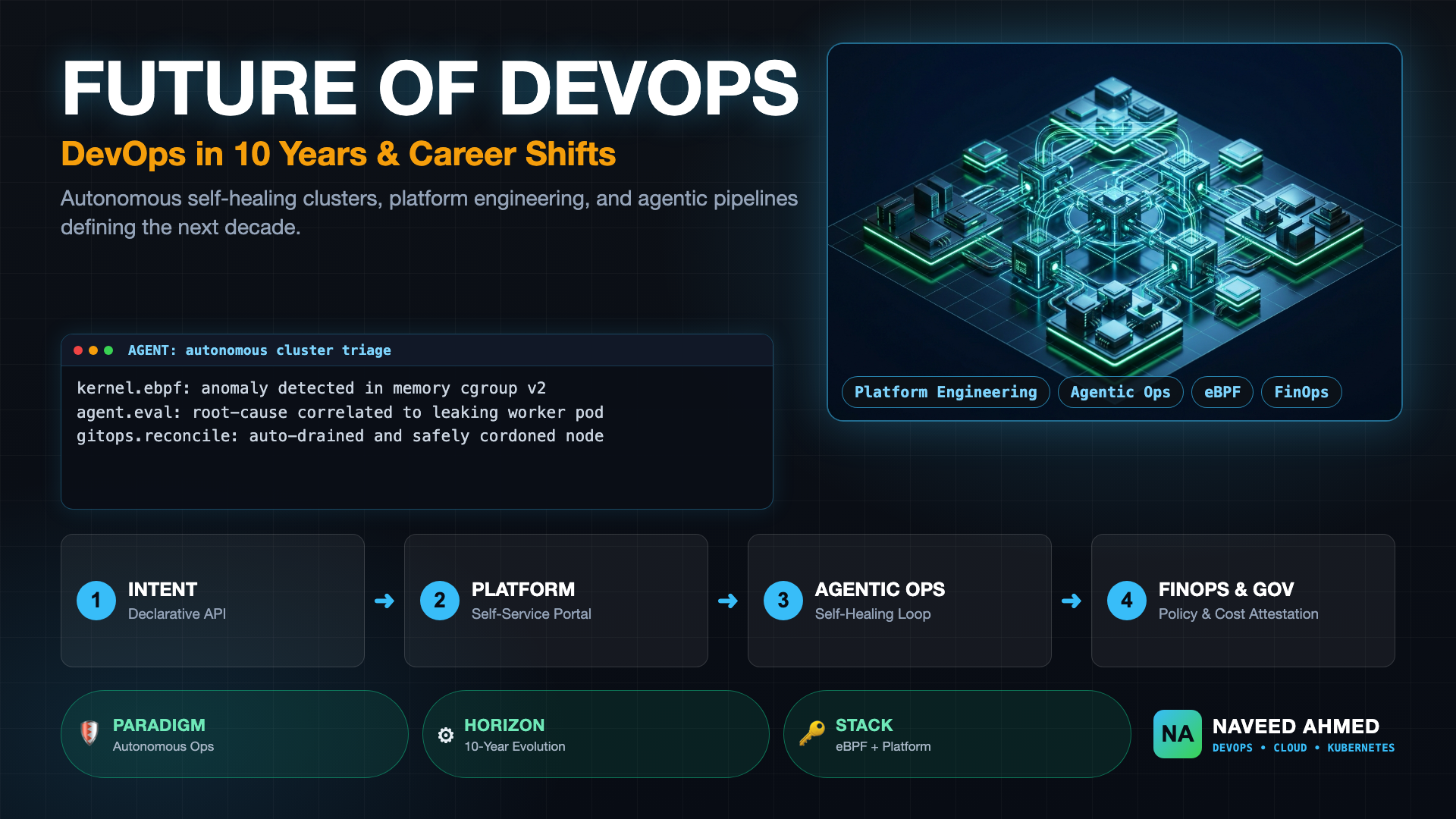
When Patrick Debois coined the term DevOps in 2009, the industry was wrestling with a straightforward dilemma: developers threw application code over a wall, and system administrators scrambled to keep production servers alive. Over the past fifteen years, that divide was paved over with CI/CD pipelines, containerization, and Infrastructure as Code. Yet, as engineering teams now face sprawling Kubernetes estates, distributed microservices, multi-cloud compliance, and autonomous AI coding systems, the current paradigm has hit an unmistakable wall. Understanding the future of DevOps is no longer an academic exercise—it is an urgent operational necessity. In this deep dive, we examine what DevOps in 10 years truly looks like, how the discipline will transform beyond manual YAML glue code, and why engineers who master declarative platform abstractions and agentic observability will lead the next decade of infrastructure engineering.
The Evolution Curve: Why Ticket-Based Ops Is Obsolete
For nearly a decade, many organizations implemented DevOps in name only. Instead of shared operational ownership and cultural alignment, they rebranded operations teams as "DevOps teams." The result was predictable: software developers opened Jira tickets requesting an Amazon S3 bucket, a DNS record, or a Helm chart update, and a dedicated DevOps engineer manually crafted Terraform modules or Jenkins pipelines to satisfy the request.
This operational model has collapsed under modern software delivery velocity. When product engineering teams deploy dozens of microservices per day, human gatekeepers running manual deployment pipelines create severe bottlenecks. The future of DevOps completely dismantles this ticket-driven bottleneck in favor of self-service developer platforms and automated control loops.
In high-maturity engineering organizations, DevOps engineers no longer write pipelines for individual application repositories. Instead, they operate as internal product managers and systems architects building an Internal Developer Platform (IDP). They deliver golden paths, self-healing runtime environments, and guardrailed APIs that empower product teams to ship safely without touching raw cloud manifests.
To understand the transition underway, we must examine how the role of the future of DevOps engineer shifts from pipeline maintenance to distributed platform synthesis. As covered in our comprehensive guide on DevOps to platform engineering, treating the infrastructure platform as an internal software product is the cornerstone of sustainable scaling. Practice the interview side of this shift with the platform engineering and internal developer platform interview questions. Treat the timelines below as informed projections from current platform, AI and security trends, not guarantees.
The 970+ Incident Handbook & K8s Runbooks are exclusive to subscribers — unlock for FREE
Get battle-tested production runbooks, AWS architecture blueprints, and zero-downtime CI/CD post-mortems sent directly to your inbox. 100% free, no spam.
DevOps in 10 Years: The Five Paradigm Shifts
Projecting DevOps in 10 years requires looking past ephemeral tooling hype and focusing on the underlying architectural vectors: abstraction layers, telemetry density, feedback automation, and cryptographic trust. Over the next decade, five core paradigm shifts will define how resilient systems are built and operated.
1. Internal Developer Platforms and Declarative Control Planes
Today, developers often grapple with hundreds of lines of Kubernetes YAML, Dockerfile nuances, and cloud IAM roles just to deploy a stateless microservice. In 10 years, application developers will declare pure business intent (e.g., ingress requirements, latency budgets, state persistence, and data privacy classifications) using high-level configuration languages like CUE or KCL, or through standardized APIs.
Declarative control planes built on technologies like Crossplane and Kubernetes Custom Resource Definitions (CRDs) synthesize these high-level intents into concrete, compliant cloud infrastructure on demand:
# Example: Intent-driven application abstraction in Crossplane
apiVersion: platform.naveedkumbhar.com/v1alpha1
kind: AppEnvironment
metadata:
  name: payments-service-prod
  namespace: platform-workloads
spec:
  tier: mission-critical
  intent:
    computeType: autoscaled-container
    minReplicas: 3
    maxReplicas: 50
    targetLatencyP99Ms: 120
    dataPersistence:
      engine: postgresql
      highAvailability: multi-region
      backupRetentionDays: 30
    securityZone: pci-dss-enclave
  telemetry:
    tracing: distributed-opentelemetry
    sloAlerting: automated-pagerduty
The platform control plane automatically reconciles this resource, provisioning VPC peering, IAM roles with least-privilege policies, managed databases, and telemetry sidecars without developer intervention.
2. Autonomous Agentic Operations (Self-Healing Control Loops)
The traditional incident lifecycle—Alert fires at 2 AM → On-call engineer wakes up → Gathers logs → Inspects Grafana dashboards → Executes runbook command → Deploys hotfix—is structurally unsustainable in complex distributed systems. The future of DevOps is anchored in closed-loop, agentic remediation.
In this architecture, autonomous AI agents operate within strictly bounded, deterministic sandboxes. They do not have unconstrained root shell access; instead, they interact with the control plane via standardized APIs and immutable GitOps pull requests. As detailed in our breakdown of how AI agents automate DevOps runbooks safely, autonomous agents can consume rich telemetry, isolate likely root causes, execute pre-approved canary rollbacks, and draft postmortems before a human engineer needs to step in.
3. Kernel-Level Observability via eBPF
Traditional APM agents that inject heavyweight bytecode or require language-specific profilers are quickly becoming relics. In the future of DevOps, telemetry is captured non-invasively at the OS kernel boundary using extended Berkeley Packet Filter (eBPF) programs like Cilium and Tetragon.
eBPF provides microsecond-level visibility into network socket connections, memory page faults, syscall latencies, and security violations across thousands of containers with near-zero CPU overhead:
# Example: Tetragon eBPF TracingPolicy for anomalous namespace execution
apiVersion: cilium.io/v1alpha1
kind: TracingPolicy
metadata:
  name: block-unauthorized-namespace-execution
  namespace: kube-system
spec:
  kprobes:
    - call: "sys_execve"
      syscall: true
      args:
        - index: 0
          type: "string"
      selectors:
        - matchArgs:
            - index: 0
              operator: "Prefix"
              values:
                - "/bin/sh"
                - "/bin/bash"
                - "/usr/bin/python"
          matchNamespaces:
            - "production-workloads"
          matchActions:
            - action: Sigkill
Coupled with distributed OpenTelemetry standards, this kernel-native telemetry feeds autonomous anomaly detectors with high-fidelity signal, eliminating alert fatigue caused by brittle CPU threshold triggers.
4. Carbon-Aware FinOps and Predictive Resource Scheduling
Cloud waste is a persistent drag on engineering efficiency. Static container resource requests, over-provisioned worker node groups, and idle development clusters waste massive amounts of capital and electrical power.
Over the next decade, FinOps will no longer be an end-of-month spreadsheet reconciliation. It is likely to become an active scheduling constraint, enforced by autoscalers such as Karpenter and KEDA as they mature. Workload orchestrators may evaluate real-time spot market pricing, hardware accelerator utilization (GPU/NPU tensor core saturation), and regional power grid carbon intensity to migrate batch jobs dynamically to green, low-cost regions. You can practice today's building blocks in the AWS EKS IRSA and Karpenter autoscaling hands-on runbook.
Engineers optimizing infrastructure cost profiles frequently leverage specialized calculation models; explore our interactive calculators on the DevOps tools hub to benchmark container resource sizing and subnet architectures, then test your reasoning on the cloud cost optimization across dev, QA, UAT and production FinOps scenario.
5. Zero-Trust Cryptographic Software Supply Chains
Long-lived API tokens, static SSH keys, and unverified container images are likely to be largely replaced by short-lived, identity-bound credentials and signed, attested images over the next decade of infrastructure engineering. The software supply chain is moving toward continuous zero-trust attestation.
Every artifact—from source commits to compiled container images and deployment manifests—will require cryptographic signing via Sigstore Cosign, SLSA (Supply-chain Levels for Software Artifacts) Level 4 provenance, and SPIFFE/SPIRE workload identities. Ephemeral compute environments will spin up with cryptographic identities valid for minutes rather than months, rendering credential exfiltration attacks virtually impossible.
Understanding these supply chain security boundaries is vital for modern incident readiness. Teams regularly practice these failure modes through real-world SRE drills on the DevOps interview scenarios portal, including the enterprise software supply chain system design with SLSA Level 3 and Cosign.
DevOps Today vs. DevOps in 10 Years: Direct Comparison
To summarize how the day-to-day discipline of DevOps transforms over the coming decade, consider the contrast across key operational dimensions:
| Operational Dimension | DevOps Today (2026) | DevOps in 10 Years (2036) |
|---|---|---|
| Core Operational Activity | Writing CI/CD YAML pipelines, managing Terraform state locks, triaging alerts | Architecting internal developer platforms, tuning agent control loops, governing SLO policies |
| Infrastructure Definition | Imperative bash scripts, verbose Helm charts, fragmented cloud modules | High-level declarative intent contracts synthesized by Crossplane and autonomous control planes |
| Incident Triage & Paging | Engineers paged at 2 AM to correlate logs, restart pods, and follow wiki runbooks | Autonomous agents diagnose kernel telemetry, cordon faulty nodes, roll back canaries, and file PRs |
| Observability Architecture | Heavyweight runtime APM agents, noisy static Prometheus threshold alerts | Non-invasive kernel eBPF probes, continuous dynamic tracing, anomaly correlation engines |
| Configuration Drift | Periodic drift detection or manual hotfixing directly inside cloud consoles | Immutable GitOps engines continuously reconciling state; read our analysis on ArgoCD drift elimination |
| Cloud Cost Management | Monthly AWS bill audits, static over-provisioning, manual rightsizing tickets | Predictive, carbon-aware autoscaling with dynamic multi-cloud spot bidding and zero-idle environments |
| Security & Compliance | Periodic vulnerability scans, long-lived IAM keys, manual compliance audits | Cryptographic SLSA Level 4 provenance, short-lived SPIFFE identities, automated policy attestation |
Does DevOps Have a Future? The Career and Engineering Outlook
When engineers ask "does devops have future?" or wonder whether artificial intelligence will make infrastructure roles redundant, the short answer is an emphatic yes. However, the scope of what constitutes valuable DevOps work is experiencing a profound tectonic shift.
If an engineer's entire skillset consists of writing simple GitHub Actions workflows, provisioning single EC2 instances via Terraform, or copying Helm templates from StackOverflow, their role is indeed at grave risk of automation. LLMs and platform frameworks can synthesize boilerplate configuration faster and with fewer syntax errors than humans.
Conversely, the devops future scope for engineers who understand distributed systems fundamentals has never been brighter. The reasons why devops is the future of modern digital business remain immutable:
- Distributed Complexity Is Compounding: As enterprises adopt hybrid cloud, edge compute, distributed AI inference clusters, and asynchronous microservices, the surface area for catastrophic failure modes expands exponentially. Systems require architects who understand network topologies, distributed consensus (Raft, Paxos), and failure domain isolation.
- AI Agents Require Deterministic Guardrails: Autonomous systems cannot run amok in production. Infrastructure engineers must design the sandboxes, RBAC permissions, audit trails, and automated canary rollback mechanisms that keep AI-driven deployments safe.
- Platform Engineering Is a Revenue Multiplier: Accelerating developer cycle time while enforcing strict security, compliance, and cost governance directly impacts an organization's competitive survival. High-performing engineering teams treat their internal platform as their most important internal product.
- Kubernetes Remains the Universal Runtime: Container orchestration continues to form the substrate for cloud-native operations. Deepening your container debugging skills through the Kubernetes mastery path provides an enduring technical moat.
How Engineers Should Prepare for the Future of DevOps
Navigating the transition toward devops future after 10 years requires intentional upskilling. Rather than chasing every transient framework, focus on foundational engineering capabilities:
- Master Systems Programming and Kernel Mechanics: Go, Rust, and Linux kernel internals (cgroups v2, namespaces, eBPF, TCP/IP stack) provide the technical foundation for building modern platform tooling and diagnostic agents.
- Treat Infrastructure as a Composable Product: Move beyond monolithic Terraform states. Learn declarative control plane patterns using Crossplane, Kubernetes Operators, and internal developer portals like Backstage.
- Implement Strict Reliability Engineering (SRE): Learn how to define quantitative Service Level Objectives (SLOs), error budgets, and chaos engineering experiments to empirically validate system resilience under stress.
- Automate Drift Prevention and Auditability: Ensure all production changes flow through declarative, auditable version control systems rather than interactive console modifications.
- Embrace FinOps as a Core Architecture Discipline: Understand cloud provider unit economics, spot instance lifecycle management, container bin-packing efficiency, and storage tiering strategies.
Conclusion: The Future of DevOps Belongs to Systems Thinkers
The future of DevOps is not about the demise of operations; it is about the triumphant ascension of systems engineering. In 10 years, the routine toil of manually provisioning VMs, crafting YAML boilerplate, and waking up to restart crashed containers will increasingly be handled by autonomous, self-healing platforms. What remains—and what becomes infinitely more valuable—is the ability to design resilient distributed architectures, enforce cryptographic trust, synthesize intuitive developer platforms, and build the guardrails that govern autonomous operations. By mastering these core capabilities today, you will not merely survive the next decade of infrastructure evolution—you will architect it.
Frequently Asked Questions
Does DevOps have a future?
Yes. DevOps is not disappearing; it is evolving from manual glue code and ticketing into platform engineering and autonomous systems. Organizations still need engineers who understand distributed systems, reliability, kernel-level networking, and release safety, but the focus shifts from writing pipeline scripts to architecting self-healing platforms.
What will replace DevOps in 10 years?
DevOps will not be replaced by a single new methodology; rather, it matures into three interdependent disciplines: Platform Engineering (providing paved-road developer portals), Site Reliability Engineering (governing resilience and SLOs), and Autonomous Systems Engineering (supervising AI agents and closed-loop control planes).
Why DevOps is the future of resilient software delivery?
DevOps remains the foundation of software delivery because its core philosophy—breaking silos between development, operations, and business goals—is permanent. As systems become exponentially more complex with microservices, multi-cloud, and AI workloads, automated feedback loops and declarative delivery become even more critical.
What is the future scope and demand for DevOps engineers?
The future scope of DevOps engineering is strong for practitioners who advance beyond basic CI/CD scripting. High-demand specializations over the next decade include internal developer platform design, eBPF observability, cloud FinOps optimization, and secure software supply chain architecture.
How will AI agents impact DevOps workflows over the next decade?
AI agents are likely to handle first-tier incident triage, log correlation, anomaly remediation, and routine patch PRs. Rather than manually paging engineers at 2 AM, autonomous runbook agents can diagnose root causes and propose fixes within bounded, sandboxed guardrails, while human engineers maintain architectural governance.