1. The Commoditization of Syntax: What Actually Changed
For four decades, the software engineering profession measured output in tokens of human labor: lines of code committed, pull request volume, and speed of typing boilerplates. Developers spent 70% of their workday wrestling with boilerplate language mechanics—writing ORM queries, structuring JSON deserializers, writing repetitive HTTP handlers, and looking up framework APIs on Stack Overflow.
That era is permanently closed. In 2026, large language models, agentic IDEs, and code synthesizers generate standard algorithms, unit tests, and API glue in seconds. Code syntax has achieved near-zero marginal cost. However, generating code is not the same as engineering a system.
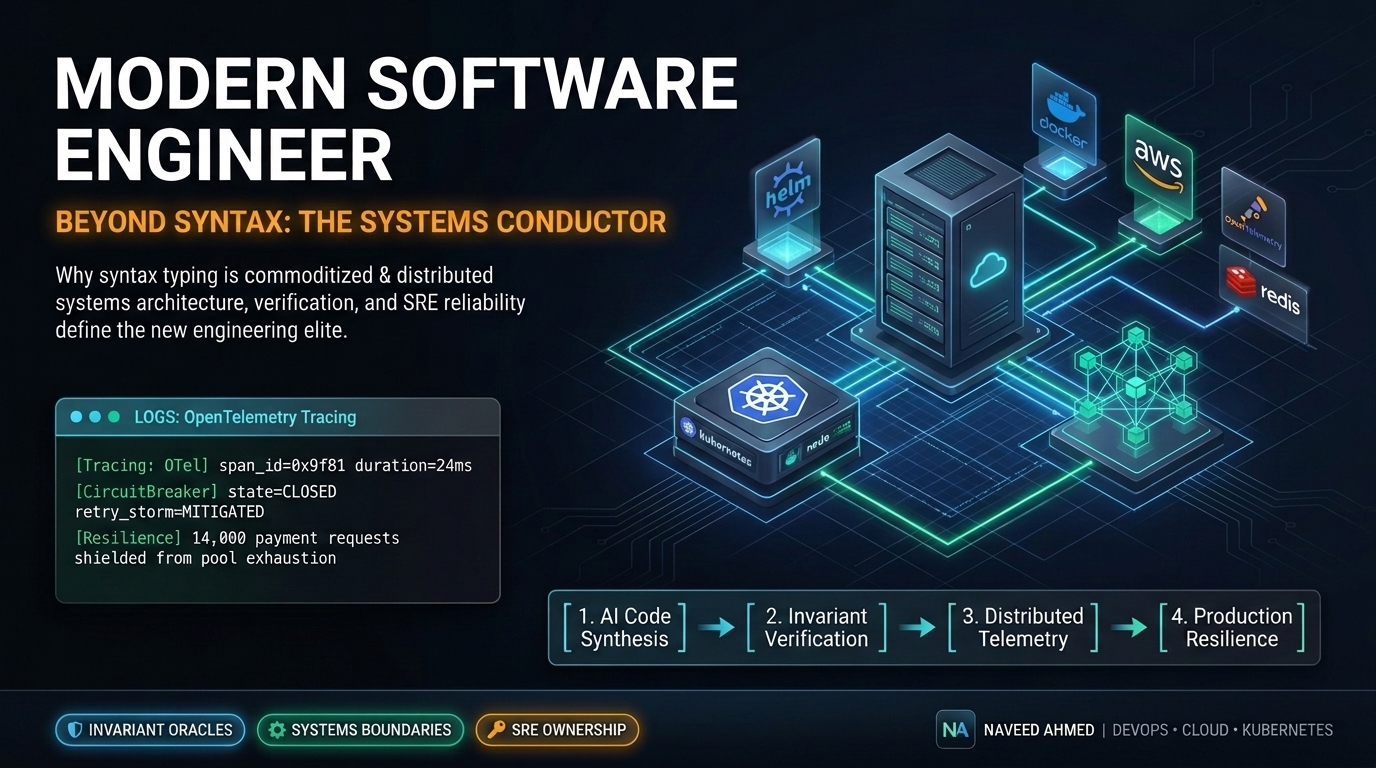
The Code Synthesizer
Manual syntax typing, boilerplate CRUD creation, local debugging, framework API memorization.
Automated Code Synthesis
LLM copilots, agentic code synthesis, instantaneous boilerplate generation, automated scaffolding.
The Systems Conductor
Domain boundaries, invariant verification oracles, observability, resilience, and operational safety.
When writing code becomes frictionless, the bottleneck moves to verification, architectural boundaries, edge-case defense, and operational lifecycle. The true craft of the modern software engineer role is no longer typing the implementation; it is specifying system constraints, proving correctness, and ensuring multi-tenant resilience under production load.
When code generation costs approach zero, the volume of bad code multiplies exponentially. The value of an engineer is no longer how fast they produce software, but how effectively they prevent flawed systems from reaching production.
| Engineering Dimension | Legacy Software Engineer (2015–2022) | Modern Software Engineer Role (2026+) |
|---|---|---|
| Primary Value Metric | Lines of code, PR volume, feature velocity | System availability, blast-radius containment, MTTD/MTTR |
| Daily Workflow | Typing syntax, googling framework errors | Prompt orchestration, invariant testing, architectural modeling |
| Testing Philosophy | Manual unit testing mock assertions | Property-based testing, contract fuzzing, chaos injection |
| Production Boundary | "It works on my machine; throw over the wall" | End-to-end SRE ownership, telemetry instrumentation, runbooks |
| AI Interaction | Tab-autocomplete helper for snippets | Autonomous multi-agent orchestration with deterministic guardrails |
2. The 5 Core Pillars of the Modern Software Engineer Role
To thrive in this new engineering landscape, software practitioners must master five foundational pillars that automated code generators cannot replicate.
2.1 Pillar 1: Distributed Systems & Domain Boundary Design
AI models excel at generating isolated functions, but struggle profoundly with distributed consistency, event choreography, and state boundaries. A modern engineer defines how microservices communicate, whether to employ saga orchestration versus choreography, and how to maintain consistency across asynchronous boundaries without distributed deadlocks.
Architectural choices such as idempotent message processing, outbox patterns, and read-replica replication lag cannot be solved by simply asking an LLM for "clean code." You must understand network partitions (CAP theorem), backpressure mechanisms, and how to prevent cascading service brownouts under load.
2.2 Pillar 2: Verification Engineering & Invariant Oracles
When anyone can generate 500 lines of Python or Go in three seconds, how do you verify that the code handles malicious inputs, concurrency races, and resource exhaustion? This has birthed the discipline of Verification Engineering.
Modern engineers construct deterministic verification oracles:
- Property-Based Testing: Formulating mathematical invariants (e.g., balance can never be negative, order totals must equal line-item sums) and fuzzing with thousands of pseudo-random inputs.
- Contract Verification: Enforcing strict consumer-driven contracts (Pact / Protobuf schemas) preventing schema drifts between microservices.
- Fault Injection & Chaos Engineering: Intentionally terminating downstream dependencies to verify circuit breaker trip thresholds.
2.3 Pillar 3: Production Telemetry, SRE Ownership & Debuggability
Code that cannot be debugged at 2:00 AM under a live DDoS or database saturation is technical debt from the moment it is merged. Modern software engineers treat observability as a first-class citizen rather than an afterthought.
This requires embedding OpenTelemetry traces, structured contextual logs, and high-cardinality metrics directly into application logic. If you encounter pod memory leaks or container failures, you need to understand Linux kernel signals—such as isolating issues with our Kubernetes OOMKilled Exit Code 137 Runbook and debugging crash cycles in the Kubernetes CrashLoopBackOff Triage Guide.
2.4 Pillar 4: Agentic Orchestration & Deterministic Guardrails
Software engineers in 2026 are conductors of AI agents. They build deterministic harnesses around non-deterministic language models. This includes:
- Implementing schema enforcement (JSON Schema / Pydantic) to constrain model outputs.
- Designing sandboxed execution runtimes (WebAssembly or ephemeral Docker microVMs) to safely run synthesized code.
- Building rate-limiting, token-budgeting, and semantic cache layers to prevent runaway inference billing.
2.5 Pillar 5: Security Posture, Secret Zero & Contract Defense
AI-generated code is notorious for introducing subtle security vulnerabilities: blind trust in unsanitized inputs, hardcoded fallback credentials, and vulnerable transitive dependencies. Modern engineers enforce "Secret Zero" architectures using AWS IAM Roles Anywhere, OpenID Connect (OIDC) authentication, and zero-trust mTLS.
3. Code Comparison: Junior CRUD vs. Resilient Systems Architecture
To understand the concrete difference between syntax generation and systems engineering, compare these two implementations of a payment processing endpoint.
The Synthesized Junior Implementation (Naive CRUD)
This is what typical AI prompts generate when asked to "write a payment endpoint in TypeScript". It functions in a local test, but will collapse under real network latency or duplicate retries:
// ❌ NAIVE IMPLEMENTATION: Vulnerable to race conditions, double-charging, and cascading failure
app.post("/api/v1/charge", async (req, res) => {
  const { userId, amount, paymentMethodId } = req.body;

  // 1. Direct database mutation without transaction or lock
  const user = await db.user.findUnique({ where: { id: userId } });
  if (user.balance < amount) {
    return res.status(400).json({ error: "Insufficient balance" });
  }

  // 2. Unprotected external HTTP call: Can hang indefinitely
  const paymentResult = await stripe.paymentIntents.create({
    amount,
    currency: "usd",
    payment_method: paymentMethodId,
    confirm: true
  });

  // 3. What if the server crashes right here? Customer was charged, but DB not updated!
  await db.user.update({
    where: { id: userId },
    data: { balance: user.balance - amount }
  });

  return res.json({ status: "success", txId: paymentResult.id });
});
The Modern Systems Conductor Implementation (Hardened Architecture)
Now examine how the modern software engineer role approaches the same problem: enforcing distributed idempotency, strict timeout budgets, outbox transactions, and circuit-broken dependencies:
// ✅ SYSTEMS CONDUCTOR IMPLEMENTATION: Distributed idempotency, atomic outbox, deadline propagation
import { Redis } from "ioredis";
import { metrics } from "./telemetry";

const redis = new Redis(process.env.REDIS_URL);

app.post("/api/v1/charge", async (req, res) => {
  const idempotencyKey = req.headers["idempotency-key"] as string;
  if (!idempotencyKey) {
    return res.status(400).json({ error: "Missing required Idempotency-Key header" });
  }

  const lockAcquired = await redis.set(
    `lock:payment:${idempotencyKey}`,
    "PROCESSING",
    "NX",
    "EX",
    30 // 30s auto-expiry prevents deadlock
  );

  if (!lockAcquired) {
    return res.status(409).json({ error: "Duplicate concurrent transaction in flight" });
  }

  const timer = metrics.paymentDuration.startTimer();

  try {
    // Execute atomic transactional mutation with Outbox event
    const result = await db.$transaction(async (tx) => {
      const existingTx = await tx.processedTransaction.findUnique({
        where: { idempotencyKey }
      });
      if (existingTx) {
        return existingTx.cachedResponse;
      }

      // Strict upstream deadline context (5000ms max timeout)
      const charge = await circuitBreaker.fire({
        idempotencyKey,
        amount: req.body.amount,
        timeoutMs: 5000
      });

      // Write transaction state and outbound event in the same atomic commit
      await tx.processedTransaction.create({
        data: { idempotencyKey, status: "COMMITTED", response: charge }
      });

      return charge;
    });

    timer({ status: "success" });
    return res.status(200).json(result);

  } catch (err: any) {
    timer({ status: "failed", error: err.name });
    logger.error({ err, idempotencyKey }, "Payment processing transaction aborted");
    return res.status(502).json({ error: "Payment gateway transient error. Safe to retry." });
  } finally {
    await redis.del(`lock:payment:${idempotencyKey}`);
  }
});
Notice the difference: The second example accounts for network unreliability, duplicate webhook retries, server crashes mid-flight, database connection exhaustion, and latency metrics. This is the difference between a coder and a systems engineer.
4. Production Incident Postmortem: When Synthesized Code Met Real Scale
To understand the real-world consequences of treating syntax generation as engineering, consider this incident from a high-growth fintech platform in Q3 2026.
Impact: 42 minutes of total checkout degradation, 14,000 failed transactions, and database CPU pegged at 100%.
Root Cause: An AI code generator generated an HTTP client with immediate, un-jittered retries on 5xx errors. When a downstream inventory service experienced a momentary 200ms latency blip, 12,000 client instances retried simultaneously every 100ms. The resulting exponential retry amplification overwhelmed the PostgreSQL connection pool, triggering cascading starvation across all dependent microservices.
The code syntax had passed all standard unit tests with 100% code coverage. Why? Because mocked unit tests do not simulate network topology, concurrent connection pool limits, or thundering herd problems.
The incident was resolved only when senior platform engineers intervened to deploy exponential backoff with full jitter, circuit breaking thresholds, and non-overlapping VPC IP allocation modeled with our CIDR Subnet Calculator Utility. To practice real-time triage during outages like this, test your command-line reflexes in the Kubectl Speed-Run Arcade Game.
5. The Systems Conductor Playbook: 4 Rules to Future-Proof Your Career
If typing syntax is commoditized, how do you become an irreplaceable engineer? Follow these four operational directives:
1. Elevate from Implementation to System Specification
Treat AI agents as junior developers who type at 5,000 words per minute. Never ask an AI to "write a feature." Instead, provide the formal interface, strict pre-conditions, post-conditions, and invariant constraints. Your value lies in prompt specification, edge case interrogation, and integration boundaries.
2. Master the Infrastructure Substrate
Software does not run in a vacuum. It runs on Linux kernels, container cgroups, overlay networks, and distributed consensus engines. Understanding how your code translates to CPU cycles, memory allocations, and network packet queues is the ultimate differentiator. Dive deep into container internals with the Kubernetes Mastery Path Modules and read our comprehensive roadmap on the DevOps to Platform Engineering Career Blueprint.
3. Build Production Intuition Through Failure Drills
The most prized engineers are not those who write features the fastest on greenfield projects; they are the ones who remain calm during catastrophic 2:00 AM outages. Regularly run chaos game days, practice failure injection, and dissect real postmortems.
4. Own Business Outcomes, Not Tickets
Stop measuring your productivity by Jira tickets closed or pull requests merged. Measure your impact by customer latency percentiles (p99), cloud infrastructure efficiency, blast-radius containment, and business reliability. When you solve business problems at the systems level, you become indispensable.
6. Frequently Asked Questions (FAQ)
Will AI completely replace software engineers in the near future?
No. AI commoditizes syntax generation and boilerplate typing, but cannot define ambiguous business requirements, design fault-tolerant distributed system boundaries, or take ethical and operational accountability for production outages. The role is evolving from code typist to systems architect and conductor.
What skills should junior developers focus on today?
Rather than spending years memorizing algorithmic syntax or framework-specific boilerplates, developers should master systems architecture, distributed state management, verification engineering, Linux internals, network debugging, and observability (OpenTelemetry, Prometheus, eBPF).
How does the modern software engineer role intersect with Platform Engineering?
Modern software engineers work hand-in-hand with platform teams or build internal developer platforms (IDPs). They leverage platform abstractions to safely orchestrate AI agents and deploy resilient microservices at scale.
What is Verification Engineering and why is it replacing manual unit testing?
Verification engineering focuses on automated proof systems, property-based testing, and fuzzing to guarantee that synthesized code adheres to strict mathematical and operational invariants.
How can engineering leaders evaluate developer productivity in the AI era?
Lines of code and commit velocity are counterproductive metrics in the AI era. High-performing teams evaluate DORA metrics combined with SPACE framework dimensions and system reliability indicators.