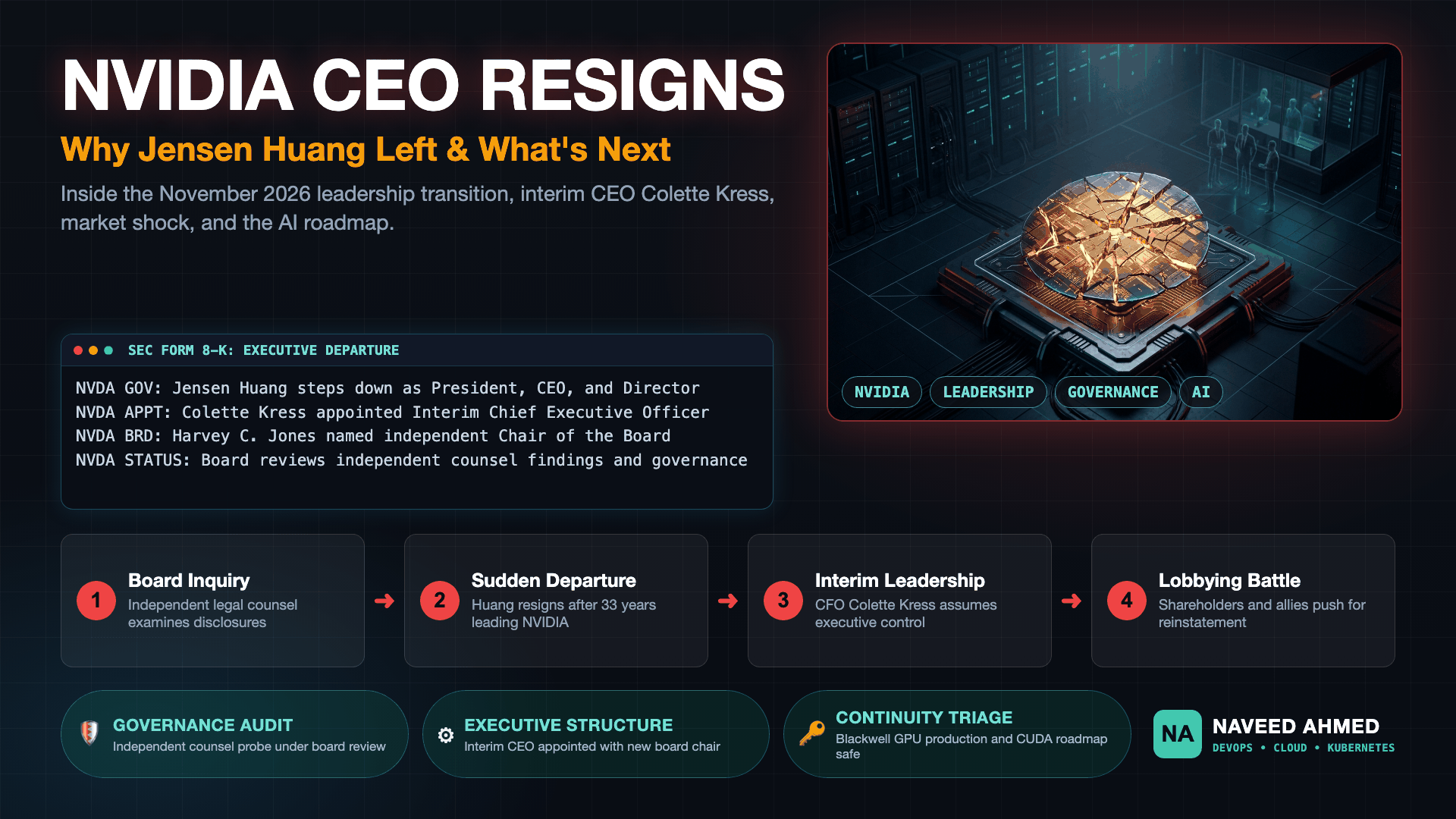
On November 12, 2026, the sudden nvidia ceo resign announcement confirmed that co-founder and Chief Executive Officer Jensen Huang stepped down as President, CEO, and director, effective November 11. Chief Financial Officer Colette Kress assumed immediate responsibilities as Interim CEO, while longtime director Harvey C. Jones became the company's first independent Board Chair. While Wall Street absorbed an immediate market capitalization contraction and industry leaders launched lobbying campaigns regarding a possible comeback, the timeline for a permanent successor and the conclusions of an independent board inquiry remain unresolved.
For cloud architects, DevOps engineers, and SREs managing multi-million-dollar accelerated computing clusters, this transition introduces operational questions. Similar to our infrastructure analysis during the Microsoft Azure global outage, enterprise engineering leaders must separate sensational headlines from operational facts. Below is an investigative analysis of the verified timeline, governance structure, financial impact, and enterprise roadmap continuity.
NVIDIA CEO Resignation — What Happened?
The formal NVIDIA CEO resignation was finalized on November 11, 2026, when the Board of Directors accepted Jensen Huang's departure from all executive and board positions. NVIDIA disclosed the transition publicly on November 12 via a Current Report on Form 8-K filed with the Securities and Exchange Commission, concluding Huang's 33-year tenure.
According to official regulatory filings, the transition took effect immediately upon board acceptance. Huang stepped down simultaneously as President, Chief Executive Officer, and member of the Board of Directors. The board acted to establish continuity by appointing internal leadership to run daily business functions while initiating an executive search for a permanent successor.
| Event Milestone | Date | Official Source | Operational Significance |
|---|---|---|---|
| Board Inquiry Commenced | October 2026 | Internal Board Disclosures | Independent counsel initiated review of undisclosed relationships and partner associations. |
| Resignation Accepted | November 11, 2026 | SEC Form 8-K (Item 5.02) | Jensen Huang formally concluded 33 years as President, CEO, and Director. |
| Public Announcement | November 12, 2026 | NVIDIA Investor Relations | Colette Kress named Interim CEO; Harvey C. Jones appointed independent Board Chair. |
| Market Reaction & Close | November 12, 2026 | Nasdaq Trading Data | Shares hit an intraday low of 14.35% before closing down 4.34% ($180B market cap loss). |
The 970+ Incident Handbook & K8s Runbooks are exclusive to subscribers — unlock for FREE
Get battle-tested production runbooks, AWS architecture blueprints, and zero-downtime CI/CD post-mortems sent directly to your inbox. 100% free, no spam.
Why Did Jensen Huang Resign?
Jensen Huang resigned following an independent board inquiry into personal conduct and undisclosed relationships involving company subordinates and an executive at a partner cloud firm. While Huang publicly acknowledged personal marital infidelity, the board acted to resolve compliance, governance, and national security questions raised by federal regulatory oversight.
Journalistic rigor requires separating official corporate disclosures from ongoing investigative reporting. In corporate statements, NVIDIA emphasized its commitment to governance standards, conflict-of-interest guidelines, and rigorous operational compliance. Huang released a public statement expressing regret over personal conduct and acknowledging unfaithfulness in his marriage.
Concurrently, reporting from major financial and investigative outlets documented that the board's special committee retained outside legal counsel to examine undisclosed relationships. Scrutiny centered on whether personal ties with an external cloud partner executive who was examined by federal authorities created undisclosed corporate risks. While third-party commentary cited Department of Justice antitrust inquiries as an intensifying backdrop, the documented legal trigger for the resignation was the board's internal conduct and compliance review, as summarized in the NVIDIA leadership transition news report.
Who Is NVIDIA's CEO Now?
Colette Kress serves as NVIDIA's Interim Chief Executive Officer, managing daily executive operations and foundry relationships while retaining her role as Chief Financial Officer. Longtime director Harvey C. Jones was appointed independent Chair of the Board, separating executive management from board governance during the global search for a permanent CEO.
Engineers and enterprise customers evaluating who is nvidia ceo now find reassurance in Kress's executive record. Serving as Executive Vice President and CFO since 2013, Kress managed NVIDIA's financial expansion through the graphics, crypto, enterprise data center, and generative AI waves. Her dual interim CEO and CFO appointment provides stability for TSMC wafer procurement, hyperscaler multi-year commitments, and capital allocation.
Simultaneously, the board appointed Harvey C. Jones as independent Chair of the Board. Jones, an electrical engineer and former CEO of Synopsys, has served on NVIDIA's board since its 1993 founding. This appointment represents the first time in NVIDIA's history that the roles of CEO and Chairman have been separated, providing independent governance oversight.
| Leadership Position | Current Executive | Tenure at NVIDIA | Core Responsibilities |
|---|---|---|---|
| Interim CEO & CFO | Colette Kress | 13+ Years (Joined 2013) | Daily executive execution, hyperscaler agreements, TSMC allocations, and financial reporting. |
| Independent Board Chair | Harvey C. Jones | 33 Years (Director since 1993) | Corporate governance, independent counsel oversight, and permanent CEO search. |
| Former President & CEO | Jensen Huang | 33 Years (Co-founder 1993) | Stepped down November 11, 2026; subject of ongoing shareholder reinstatement lobbying. |
Could Jensen Huang Return to NVIDIA?
While Jensen Huang has reportedly held discussions regarding a potential comeback, his return remains unconfirmed and legally constrained. Prominent institutional shareholders and tech executives have actively lobbied the board for his reinstatement, but any formal return depends on the conclusion of the independent board review and regulatory compliance clearance.
The question of whether jensen huang could return gained momentum within days of his exit. Major institutional investors, including Brad Gerstner of Altimeter Capital and Gavin Baker of Atreides Management, publicly urged NVIDIA's board to keep all options open, explicitly advocating for Huang's reinstatement. Concurrently, an online petition titled "Stand with Jensen" gathered over 150,000 signatures from semiconductor engineers and retail investors, while tech leaders including Elon Musk voiced public backing.
The search phrase jensen huang mount emerged across search engines during this period, reflecting reporting on the "mounting pressure" from allies and questions over whether Huang could "mount a comeback." Credible reporting indicates that Huang met privately with confidants to evaluate reinstatement conditions. However, corporate governance experts emphasize that unless the independent review clears all conflict-of-interest and national security exposure questions, a rapid return as CEO faces substantial regulatory hurdles.
| Succession Scenario | Status Classification | Prerequisites & Obstacles | Roadmap Implication |
|---|---|---|---|
| Reinstatement as CEO | Reported / Unconfirmed | Requires full clearance by independent probe and unanimous board consensus. | Maximum product cadence continuity; restores founder-led roadmap velocity. |
| Transition to Chief Architect | Speculative | Requires legal firewall separating operational HR/governance from silicon design. | Preserves Huang's technical vision while maintaining independent board oversight. |
| Permanent External Successor | Confirmed Process | Board succession committee evaluating internal and external semiconductor candidates. | Focus on operational institutionalization and enterprise supply chain execution. |
Who Is Jensen Huang's Wife, Lori Huang?
Jensen Huang's wife is Lori Huang, formerly Lori Mills, an electrical engineer and philanthropist who met Jensen in the early 1980s as undergraduate lab partners at Oregon State University. Married in 1985 before NVIDIA's founding, she serves as president of the Jen-Hsun and Lori Huang Foundation, funding major educational and supercomputing initiatives.
Biographical records from Oregon State University document that Lori Mills and Jensen Huang met in an electrical engineering fundamentals laboratory class in Corvallis, Oregon. Paired as laboratory partners, their collegiate collaboration grew into a lifelong partnership. Lori earned her Bachelor of Science in Electrical Engineering from Oregon State in 1985, the same year the couple married.
Throughout NVIDIA's rise, Lori Huang maintained an active philanthropic and administrative role. As president of the Jen-Hsun & Lori Huang Foundation, she directed philanthropic investments, including a landmark $50 million gift to Oregon State University to establish the Jen-Hsun and Lori Mills Huang Collaborative Innovation Complex, a high-performance supercomputing research hub. The couple also funded the Jen-Hsun Huang School of Engineering Center at Stanford University. Furthermore, public filings indicate that Lori Huang serves as co-trustee of the family trusts holding the couple's NVIDIA equity shares.
Jensen Huang Net Worth and NVIDIA CEO Compensation
Jensen Huang's net worth is estimated between 130 billion and 145 billion dollars, derived primarily from his direct ownership of approximately 86 million NVIDIA shares. According to official SEC Schedule 14A proxy disclosures, Huang received a base salary of 1.5 million dollars in fiscal 2026, with total reported annual compensation of 34.3 million dollars.
Financial clarity requires distinguishing executive salary, annual compensation packages, and equity-based personal net worth. The search keyword nvidia ceo salary points to a base cash wage that is modest relative to tech peers. In fiscal year 2026, Huang received $1.5 million in base salary. His total executive package was valued at $34.3 million, consisting of $24.8 million in performance-tied stock awards, $4.2 million in non-equity incentive plan compensation, and roughly $3.8 million for security, personal protection, and private aviation.
In contrast, jensen huang net worth reflects direct equity ownership. Holding approximately 3.5% to 3.6% of NVIDIA's outstanding common stock across personal accounts and family trusts, Huang's wealth expanded rapidly as NVIDIA surpassed a $3 trillion market valuation. While the post-resignation stock contraction trimmed several billion dollars in paper equity, Huang remains one of the ten wealthiest individuals in the global technology sector.
| Compensation Category | FY2025 Reported | FY2026 Reported | Governance Purpose |
|---|---|---|---|
| Base Salary | $1,300,000 | $1,500,000 | Fixed executive cash compensation. |
| Stock Awards (Equity) | $38,800,000 | $24,800,000 | Long-term equity alignment with shareholder performance metrics. |
| Non-Equity Incentive Plan | $5,200,000 | $4,200,000 | Performance bonus tied to datacenter revenue and operating margins. |
| Security, Travel & Other | $4,500,000 | $3,800,000 | Board-mandated residential security, travel protection, and secure transport. |
| Total SEC Compensation | $49,800,000 | $34,300,000 | Total reported executive compensation package. |
NVIDIA Stock Reaction Following the Resignation
Following the resignation announcement on November 12, 2026, NVIDIA shares fell up to 14.35 percent intraday before closing down 4.34 percent at the end of regular trading. The single-day market decline wiped out approximately 180 billion dollars in market capitalization, pulling NVIDIA's valuation temporarily below the four trillion dollar threshold.
Market analysts differentiate between volatile intraday trading and established closing numbers. Upon market open on November 12, panic selling pushed NVDA shares down to an intraday low near $148.80, reflecting uncertainty over leadership continuity. As institutional buyers absorbed the selloff and evaluated Colette Kress's interim appointment, shares recovered from their lows to close down 4.34%.
Factoring in the preceding weeks of rumors and executive scrutiny, NVIDIA stock experienced a cumulative pullback of roughly 30 percent from its historical peak. However, market analysts observed that institutional investors stabilized prices once it became evident that physical silicon wafer shipments and Blackwell production schedules remained intact.
Jensen Huang's Career and Role in NVIDIA's Growth
Jensen Huang's career began in microprocessor logic design at AMD and custom ASIC engineering at LSI Logic before co-founding NVIDIA at a San Jose diner in 1993. Over 33 years, Huang guided NVIDIA through programmable shaders, the CUDA parallel computing revolution, and the modern AI supercomputing era.
Huang was born in Tainan, Taiwan, emigrated to the United States as a child, and worked as a dishwasher at Denny's during high school. He graduated with a bachelor's degree in electrical engineering from Oregon State University in 1984, immediately joining Advanced Micro Devices (AMD) to design microprocessors. In 1985, he joined LSI Logic, rising to Director of CoreWare while completing his master's degree in electrical engineering at Stanford University in 1992.
In April 1993, Huang met engineers Chris Malachowsky and Curtis Priem over coffee at a Denny's in San Jose, co-founding NVIDIA with $40,000 in capital. Huang's defining leadership gamble occurred in 2006 with the release of CUDA (Compute Unified Device Architecture). By requiring every NVIDIA GPU to include parallel computing silicon at a significant margin cost, Huang laid the hardware foundation that enabled modern generative AI foundation models.
What Does This Mean for NVIDIA's AI Future?
NVIDIA's short-term AI roadmap remains protected by multi-year TSMC foundry contracts and extensive CUDA software integration, ensuring that Blackwell GPU shipments and cluster deployments proceed on schedule. However, long-term strategic execution requires monitoring architectural transitions to the Rubin generation, enterprise software pricing, and hyperscaler supplier diversification.
Enterprise infrastructure teams must separate immediate governance noise from physical silicon production. NVIDIA's core technology moats remain intact across three key layers:
- Foundry Allocations (TSMC CoWoS Packaging): Wafer allocations for Blackwell GB200 systems are secured via multi-year binding agreements with TSMC. Executive departures do not disrupt fab scheduling.
- CUDA Software Moat: Thousands of internal software engineers maintain CUDA libraries (cuDNN, TensorRT, NCCL). Software dependencies across PyTorch and enterprise inference stacks remain stable.
- System Interconnects: NVLink interconnects and InfiniBand networking hardware provide architectural performance advantages that competitors require years to replicate.
However, long-term risks center on strategic vision. Huang drove rapid one-year silicon cadences and ambitious software acquisitions. Whether interim or permanent successors can sustain this aggressive product tempo remains an important question for technology planners.
Lessons for DevOps and AI Infrastructure Teams
The executive transition at NVIDIA underscores the necessity of managing hardware vendor concentration risk, decoupling software training pipelines from proprietary GPU runtimes, and verifying cluster firmware integrity. DevOps and SRE teams must implement multi-accelerator abstractions and establish transparent procurement agreements.
Infrastructure leaders managing GPU footprints should apply specific operational safeguards:
| Infrastructure Risk Vector | Risk Level | Recommended Engineering Safeguard |
|---|---|---|
| Hardware Allocation Slippage | Low | Maintain binding Service Level Agreements (SLAs) with cloud hyperscalers for reserved Blackwell instances. |
| Proprietary CUDA Lock-In | Medium | Adopt intermediate compilation frameworks such as Triton and OpenXLA to preserve workload portability. |
| Supply Chain Pricing Volatility | Medium | Benchmark secondary accelerators (AMD Instinct, custom cloud ASICs) for non-critical training and batch inference. |
| Firmware & Cluster Governance | Low | Implement cryptographic firmware validation and automated health checking during GPU node provisioning. |
Addressing these risks connects directly with our analysis of modern engineering paradigms and navigating AI infrastructure career shifts, where platform resilience requires decoupling architectures from single-vendor dependencies.
What Happens Next for NVIDIA?
NVIDIA's Board of Directors has initiated a formal executive search process to select a permanent Chief Executive Officer, while Interim CEO Colette Kress prepares upcoming quarterly earnings disclosures. Upcoming shareholder meetings and regulatory filings will reveal whether governance inquiries produce further board changes or clarify leadership succession.
Key indicators to monitor over the coming months include:
- Succession Committee Updates: The board's formal timeline for interviewing internal candidates, including Colette Kress, versus external semiconductor chief executives.
- Quarterly Earnings & Guidance: Executive commentary during NVIDIA's upcoming quarterly investor conference calls regarding datacenter demand and Blackwell margin stability.
- Status of Board Inquiries: Formal conclusion and public summary of the independent review regarding personal conduct and partner disclosures.
- Shareholder Activism: Whether major institutional investors mount formal proxy motions regarding Huang's ongoing advisory or technical role.
Final Thoughts
The departure of Jensen Huang closes a foundational era in semiconductor history, transitioning NVIDIA from a founder-led pioneer into an institutionalized computing enterprise. While near-term market volatility and comeback speculation dominate headlines, NVIDIA's silicon manufacturing commitments and CUDA developer moats ensure operational continuity for enterprise AI infrastructure.
For technology leaders and engineering teams, the critical takeaway is pragmatic risk management. Monitoring board governance and leadership succession is essential, but building workload portability, enforcing rigorous firmware validation, and maintaining vendor-neutral platform abstractions remain the most effective strategies for long-term cloud stability.
Frequently Asked Questions
Direct answers to frequent engineering questions regarding AI coding agent disruptions, entry-level career outlooks, computer science degree value, and the changing landscape of software development roles in production environments.
Why did Jensen Huang resign as NVIDIA CEO?
Jensen Huang stepped down after an independent board inquiry examined undisclosed personal relationships involving subordinates and an external cloud partner executive. While Huang acknowledged personal marital infidelity, conflict-of-interest policies and federal regulatory scrutiny prompted the board to accept his resignation on November 11, 2026.
Who is NVIDIA's CEO now?
NVIDIA Chief Financial Officer Colette Kress is serving as Interim Chief Executive Officer, managing daily operations, TSMC manufacturing allocations, and financial strategy while continuing her CFO responsibilities. Longtime director Harvey C. Jones was appointed the company's first independent Board Chair to oversee the permanent executive search.
Who is Jensen Huang's wife, Lori Huang?
Jensen Huang's wife is Lori Huang, formerly Lori Mills, an electrical engineer who met Jensen in the early 1980s when they were paired as lab partners at Oregon State University. Married in 1985, she serves as president of the Jen-Hsun and Lori Huang Foundation, supporting education and supercomputing research.
Where did Jensen Huang meet Lori Huang?
Jensen Huang and Lori Mills met in an electrical engineering fundamentals laboratory class as undergraduate students at Oregon State University in Corvallis, Oregon. Both completed engineering degrees at the university before marrying in 1985, eight years before Jensen co-founded NVIDIA in 1993.
What is Jensen Huang's net worth?
Jensen Huang's net worth is estimated between 130 billion and 145 billion dollars, derived primarily from his direct ownership of approximately 86 million NVIDIA shares, representing 3.5 to 3.6 percent of common equity held across personal accounts and family trusts.
How much does NVIDIA's CEO earn in annual salary?
According to official SEC Schedule 14A proxy disclosures, Jensen Huang received a base cash salary of 1.5 million dollars in fiscal year 2026. His total reported executive compensation package was 34.3 million dollars, largely structured as performance-contingent stock awards and security allowances.
Could Jensen Huang return to NVIDIA as CEO?
While tech leaders including Elon Musk and major shareholders have lobbied NVIDIA's board to reinstate Huang, and reports confirm private comeback discussions, his return remains unconfirmed. Any formal reinstatement depends on the board concluding its independent legal review and clearing compliance standards.
How could the leadership change affect NVIDIA's AI strategy?
Physical manufacturing allocations for Blackwell GB200 systems are secured through multi-year foundry contracts with TSMC, and core CUDA runtime development continues uninterrupted. However, infrastructure leaders must monitor long-term roadmap pacing for next-generation Rubin chips, enterprise pricing adjustments, and hyperscaler supplier diversity.