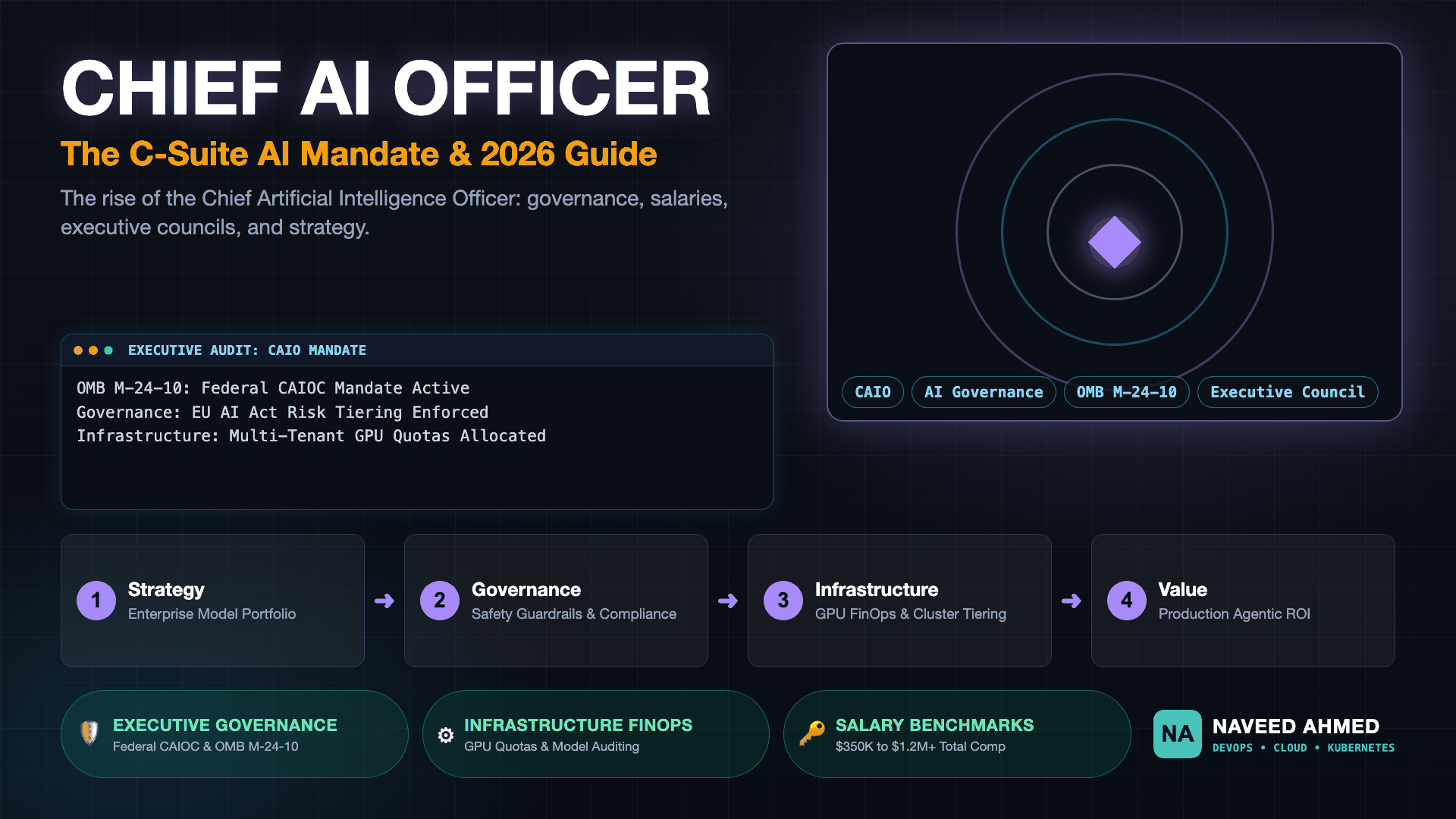
Across enterprise boardrooms, corporate leadership is undergoing its most significant structural evolution since the creation of the Chief Information Security Officer role two decades ago. The appointment of a dedicated chief artificial intelligence officer has moved from a speculative corporate experiment to a boardroom imperative. As enterprises transition from informal generative AI proofs-of-concept to mission-critical autonomous agents, organizations face multi-million-dollar GPU infrastructure commitments, non-deterministic operational risks, and aggressive international regulatory scrutiny. Without centralized C-suite ownership, enterprise AI initiatives fracture into redundant departmental experiments, shadow SaaS spend, and catastrophic data governance liabilities.
In this technical and strategic analysis, we examine why the CAIO role is dominating leadership discussions, dissect federal mandates like OMB Memorandum M-24-10, map the organizational boundaries between the CAIO and the CTO, analyze executive compensation benchmarks, and provide a concrete architectural blueprint for operationalizing the role.
What Is a Chief Artificial Intelligence Officer and Why Is It Trending?
Answer Capsule: A Chief AI Officer is an executive leader responsible for aligning enterprise AI initiatives with corporate strategy, ethical safety, regulatory mandates, and financial ROI. The position is trending because organizations must centralize governance over expensive GPU infrastructure, mitigate generative model hallucinations, comply with legal frameworks, and convert AI experiments into defensible commercial revenue.
To understand the current surge in executive recruiting, we must unpack the question: what is a Chief AI Officer? Unlike traditional engineering leaders who oversee deterministic software lifecycles, the CAIO manages probabilistic systems. Large language models and diffusion systems do not behave like transactional relational databases; they exhibit hallucinations, context degradation, and non-deterministic execution paths that require entirely new risk management paradigms.
When leadership teams establish an official Office of the CAIO, they establish a single point of accountability for model acquisition, fine-tuning infrastructure, data privacy, and ethical alignment. The role is trending across both commercial enterprises and public sector institutions for three structural reasons:
- Infrastructure Capital Intensity: Training and serving enterprise models requires astronomical capital expenditure. Without centralized executive oversight, engineering teams duplicate GPU clusters, mismanage token rate limits, and burn cloud budgets without clear unit economics.
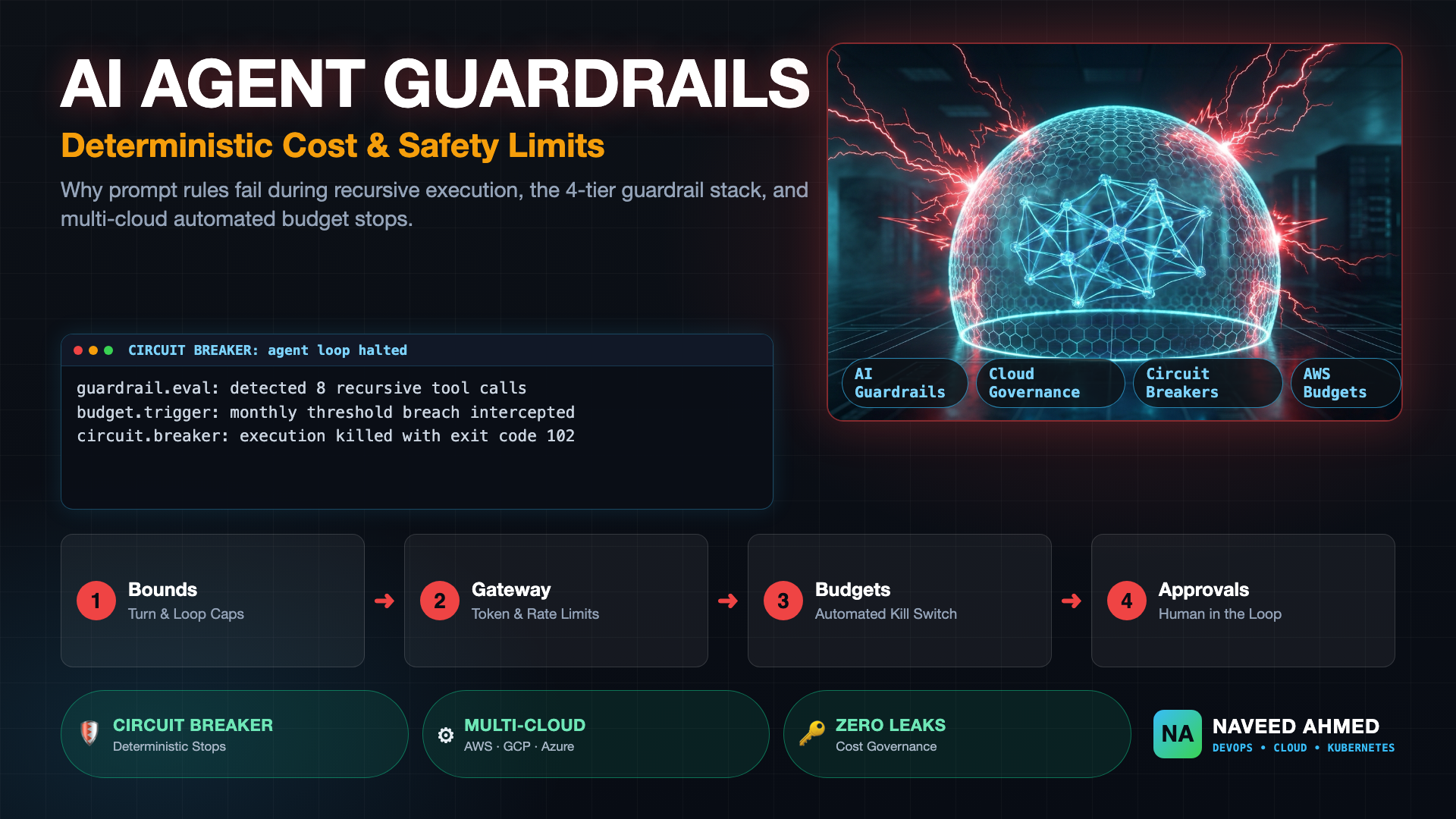
- Algorithmic and Reputational Risk: Deploying customer-facing AI agents without deterministic guardrails exposes enterprises to brand destruction, automated hallucination lawsuits, and intellectual property leakage. As we explored in our deep-dive on AI agent guardrails and runtime circuit breakers, models need rigorous external boundaries to prevent catastrophic failure modes.
- The Boardroom Translation Gap: Board members and audit committees frequently lack the technical vocabulary to evaluate transformer architectures, while machine learning researchers struggle to articulate quarterly revenue impact. The CAIO serves as the translator between statistical loss curves and financial shareholder value.
A common question in executive search is whether the correct title is ciao or caio. While some casual observers accidentally type "ciao" (confusing the Italian greeting with corporate acronyms), the recognized global standard is CAIO (Chief AI Officer). Using CAIO avoids confusion with the Chief Information Officer (CIO) and Chief Information Security Officer (CISO).
The 970+ Incident Handbook & K8s Runbooks are exclusive to subscribers — unlock for FREE
Get battle-tested production runbooks, AWS architecture blueprints, and zero-downtime CI/CD post-mortems sent directly to your inbox. 100% free, no spam.
The Regulatory Catalyst: Federal Mandates, OMB M-24-10, and the CAIOC
Answer Capsule: Executive AI appointments accelerated after the White House issued OMB Memorandum M-24-10, directing every federal agency to designate an official CAIO. The memorandum established the federal Chief AI Officer Council (CAIOC) to coordinate statutory standards for algorithmic safety, procurement transparency, and annual compliance reporting across government infrastructure.
The regulatory landscape reached a turning point when the United States federal government recognized that uncoordinated machine learning adoption threatened citizen civil rights and national security. Under OMB Memorandum M-24-10, federal agencies were legally mandated to appoint a qualified senior executive to govern artificial intelligence across their agency portfolios.
This mandate created the interagency chief artificial intelligence officer council (widely known as the CAIOC). The council convenes executive leaders, including the DOE Chief AI Officer at the Department of Energy and the NASA Chief AI Officer, alongside the Department of Justice, to establish standardized safety benchmarks, interoperability protocols, and public algorithmic inventories.
Commercial enterprises in healthcare, defense, and finance rapidly mirrored this structure. With the enforcement of the European Union AI Act, global organizations operating cross-border services face statutory fines up to 35 million euros or 7% of annual worldwide turnover for uncertified high-risk AI deployments. Boardrooms quickly recognized that delegating compliance to part-time committee members was a catastrophic legal liability. The CAIO role transformed from an optional innovation title into an indispensable regulatory shield.
Executive Turf Wars: Chief AI Officer vs CTO vs CDAO
Answer Capsule: The Chief AI Officer differs fundamentally from the CTO and CDAO in operational focus. While a CTO manages software engineering, core platforms, and delivery pipelines, a CAIO focuses on non-deterministic model architectures, training data lineage, and safety evaluation. Organizations frequently merge data with modeling under a Chief Data and Artificial Intelligence Officer (CDAO) to streamline infrastructure spend.
As organizations create this seat, executive friction inevitably emerges. Who owns the AI budget? Does the machine learning engineering group report to the Chief Technology Officer or the Chief AI Officer? When comparing chief ai officer vs cto, the division of labor must be clearly established in the corporate charter:
| Executive Role | Primary Operational Focus | Core Architectural Domain | Primary North Star Metric |
|---|---|---|---|
| Chief AI Officer (CAIO) | Model portfolio, AI safety, LLM fine-tuning, ethical governance | Vector databases, transformer pipelines, evaluation harnesses | Task accuracy, unit inference cost, compliance posture |
| Chief Technology Officer (CTO) | Product engineering, application stability, platform delivery | Microservices, CI/CD, Kubernetes clusters, public cloud infra | Deployment frequency, mean time to recovery (MTTR), uptime |
| Chief Data & AI Officer (CDAO) | Unified data fabric, warehouse governance, model inputs | Data lakes (Snowflake, Databricks), feature stores, ETL/ELT | Data freshness, schema fidelity, pipeline latency |
| Chief Information Officer (CIO) | Internal enterprise IT, vendor licensing, employee productivity | Identity management (Okta), SaaS tooling, corporate network | IT spend efficiency, service desk SLA, employee satisfaction |
In mid-sized organizations, splitting these titles leads to bureaucratic gridlock. Consequently, many forward-thinking enterprises appoint a unified chief digital and artificial intelligence officer or a combined chief data and artificial intelligence officer (frequently abbreviated as chief digital and artificial intelligence officer cdao). In technical-first organizations where infrastructure is deeply intertwined with model serving, you also find the chief technology and artificial intelligence officer title emerging.
Lessons from Corporate Precedents: UBS, Novo Nordisk, and GM
The practical realities of this role are visible in Fortune 500 corporate case studies. Swiss financial services giant UBS appointed a dedicated chief artificial intelligence officer ubs to oversee algorithmic portfolio risk, automated fraud surveillance, and strict compliance with global banking capital requirements. In healthcare, the novo nordisk chief artificial intelligence officer spearheads generative molecular modeling and clinical trial acceleration, reducing drug discovery timelines by orders of magnitude.
However, the executive dynamics can be volatile. High-profile headlines such as when gm's chief artificial intelligence officer unexpectedly leaves the company highlight the friction that occurs when leadership expectations diverge. When an organization hires a CAIO without giving them direct engineering resources, or when the CTO treats the CAIO as an advisory figure rather than an operational executive with budget authority, executive churn is inevitable.
What Is the Primary Role and Job Description of a CAIO?
Answer Capsule: The primary role of the CAIO is translating raw machine learning capabilities into sustainable business advantage while enforcing security, compliance, and infrastructure efficiency. Key responsibilities include model lifecycle governance, GPU FinOps optimization, evaluation benchmarking, and establishing deterministic runtime guardrails across enterprise products.
In professional examinations and boardroom audits, engineers often ask: which of the following is the primary role of the chief artificial intelligence officer? The answer is not writing custom PyTorch algorithms or training foundational models from scratch. Rather, the primary role is cross-functional orchestration: ensuring models are reliable, cost-effective, auditable, and aligned with enterprise revenue goals.
Similarly, when assessing what is a key focus area for the chief artificial intelligence officer caio ), executives isolate four strategic pillars that define the comprehensive chief ai officer job description (or enterprise CAIO job description):
1. Model Lifecycle Governance and Evaluation
The office of the CAIO establishes an internal Model Evaluation Board. Rather than allowing developers to blindly connect proprietary customer data to third-party proprietary APIs, the CAIO standardizes model selection criteria. They evaluate open-weights alternatives using self-hosted local LLM architectures against commercial proprietary APIs, benchmarking accuracy, latency, and operational cost.
2. GPU FinOps and Resource Optimization
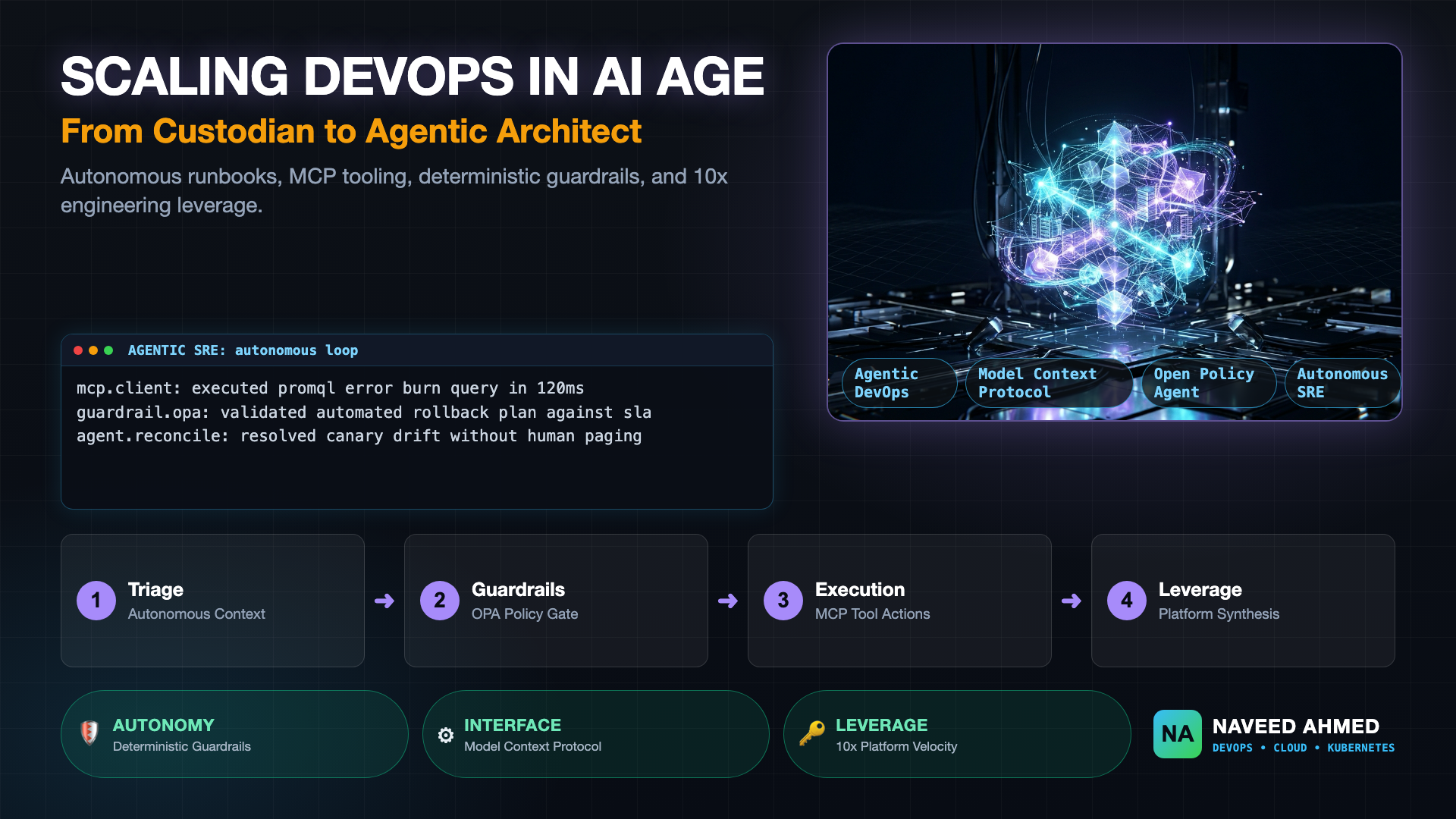
Training and inference costs scale exponentially if left unmanaged. A central responsibility of the modern CAIO is enforcing GPU FinOps. They establish multi-tenant GPU allocation clusters, implement dynamic model quantization (such as AWQ and GGUF), and mandate automated idle instance reclamation across cloud provider fleets. For insights on managing infrastructure during rapid organizational scaling, review our guide on scaling DevOps in the age of AI.
3. Data Provenance and Synthetic Data Integrity
Models are only as defensible as the datasets used to train them. The CAIO oversees data curation pipelines, verifying that training corpora are free from copyright violations, toxic biases, and poisoned samples. They design secure synthetic data generation environments to fine-tune specialized models without exposing confidential customer transactions.
4. Autonomous Agent Security and Guardrails
As enterprises adopt agentic workflows for software delivery and IT operations, models gain the ability to invoke tools and run shell commands. The CAIO collaborates with cybersecurity teams to enforce strict sandboxing, prevent recursive execution loops, and require cryptographic human authorization before an agent can mutate production state.
Compensation Realities: Chief AI Officer Salary Benchmarks
Answer Capsule: Chief AI Officer salary packages typically range from $350,000 to over $1,200,000 in total annual compensation. Early-stage AI startups offer competitive base salaries with heavy equity upside, while Fortune 100 enterprises and Wall Street investment firms provide multimillion-dollar packages combining base, cash performance bonuses, and restricted stock units.
Because the talent pool combining deep mathematical machine learning credentials with public company executive governance is exceptionally small, compensation for chief artificial intelligence officer salary bands reflects extreme market demand. According to verified executive recruiting data across technology and financial sectors in 2026, compensation breaks down into distinct tiers:
- Early-Stage High-Growth Startups (Series A–B): Base salaries average $275,000 to $350,000, complemented by 1.5% to 3.5% in company equity vesting over four years. In these roles, the CAIO is often expected to be hands-on with model architecture and developer recruiting.
- Mid-Market and Growth Enterprises: Base salaries range between $350,000 and $475,000, with annual cash bonuses between 30% and 50%, alongside equity grants totaling $300,000 to $500,000 annually.
- Fortune 100 and Global Financial Institutions: Total compensation frequently eclipses $1,200,000 to $2,500,000+. At this tier, base pay ($500,000+) is dwarfed by multi-year performance share units (PSUs) tied to successful enterprise-wide digital transformation and regulatory audit compliance.
Demand for chief artificial intelligence officer jobs has surged across defense contractors, healthcare networks, pharmaceutical developers, and retail conglomerates, making it one of the fastest-growing executive titles in North America and Europe.
How to Become a CAIO: Education, Programs, and Certifications
Answer Capsule: To become a CAIO, senior engineering and product leaders combine strong technical foundations in computer science or machine learning with executive business acumen. Many credential themselves through specialized university programs like Duke or MIT, complemented by real-world leadership in deploying production AI systems and managing regulatory compliance.
Aspiring engineering directors and architects searching for chief ai officer how to become must recognize that technical depth alone is insufficient. You cannot code your way to a C-suite appointment; you must demonstrate enterprise risk management, board-level communication, and strategic budget governance.
The academic and executive education sector has responded rapidly to this demand by launching specialized executive credentials:
Executive University Programs: The Duke Benchmark
Among the most widely recognized executive offerings is the duke chief artificial intelligence officer caio program (also known as the Duke executive CAIO track). Offered through Duke University's Pratt School of Engineering and Fuqua School of Business, this executive curriculum trains senior leaders in AI governance, model evaluation frameworks, and enterprise scaling.
When prospective applicants evaluate Duke CAIO program tuition costs, tuition typically ranges from $12,000 to $16,000 depending on the cohort and executive delivery format. These programs provide an accelerated curriculum covering model risk governance, enterprise architecture, and boardroom communication.
Certifications and Structured Learning Paths
Beyond university executive tracks, industry certifications have gained traction among technology leaders:
- Certified Executive Credentials: Organizations like the International Council for Executive AI Leadership offer specialized chief artificial intelligence officer certification programs (frequently titled certified CAIO) focusing on algorithmic auditing, EU AI Act compliance, and corporate risk frameworks.
- Free Learning Paths and Self-Directed Study: For engineers exploring chief ai officer certification free alternatives, foundational knowledge can be developed by combining the White House CAIOC guidelines, the NIST AI Risk Management Framework (RMF 1.0), and open-source model evaluation tools like EleutherAI's LM-Evaluation-Harness. Hands-on practitioners often study production scenario breakdowns like those in our DevOps & SRE Interview Hub to master infrastructure edge cases.
Reviewing the global chief artificial intelligence officer list reveals that the most effective leaders share a common trajectory: they built production systems as principal engineers or researchers, transitioned into engineering directors managing distributed cloud footprints, and subsequently led business unit digital transformations.
Enterprise Implementation Checklist: The CAIO 90-Day Playbook
Answer Capsule: A successful CAIO 90-day playbook starts with a comprehensive audit of shadow AI tools and API billing during the first 30 days. The next 30 days focus on establishing deterministic guardrails and GPU cluster quotas, while days 60 through 90 operationalize production agentic workflows backed by provable financial ROI.
When stepping into the CAIO role, leadership must demonstrate immediate operational value while establishing long-term safety boundaries. Here is the field-tested 90-day roadmap:
Audit all unauthorized third-party LLM endpoints across corporate networks. Identify developer teams pasting proprietary code into unvetted cloud models. Inventory all active GPU reservations in AWS, Azure, and GCP to eliminate orphan instances and establish baseline spend.
Publish the Enterprise AI Acceptable Use Policy. Deploy centralized API gateways that automatically strip personally identifiable information (PII) before requests hit external inference endpoints. Introduce programmatic token quotas and circuit breakers to prevent runaway loops, adopting disciplined practices from spec-driven software development.
Select two high-impact internal use cases (such as automated customer support tiering or internal developer documentation retrieval). Partner with product engineering to ship these models into production with end-to-end evaluation dashboards, demonstrating measurable labor efficiency and positive unit economics to the board.
Key Takeaways for Future Technology Leaders
The appointment of a dedicated CAIO is not a temporary marketing fad; it is a permanent structural adaptation to probabilistic computing. As foundational models become pervasive enterprise utilities, organizations that treat AI governance as an ad-hoc side project will suffer from spiraling infrastructure bills, regulatory penalties, and organizational paralysis.
For engineering directors, cloud architects, and aspiring executives, the path forward is clear: master the statistical underpinnings of machine learning, understand the distributed infrastructure required to serve high-throughput models, and cultivate the boardroom financial rigor necessary to govern the future of intelligent enterprise systems.
Frequently Asked Questions
What is the correct acronym: ciao or caio?
The industry-standard acronym is CAIO (Chief Artificial Intelligence Officer). While some colloquially write ciao or caio, CAIO prevents confusion with the Chief Information Officer (CIO) or Chief Information Security Officer (CISO).
How does a Chief AI Officer differ from a CTO?
A CTO governs core engineering, platform reliability, software delivery pipelines, and cloud infrastructure. A Chief AI Officer oversees non-deterministic models, training data provenance, algorithmic risk guardrails, FinOps GPU allocations, and regulatory compliance like the EU AI Act.
What is the typical Chief AI Officer salary?
In 2026, a Chief Artificial Intelligence Officer salary ranges from $350,000 to over $1,200,000 in total compensation. Enterprise compensation packages include significant equity grants and performance incentives tied to successful model deployment and ROI.
How can an engineering leader become a Chief AI Officer?
To become a CAIO, senior engineers progress from machine learning engineering or cloud architecture into executive leadership. Many augment hands-on systems experience with executive education like the Duke Chief Artificial Intelligence Officer CAIO Program, AI governance certifications, and demonstrated P&L impact.
Why was the Chief AI Officer Council established?
The Chief Artificial Intelligence Officer Council (CAIOC) was established under White House OMB Memorandum M-24-10. It coordinates federal AI policy, mandates ethical risk evaluations across agencies, and sets statutory governance benchmarks that commercial enterprises now adopt.