Autonomous AI agents equipped with CLI access, cloud credentials, and automated tool-calling capabilities represent a massive leap in engineering velocity. However, deploying agentic workflows without deterministic ai agent guardrails is an operational disaster waiting to happen. When an LLM-driven agent enters a recursive debugging or deployment loop, soft system prompts like "please keep cloud bills low" invariably fail under context window dilution. Without hard, external boundaries, an autonomous agent will happily execute repetitive cloud API calls—such as batch cache purges, compute provisioning, or recursive tool iterations—until your cloud billing threshold explodes.
In this technical guide, we examine why prompt-based safeguards fail during recursive execution, establish an enterprise ai agent guardrails framework, walk through concrete ai guardrails examples across AWS, GCP, and Azure, and provide runnable Python circuit breakers designed to stop runaway agent loops cold.
What Are AI Guardrails Primarily Used For in Autonomous Systems?
Answer Capsule: AI guardrails in autonomous agent architectures are deterministic, programmatic control layers that monitor, intercept, and restrict an agent's reasoning and execution cycles. Unlike conversational safety filters, agentic guardrails enforce execution iteration caps, API rate limits, least-privilege cloud IAM boundaries, and hard financial budget stops to prevent unconstrained resource consumption and unauthorized infrastructure mutations.
To understand what is guardrails in modern software engineering, we must distinguish between traditional LLM text generation and autonomous agent execution. In standard conversational applications, guardrails in llm implementations primarily focus on content safety: preventing prompt injection, masking personally identifiable information (PII), and filtering toxic responses. Tools like local LLM inference engines and open-source moderation libraries serve this role well.
However, when an LLM is given shell execution rights or cloud SDK access (such as in Antigravity, Claude Code, AutoGPT, or LangGraph), the risk profile shifts from textual toxicity to catastrophic operational failure. In an agentic environment, what are ai guardrails primarily used for?
- Halting Runaway Execution Loops: Intercepting recursive logic where an agent repeatedly retries a failing command or re-executes redundant deployment scripts.
- Enforcing Strict Financial Governance: Translating organization-level cloud budgets into programmatic hard stops that cut off API keys or revoke IAM tokens before billing spikes occur.
- Preventing Unintended Infrastructure Destruction: Blocking destructive CLI commands (such as
rm -rf,kubectl delete ns, or dropping database tables) without cryptographic human approval. - Mitigating Tool-Call Drift: Ensuring that tool arguments conform strictly to Pydantic schemas and authorized parameter ranges.
Why can't you just tell the model in its system prompt: "Never run more than 5 cloud calls and keep the monthly bill under $5"? Because LLMs are probabilistic sequence predictors, not state machines. As an agent debugs complex code, its context window fills with hundreds of lines of shell stdout, compiler errors, and tool outputs. This causes attention dilution: early negative prompt instructions lose mathematical weight in the attention mechanism. When faced with an unresolved error, the agent's task-completion objective overrides its cost instructions every single time. Guardrails must exist outside the LLM context window.
The 970+ Incident Handbook & K8s Runbooks are exclusive to subscribers — unlock for FREE
Get battle-tested production runbooks, AWS architecture blueprints, and zero-downtime CI/CD post-mortems sent directly to your inbox. 100% free, no spam.
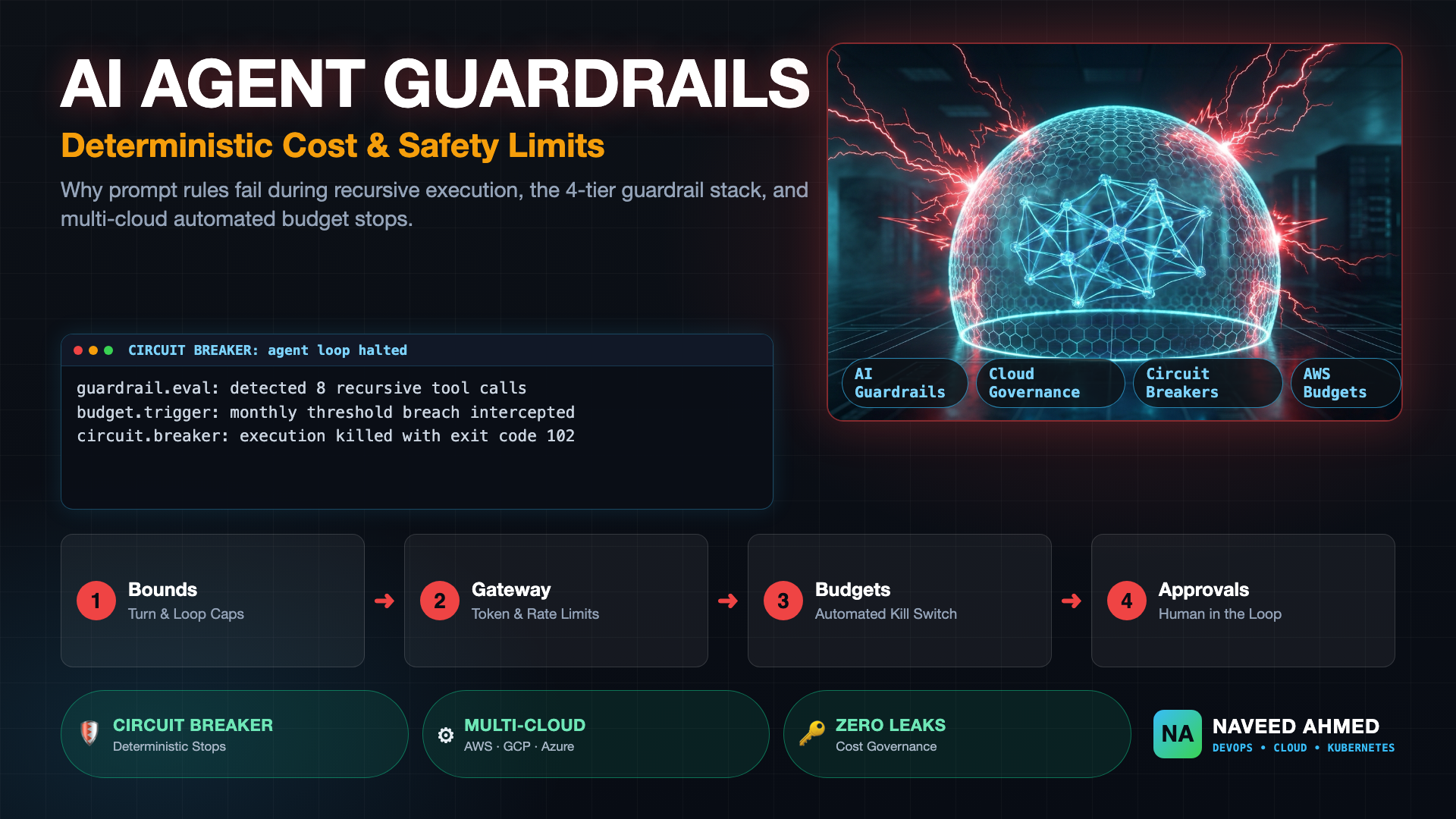
The 4-Tier AI Agent Guardrails Framework
Answer Capsule: A resilient agent guardrail architecture isolates safety checks into four decoupled layers: runtime execution bounds (limiting turns and sub-agent depth), gateway and token quotas (throttling requests and context volume), cloud financial circuit breakers (hard budget kill switches), and cryptographic permission boundaries (read-only credentials and human-in-the-loop gates).
To successfully deploy autonomous agents in production, engineering teams must implement a multi-layered defense-in-depth model. Below is the structural hierarchy of the enterprise ai agent guardrails framework:
Execution Bounds
Deterministic iteration limits (max 15 turns), sub-agent call recursion depth caps, and strict wall-clock process timeouts.
Token & Rate Quotas
Per-minute token consumption ceilings (TPM), request rate limits (RPM), and payload size validation proxies.
Financial Circuit Breakers
Cloud-native budget triggers wired to automated kill switches that detach IAM policies or disable services upon cost overruns.
IAM & Human Approval
Zero write permissions to production without interactive human confirmation; sandboxed execution environments.
When you combine these four tiers, your team achieves operational resilience: even if an LLM hallucinates an invalid command or attempts an infinite retry sequence, the outer software layers cleanly intercept and terminate the process.
Types of Guardrails in AI Systems: Comparison & Architecture
Answer Capsule: The four primary types of guardrails in ai span input validation, output verification, execution circuit breakers, and infrastructure budget policies. Input and output guardrails evaluate semantic safety and data leakage, while execution and infrastructure guardrails enforce deterministic limits on computational loops, cloud API calls, and infrastructure state mutations.
To design an effective stack, engineers must select the right guardrail type for each operational layer. The table below outlines how each guardrail operates, the failure mode it prevents, and where it executes:
| Guardrail Category | Primary Mechanism | Target Failure Mode | Enforcement Point | Latency Overhead |
|---|---|---|---|---|
| Execution Loop Breaker | Turn counters, hashing command history | Infinite agent retry loops & repeated bash errors | Local Agent Orchestrator | < 2 ms |
| Operational Ledger Gate | Persistent JSON ledger tracking API calls | Runaway cloud API usage (e.g. invalidations, compute) | Tool Execution Wrapper | < 5 ms |
| Cloud Financial Kill Switch | CloudWatch / PubSub budget actions | Billing spikes from unconstrained cloud resources | Cloud Provider Billing Plane | Asynchronous (1–15 min) |
| Schema & Tool Validator | Pydantic / Zod argument validation | Hallucinated CLI flags, corrupted parameter payloads | Client-side Dispatcher | < 1 ms |
| Semantic & PII Filter | Llama Guard / NeMo Guardrails / Guardrails AI | Prompt injection, credential leakage in logs | LLM Proxy Gateway | 80–250 ms |
While semantic frameworks such as those documented in guardrails ai documentation or nvidia ai agent guardrails provide critical text-level protections, operational engineers managing autonomous systems must pair them with deterministic execution boundaries. Let's look at concrete ai guardrails examples applied to infrastructure safety.
How to Implement Guardrails in AI: Multi-Cloud Automated Budget Stops
Answer Capsule: To implement infrastructure guardrails across cloud environments, configure cloud-native budget controls wired directly to programmatic mitigation triggers: AWS Budgets with automated Budget Actions or SNS-driven Lambdas, Google Cloud billing budgets publishing to Pub/Sub topics that invoke Cloud Functions, and Azure Cost Management attached to Action Groups.
When an autonomous agent has access to cloud credentials, passive email alerts are inadequate. If an agent loops over an expensive API at 02:00 AM, an alert email will sit in your inbox while thousands of API requests accumulate. You need active, automated remediation.
1. AWS AI Agent Guardrails: Programmatic Budget Actions
In AWS environments, configuring aws ai agent guardrails requires combining AWS Budgets with an automated budget action or an SNS-driven Lambda function. The following AWS CLI command provisions a strict monthly budget that notifies an operations topic the instant forecasted or actual spend approaches a defined limit:
# Create an active budget threshold configuration for autonomous agent operations
aws budgets create-budget \
  --account-id 123456789012 \
  --budget '{
    "BudgetName": "Agent-Hard-Cost-Cap",
    "BudgetLimit": {
      "Amount": "25.00",
      "Unit": "USD"
    },
    "CostFilters": {
      "TagKeyValue": ["user:Environment$AutonomousAgents"]
    },
    "CostTypes": {
      "IncludeTax": true,
      "IncludeSubscription": true,
      "UseBlended": false
    },
    "TimeUnit": "MONTHLY",
    "BudgetType": "COST"
  }' \
  --notifications-with-subscribers '[
    {
      "Notification": {
        "NotificationType": "ACTUAL",
        "ComparisonOperator": "GREATER_THAN",
        "Threshold": 80,
        "ThresholdType": "PERCENTAGE"
      },
      "Subscribers": [
        {
          "SubscriptionType": "SNS",
          "Address": "arn:aws:sns:us-east-1:123456789012:agent-circuit-breaker-topic"
        }
      ]
    }
  ]'
When the SNS topic receives the threshold breach alert, a subscribed AWS Lambda function instantly executes an automated remediation action: applying an explicit DenyAll Service Control Policy (SCP) or revoking the active session tokens of the agent's IAM role:
# Lambda circuit breaker: instantly revokes agent credentials on budget breach
import boto3

iam = boto3.client("iam")

def lambda_handler(event, context):
    agent_policy_arn = "arn:aws:iam::123456789012:policy/AgentExecutionPolicy"

    # Detach policy or attach an explicit Deny policy to neutralize agent keys
    iam.attach_role_policy(
        RoleName="AutonomousAgentWorkerRole",
        PolicyArn="arn:aws:iam::aws:policy/AWSDenyAll"
    )
    print("CRITICAL: Circuit breaker triggered. Attached AWSDenyAll to AutonomousAgentWorkerRole.")
    return {"status": "Agent Neutralized"}
2. Google Cloud Platform: Billing Cap with Pub/Sub & Cloud Functions
In GCP, budgets do not stop billing automatically by default. To enforce a hard stop, link your Cloud Billing Budget to a Google Cloud Pub/Sub topic. A serverless Cloud Function listens to the topic and programmatically detaches the billing account from the project if spend breaches the ceiling:
# GCP Cloud Function to disconnect billing project on agent cost overrun
import base64
import json
from googleapiclient import discovery

def stop_billing_on_budget_alert(event, context):
    pubsub_data = base64.b64decode(event['data']).decode('utf-8')
    budget_notification = json.loads(pubsub_data)

    cost_amount = budget_notification.get('costAmount', 0)
    budget_amount = budget_notification.get('budgetAmount', 1)

    if cost_amount >= budget_amount:
        project_id = "agent-sandbox-production"
        billing_service = discovery.build('cloudbilling', 'v1')
        name = f"projects/{project_id}/billingInfo"

        # Unlink project from billing account
        billing_service.projects().updateBillingInfo(
            name=name,
            body={"billingAccountName": ""}
        ).execute()
        print(f"GCP Guardrail: Project {project_id} detached from billing.")
3. Azure AI Agent Guardrails: Cost Management Action Groups
For teams utilizing azure ai agent guardrails, configure Azure Cost Management with an Action Group wired to an Azure Automation Runbook. When projected costs exceed the resource group budget, the runbook disables the agent's Managed Identity or stops compute instances automatically.
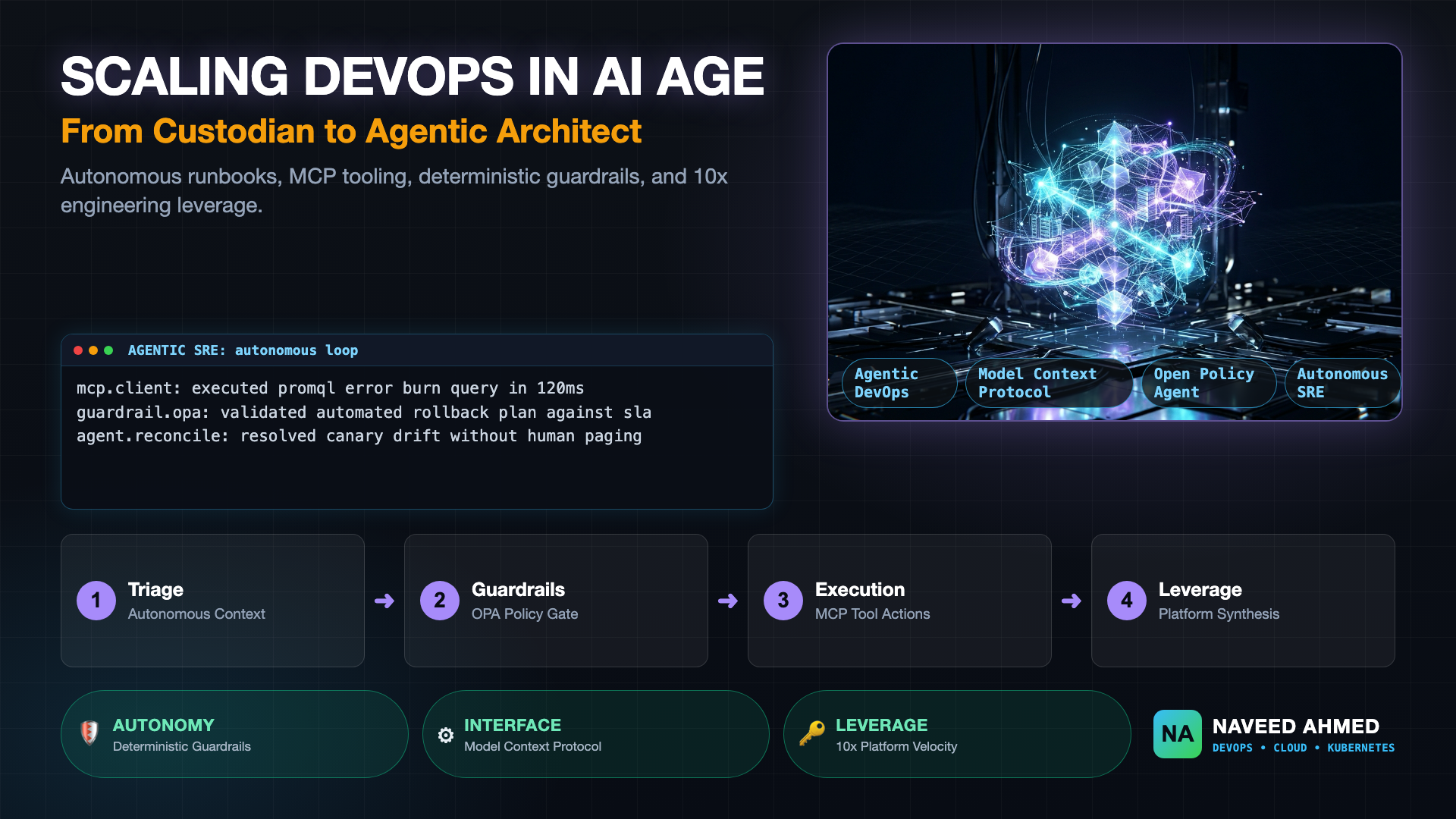
For more architectural patterns on modern automation and cloud resilience, explore our guide on scaling DevOps in the age of AI and the DevOps pipeline setup tutorial.
Code-Level Circuit Breaker: Preventing Runaway Tool-Call Loops
Answer Capsule: A code-level circuit breaker is an in-process proxy or decorator that intercepts every external tool call requested by an LLM. It maintains an on-disk operation ledger, calculates execution velocity (calls per hour), detects repetitive error patterns, and halts execution with a fatal exit code if an agent breaches predefined safety limits.
While cloud-native budget kill switches provide an essential safety net, they operate asynchronously. To prevent an agent from burning thousands of requests within minutes, you must enforce synchronous, code-level execution gates. Here is a production-tested ai agent guardrails example in Python that wraps CLI and tool actions:
"""
ai_agent_circuit_breaker.py
Deterministic operational circuit breaker for autonomous agent tool execution.
"""

import functools
import json
import os
import sys
import time
from typing import Callable, Any

LEDGER_PATH = os.path.expanduser("~/.agent_guardrails_ledger.json")

def load_ledger() -> dict:
    if os.path.exists(LEDGER_PATH):
        try:
            with open(LEDGER_PATH, "r") as f:
                return json.load(f)
        except Exception:
            pass
    return {"operations": [], "monthly_cost_estimate": 0.0}

def record_operation(op_name: str, cost_weight: float = 0.0) -> dict:
    ledger = load_ledger()
    now = time.time()

    # Retain operations from the past 24 hours
    ledger["operations"] = [
        op for op in ledger["operations"]
        if now - op.get("timestamp", 0) < 86400
    ]

    ledger["operations"].append({
        "op_name": op_name,
        "timestamp": now,
        "cost_weight": cost_weight
    })

    ledger["monthly_cost_estimate"] += cost_weight

    with open(LEDGER_PATH, "w") as f:
        json.dump(ledger, f, indent=2)
    return ledger

def agent_circuit_breaker(max_calls_per_hour: int = 15, max_cost_budget: float = 5.0):
    """
    Decorator that intercepts tool calls before execution.
    Trips the circuit breaker if hourly velocity or cost ceilings are breached.
    """
    def decorator(func: Callable) -> Callable:
        @functools.wraps(func)
        def wrapper(*args, **kwargs) -> Any:
            ledger = load_ledger()
            now = time.time()
            one_hour_ago = now - 3600

            # 1. Evaluate hourly call velocity
            recent_calls = [
                op for op in ledger["operations"]
                if op.get("timestamp", 0) > one_hour_ago and op.get("op_name") == func.__name__
            ]

            if len(recent_calls) >= max_calls_per_hour:
                print(f"\n[FATAL GUARDRAIL BREACH] Tool '{func.__name__}' called {len(recent_calls)} times in 60m.")
                print(f"[FATAL GUARDRAIL BREACH] Exceeded hourly velocity threshold ({max_calls_per_hour}/hr).")
                print("Tripping circuit breaker. Halting agent execution immediately.")
                sys.exit(102)

            # 2. Evaluate cumulative financial threshold
            if ledger.get("monthly_cost_estimate", 0.0) >= max_cost_budget:
                print(f"\n[FATAL GUARDRAIL BREACH] Cumulative spend estimate (${ledger.get('monthly_cost_estimate'):.2f}) reached budget ceiling (${max_cost_budget:.2f}).")
                print("Refusing to execute tool. Halting agent execution immediately.")
                sys.exit(103)

            # Record operation before execution
            record_operation(func.__name__, cost_weight=0.05)

            # Execute actual tool call
            return func(*args, **kwargs)
        return wrapper
    return decorator

# Example Usage within an Agentic Tool Definition:
@agent_circuit_breaker(max_calls_per_hour=5, max_cost_budget=10.0)
def execute_cloud_purge(target_path: str):
    print(f"Executing cloud resource purge on path: {target_path}")
    # Run the actual cloud API call safely...
    return {"status": "success", "purged": target_path}
This pattern provides an immediate, zero-latency hard stop. If an agent enters an infinite loop attempting to invalidate an edge cache or re-deploy a failed microservice, the decorator terminates the process on invocation number six, completely isolating your cloud infrastructure from recursive costs.
AI Guardrails and Governance: Operating Autonomous Agents Safely
Answer Capsule: Enterprise ai guardrails and governance requires establishing strict boundaries around credential issuance, auditing all tool invocations via persistent append-only ledgers, enforcing ephemeral sandboxed runtimes, and requiring cryptographic human approvals for state-altering operations.
As organizations integrate autonomous agents into production deployment pipelines, workflow engines like n8n ai agent guardrails, LangGraph orchestrators, and CLI assistants, governance can no longer be an afterthought. To balance developer velocity with organizational safety, adhere to the following governance imperatives:
- Least-Privilege Execution Roles: Never give an autonomous agent wildcard admin credentials (e.g.
AdministratorAccessorOwner). Scope IAM policies strictly to the exact resources and actions required for the task. If an agent manages documentation deployment, it should possess zero permissions to provision EC2 instances, alter VPC route tables, or configure billing accounts. - Cryptographic Human-in-the-Loop Gates: For any destructive mutation (e.g. database schema migrations, cluster deletes, production deployments), the agent must generate a cryptographically signed execution proposal and pause. The tool call must remain blocked until an authorized human engineer issues a physical confirmation command.
- Immutable Execution Audit Logging: Every agent reasoning step, shell command, and external tool call must be streamed to an append-only log sink (such as AWS CloudTrail or Datadog). This ensures that if an anomalous behavior occurs, engineers can trace the exact trajectory and context that induced the decision.
- Ephemeral Sandbox Containers: When agents execute shell commands or write code, execute them within ephemeral Docker containers or microVMs (such as Firecracker) with restricted outbound network policies. This prevents prompt injections from exfiltrating environment variables or sensitive files to external servers.
For more architectural insights on building resilient cloud and Kubernetes environments, review our Kubernetes production toolkit and explore our comprehensive DevOps & SRE system design interview guides.
Key Takeaways for SREs & Agent Developers
Answer Capsule: Hard stops beat prompt instructions every time. Securing autonomous AI agents requires treating LLM execution like untrusted user input: isolate credentials, enforce synchronous code-level circuit breakers, configure cloud-level budget kill switches, and implement human approvals for any state mutation.
- Prompts Are Not Guardrails: Large language models suffer from attention dilution during recursive loops. Never rely on system prompts alone to protect your infrastructure or financial budgets.
- Adopt Defense-in-Depth: Implement the 4-tier guardrail framework spanning runtime limits, API gateway quotas, cloud-native billing kill switches, and strict IAM permissions.
- Deploy Synchronous Circuit Breakers: Wrap all high-impact tool invocations in deterministic code-level circuit breakers that track operation velocity and kill execution before high bills occur.
- Automate Cloud Financial Stops: Configure AWS Budgets, GCP Pub/Sub triggers, and Azure Action Groups to automatically neutralize agent credentials when budget ceilings are reached.
- Enforce Human-in-the-Loop for Mutations: Destructive commands must require explicit, interactive confirmation from an authorized engineer.
Frequently Asked Questions
What are AI guardrails primarily used for in autonomous agents?
AI guardrails in autonomous agentic systems are programmable, deterministic boundaries designed to monitor, intercept, and restrict model actions. Unlike basic content filters that sanitize text outputs, agent guardrails enforce execution iteration caps, API rate limits, least-privilege cloud IAM scopes, and financial budget thresholds to prevent runaway tool loops, unauthorized infrastructure mutations, and unexpected cloud bills.
Why do prompt-based guardrails fail during recursive AI agent loops?
Prompt-based rules fail because large language models suffer from context dilution and task completion bias during recursive tool execution. As the agent's context window fills with lengthy command outputs, error logs, and intermediate reasoning steps, soft negative prompt instructions lose attention weight, allowing the model to enter expensive, repetitive execution loops without financial awareness.
What are the different types of guardrails in AI systems?
Production AI guardrails fall into four core tiers: (1) Runtime execution bounds (max reasoning turns, sub-agent delegation depth, wall-clock timeouts); (2) Token and gateway quotas (tokens-per-minute rate limits, prompt context caps); (3) Cloud-native financial circuit breakers (automated budget kill switches, billing alerts); and (4) Permission boundaries (read-only IAM credentials, cryptographic human-in-the-loop approvals for destructive mutations).
How can engineering teams implement automated cost guardrails on cloud providers?
Teams should configure programmatic cloud budgets wired to automated response handlers: AWS Budgets with Budget Actions or SNS-triggered Lambdas, Google Cloud billing budgets streaming to Pub/Sub topics backed by Cloud Functions that unlink billing accounts, and Azure Cost Management attached to Action Groups. These provide hard stops independent of the agent's code.
How do code-level circuit breakers protect CLI and tool execution?
A code-level circuit breaker is a local software wrapper or proxy decorator that intercepts every tool call an agent attempts. It evaluates execution velocity (calls per hour), cumulative elapsed time, and an operations ledger before running shell commands. If an agent repeats a failing command or breaches threshold velocity, the circuit breaker trips and halts execution with a non-zero exit code.