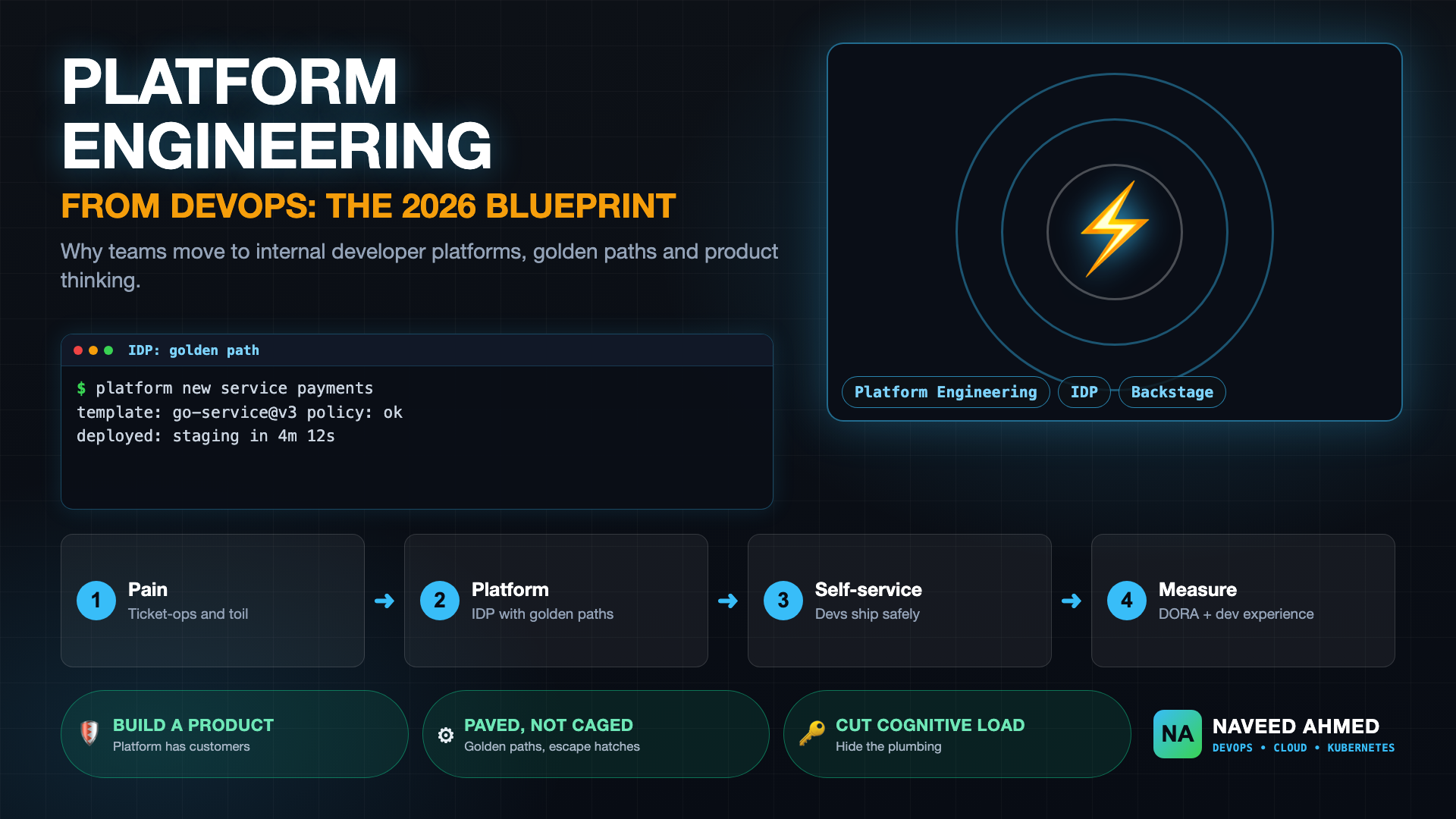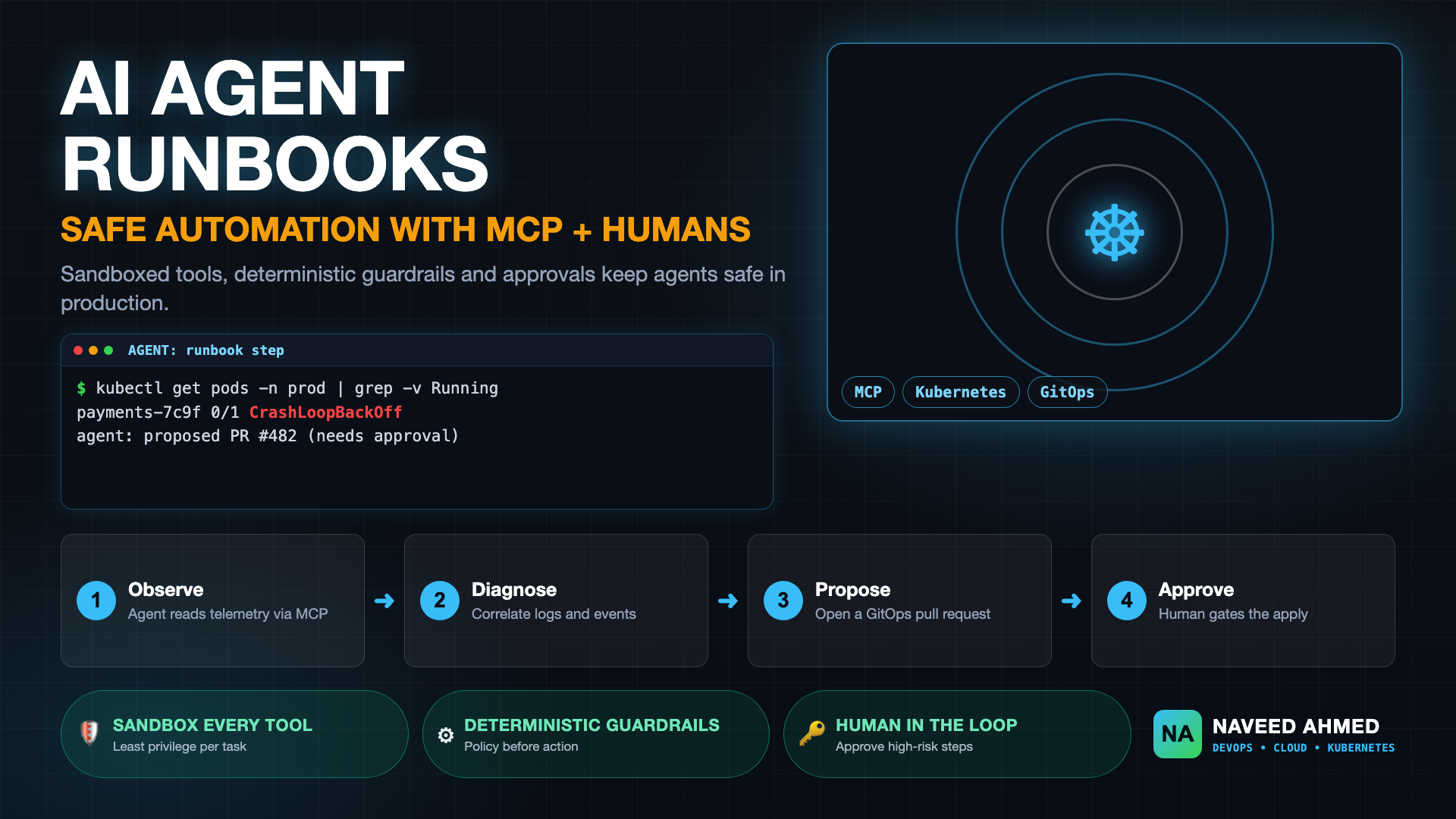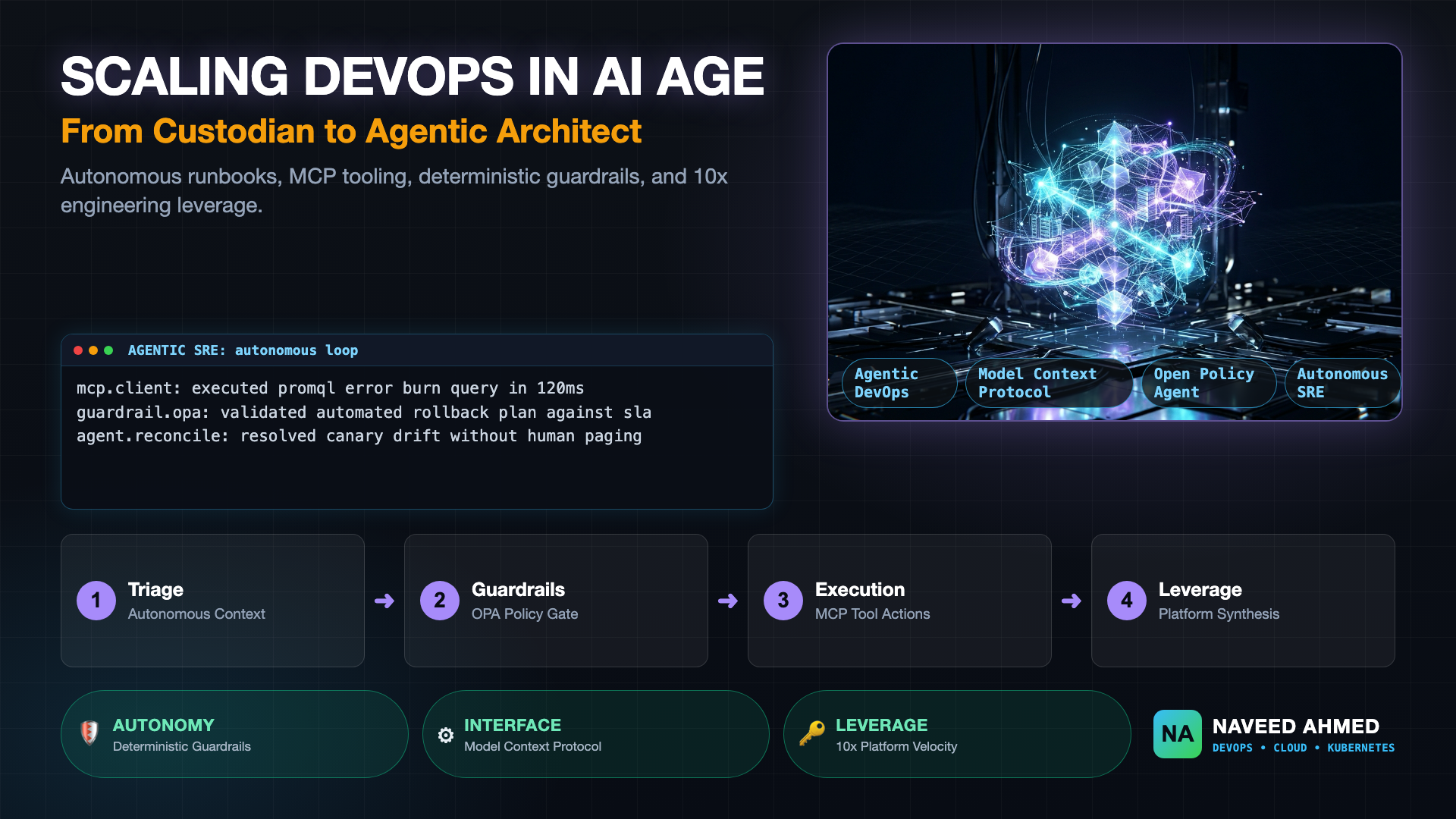
For more than a decade, the standard prescription for operational scalability was simple: automate repetitive tasks with bash scripts, write declarative infrastructure in Terraform, configure CI/CD pipelines, and establish on-call rotations. But in 2026, software estates have exploded in complexity. Microservices have fractured into distributed service meshes, event streams, and polyglot clouds. Scaling DevOps in the age of AI requires fundamentally discarding the outdated identity of the infrastructure custodian. Engineering teams that attempt to scale by manually authoring thousands of YAML manifests and fielding pager alerts during midnight outages inevitably hit an insurmountable burnout ceiling.
The practitioners who thrive today do not compete with artificial intelligence—they leverage it to multiply their architectural output. By transforming autonomous runbooks, structured agentic feedback loops, and open protocols like Model Context Protocol (MCP) into foundational building blocks, senior platform engineers now manage estates that previously demanded dozens of dedicated operators. In this guide, we break down the concrete architectural patterns, guardrail policies, and career strategies required for scaling yourself and your infrastructure in an AI-dominated engineering landscape.
The Paradigm Shift: From Infrastructure Custodian to Agentic Architect
Answer Capsule: Scaling DevOps in the age of AI transitions engineering from procedural manual operations to high-leverage agentic orchestration. Instead of writing boilerplate infrastructure manifests and manually triaging incident logs, platform architects design deterministic policy constraints, implement Model Context Protocol tooling, and govern autonomous agents that execute routine operations safely at machine speed.
Historically, a DevOps engineer spent the vast majority of their working hours trapped in reactive operational toil: updating Helm chart values, investigating broken Jenkins pipelines, manually rotating expired secrets, or running kubectl describe pod across dozens of failing microservices. When organizational demand surged, teams simply hired more engineers to absorb the ticket backlog. This linear scaling model is completely broken.
In modern high-velocity organizations, autonomous LLM agents can write boilerplate Terraform modules, synthesize complex PromQL queries, and draft postmortem timelines in seconds. If your primary value proposition is translating an engineer's verbal request into an AWS CloudFormation template or a Kubernetes deployment manifest, an AI agent can readily automate that workflow. However, agents cannot understand business blast radiuses, navigate distributed systems trade-offs, or bear legal and financial liability for prolonged downtime. To explore this organizational evolution in depth, review our breakdown of the DevOps to platform engineering transition.
| Operational Dimension | Legacy Infrastructure Custodian | AI-Native Platform Architect |
|---|---|---|
| Core Primary Focus | Writing boilerplate YAML, maintaining scripts, closing JIRA tickets | Designing deterministic guardrails, agent orchestration, system resilience |
| Incident Response | Manual human triage, reading raw log streams, executing runbook steps | Autonomous telemetry synthesis, AI agent RCA proposals, human go/no-go gates |
| Infrastructure Delivery | Bespoke module authoring for every single microservice request | Standardized Internal Developer Platform (IDP) with embedded agentic APIs |
| Verification & Safety | Post-apply debugging, manual code reviews, hope-based deployment | Strict Open Policy Agent (OPA) validation, shadow testing, eBPF telemetry |
| Practitioner Leverage | Linear (1 engineer manages 5–10 services before burnout) | Exponential (1 engineer governs autonomous tooling for 100+ services) |
The 970+ Incident Handbook & K8s Runbooks are exclusive to subscribers — unlock for FREE
Get battle-tested production runbooks, AWS architecture blueprints, and zero-downtime CI/CD post-mortems sent directly to your inbox. 100% free, no spam.
Why Scaling DevOps in the Age of AI Demands Model Context Protocol (MCP)
Answer Capsule: Model Context Protocol (MCP) provides an open, standardized RPC architecture connecting AI agents to live DevOps systems. By exposing schema-validated, least-privilege tools—such as read-only Prometheus metrics and sandboxed Kubernetes diagnostic commands—MCP eliminates unsafe raw shell access while supplying contextual telemetry directly into agentic reasoning loops.
The single greatest obstacle to deploying AI within infrastructure operations has been the interface problem. Traditionally, developers attempted to give LLMs access to infrastructure by either feeding massive walls of raw text into prompt contexts or handing raw SSH keys and AWS administrative tokens to unconstrained scripts. Both approaches are disastrous: raw text swamps token budgets with useless noise, while unrestricted credentials expose production to catastrophic agent hallucinations.
The emergence of the Model Context Protocol (MCP) solves this architectural challenge. MCP standardizes how AI clients discover and query external systems through structured JSON-RPC interfaces. Rather than giving an agent access to your production bash terminal, you deploy a dedicated MCP server that exposes curated, deterministic tools. For example, an agent cannot run arbitrary kubectl delete commands, but it can invoke a schema-validated tool named get_pod_restart_events or query_prometheus_burn_rate.
{
  "mcpServers": {
    "kubernetes-diagnostics": {
      "command": "mcp-k8s-server",
      "args": [
        "--kubeconfig=/etc/kubernetes/mcp-readonly.conf",
        "--allowed-namespaces=production,staging",
        "--rate-limit=30-req-per-min"
      ],
      "env": {
        "READ_ONLY_MODE": "true",
        "AUDIT_LOG_DESTINATION": "s3://prod-corp-security-audit/mcp-logs/"
      }
    },
    "prometheus-telemetry": {
      "command": "mcp-prometheus-bridge",
      "args": [
        "--endpoint=https://prometheus-internal.prod.corp:9090",
        "--max-query-range=3h",
        "--enforce-tenant-id=finance-core"
      ]
    }
  }
}
By implementing MCP as the secure abstraction layer between your large language models and your Kubernetes clusters, you give autonomous agents the exact diagnostic context they need without ever exposing write credentials. This enables seamless, continuous triage without operational risk.
Three-Tier Deterministic Guardrails: Preventing Agentic Production Disasters
Answer Capsule: Autonomous agents must operate within a three-tier blast-radius hierarchy: Tier 1 executes autonomous read-only diagnostic collection; Tier 2 permits policy-constrained non-destructive remediation (such as pod restarts or replica scaling) validated via Open Policy Agent (OPA); and Tier 3 strictly mandates cryptographic human approval for irreversible mutations.
Never trust an LLM to self-regulate its actions in a production environment. Stochastic models inherently generate probabilistic outputs, whereas infrastructure reliability demands deterministic policy enforcement. When scaling DevOps workflows with AI, you must enforce a strict policy boundary that intercepts every action proposed by an agent before it reaches your cloud API.
Tier 1: Telemetry (Autonomous)
Prometheus alerts trigger agent diagnostics. Logs, stack traces, and pod health queries run without human friction.
Tier 2: Policy Gate (Automated)
OPA Rego policies evaluate suggested remediations (e.g. HPA adjustments). If compliant, executed automatically.
Tier 3: Mutation (Human-in-the-Loop)
Schema changes, IAM modifications, or destructive cluster cutovers require cryptographic human approval via Slack/CLI.
Consider an operational incident where an AI agent diagnoses an out-of-memory crash loop on a critical payment service. Under our three-tier framework, the agent independently reads the pod logs and summarizes the memory leak in Tier 1. In Tier 2, if the agent proposes scaling up temporary memory limits proportionately, an Open Policy Agent (OPA) gate evaluates whether the request stays within pre-approved budgetary and node-capacity limits. If the agent instead hallucinates that dropping the database table will clear the memory lock, the policy gate categorically blocks the execution. For comprehensive implementation patterns on automated runbooks, see our guide on how AI agents automate DevOps runbooks safely.
package system.agentic.guardrails

default allow = false

# Allow Tier 2 auto-remediation only if all safety conditions match
allow {
    input.action == "scale_deployment_replicas"
    input.target_namespace == "production"
    input.requested_replicas <= 15
    input.requested_replicas >= 2
    not is_blacklisted_service(input.service_name)
    input.caller_identity == "agentic-remediation-bot@iam.gserviceaccount.com"
}

is_blacklisted_service(service) {
    blacklisted = ["ledger-database", "vault-core", "auth-identity-service"]
    blacklisted[_] == service
}
Autonomous Incident Triage: Designing Self-Healing Kubernetes Loops
Answer Capsule: Autonomous incident triage chains Prometheus alert webhooks to specialized agentic workers that correlate distributed traces, inspect error logs, and determine root causes in under 60 seconds. Rather than waking engineers at 2:00 AM for known failure modes, self-healing loops execute pre-verified remediation runbooks deterministically.
Mean Time to Resolution (MTTR) is rarely dominated by the time required to apply a fix; it is dominated by the time required to assemble context. When an alert fires at 2:00 AM, a human on-call engineer takes 10 to 15 minutes to boot up their workstation, authenticate through VPN and SSO portals, open Grafana, find the relevant dashboard, and search through logs in Loki or Datadog. By the time the engineer understands what broke, 25 minutes of downtime have elapsed.
When you scale yourself with AI, an autonomous triage loop executes the entire diagnostic phase in parallel before the human even receives a notification. The moment Alertmanager fires a CrashLoopBackOff or high latency alert, a webhook notifies an agentic triage worker. The worker inspects the pod's termination state, queries the last 200 lines of container stderr, pulls the Git commit SHA from the deployment spec, and diffs the changes against the previous release.
#!/usr/bin/env bash
# Autonomous Agent Triage Hook invoked by Alertmanager Webhook
set -euo pipefail

ALERT_PAYLOAD="${1}"
POD_NAME=$(jq -r '.labels.pod' <<< "${ALERT_PAYLOAD}")
NAMESPACE=$(jq -r '.labels.namespace' <<< "${ALERT_PAYLOAD}")

echo "[AGENT TRIAGE] Alert received for ${NAMESPACE}/${POD_NAME}"

# Step 1: Query deterministic exit code and termination reason
TERMINATION_REASON=$(kubectl get pod "${POD_NAME}" -n "${NAMESPACE}" \
  -o jsonpath='{.status.containerStatuses[0].lastState.terminated.reason}')
EXIT_CODE=$(kubectl get pod "${POD_NAME}" -n "${NAMESPACE}" \
  -o jsonpath='{.status.containerStatuses[0].lastState.terminated.exitCode}')

# Step 2: Extract tail logs prior to failure
CONTAINER_LOGS=$(kubectl logs "${POD_NAME}" -n "${NAMESPACE}" --previous --tail=80 2>&1 || true)

# Step 3: Package structured context into JSON payload for LLM analysis
cat <<EOF | curl -s -X POST https://agent-gateway.internal/triage/analyze -d @-
{
  "pod": "${POD_NAME}",
  "namespace": "${NAMESPACE}",
  "reason": "${TERMINATION_REASON}",
  "exit_code": ${EXIT_CODE:-0},
  "log_snippet": $(jq -Rs . <<< "${CONTAINER_LOGS}")
}
EOF
When the on-call engineer opens Slack, they do not see a cryptic alert; they see a synthesized diagnostic briefing: "Payment-worker-7b94 crashed with Exit Code 137 (OOMKilled). The failure started 4 minutes after deployment commit #8d2f1a was rolled out. The container exceeded its 512Mi limit during Redis batch deserialization. Tier 2 automated limit increase applied; pod stabilized." For practicing complex CI/CD pipeline deployments and release rollouts, see our hands-on DevOps pipeline setup lab.
Platform Engineering as the Force Multiplier for Scaled DevOps
Answer Capsule: Platform engineering serves as the foundational substrate that enables AI tools to scale across an organization. By encapsulating infrastructure standards into golden path templates, declarative APIs, and self-service portals, platform architects ensure AI code generation produces secure, production-ready manifests rather than fragmented architectural drift.
One of the most dangerous side effects of widespread AI adoption in software teams is the explosion of unvetted, copy-pasted infrastructure code. When software developers use AI code assistants to write their own Kubernetes manifests and Dockerfiles without centralized platform guardrails, infrastructure rapidly deteriorates into chaos. Security vulnerabilities proliferate, compute costs spiral out of control, and no two microservices share the same logging format.
This is where the platform engineer steps in as the ultimate force multiplier. Instead of acting as a gatekeeper who reviews every single PR, you construct "Golden Paths" encoded into an Internal Developer Platform (IDP). You provide verified, standardized templates where resource requests, readiness probes, security contexts, and OpenTelemetry instrumentation are pre-configured. If you need to quickly generate baseline manifests that adhere to production standards, you can utilize our free Kubernetes YAML generator tool to visually inspect and construct hardened configurations.
When developers prompt AI agents to generate services, the agent is instructed to consume your organization's Golden Path APIs rather than creating bespoke infrastructure from scratch. The AI agent becomes an accelerator for platform adoption rather than a generator of configuration drift.
The 5-Pillar Practical Playbook for Scaling Your DevOps Career
Answer Capsule: Scaling your DevOps career in the AI era requires mastering five core pillars: (1) Systems Architecture and Failure Domain Modeling; (2) Declarative Policy-as-Code; (3) LLMOps and Context Pipeline Engineering; (4) Machine-to-Machine Prompt Interface Design; and (5) FinOps Governance and Token Economics.
To future-proof your career and transition into a high-impact Principal or Staff Platform Architect, align your personal skill roadmap around these five critical pillars:
- 1. Deep Distributed Systems Architecture: AI can write code, but it cannot reason about network partition boundaries, CAP theorem trade-offs, or complex consensus protocols. Master multi-region failover, database replication lag, and Kubernetes internal networking. If you are preparing for senior engineering evaluations, test your architectural reasoning against our curated CI/CD and GitOps interview scenarios.
- 2. Policy-as-Code & Deterministic Compliance: As the volume of software increases exponentially due to automated generation, compliance can no longer be checked manually. Become an expert in Open Policy Agent (OPA), Kyverno, and automated supply chain security (Cosign, SLSA, Trivy).
- 3. Observability & Context Pipeline Engineering: AI models are only as effective as the context provided to them. Learn how to structure OpenTelemetry spans, metrics, and structured logs so that automated agents can ingest and diagnose distributed traces instantly.
- 4. Machine-to-Machine Interface Design: Move beyond writing prompts for humans. Learn to write structured prompt contracts, JSON schema tool definitions, and MCP integrations that allow heterogeneous AI agents to coordinate reliably across pipelines.
- 5. FinOps & Infrastructure Economics: AI workloads consume immense compute and token budgets. Engineering leaders reward architects who understand GPU scheduling, spot instance orchestration (via tools like Karpenter), and cost-attribution pipelines that prevent budget runaway.
Production Troubleshooting & Edge Cases: When AI Agents Hallucinate Infrastructure
Answer Capsule: Real-world production failure modes in agentic DevOps include feedback loops between autoscalers and AI remediators, hallucinated non-existent CLI flags, cyclic restart storms, and privilege escalation vulnerabilities. Mitigating these requires strict schema validation, circuit breakers, and rate-limited execution windows.
Deploying AI agents into operational environments introduces entirely new failure modes that traditional SREs have never encountered. Understanding these edge cases is critical to preventing outages:
1. The Cyclic Remediation Storm
An AI agent notices a pod is slow to respond to health checks and restarts it. However, the slowness was caused by an overloaded database connection pool. Restarting the pod drops active connections and forces the pod to re-initialize, hammering the database with connection spikes. As latency worsens across all other pods, the agent attempts to restart the entire fleet simultaneously. Remediation: Enforce strict circuit breakers that limit automated remediation actions to a conservative subset of replicas within a defined cooldown window.
2. Hallucinated Command Flags & Deprecated APIs
LLMs trained on historical internet data frequently suggest Kubernetes manifests using deprecated API versions (such as extensions/v1beta1 for Ingress) or command-line flags that have been removed in newer tool versions. If piped directly to production clusters, these commands fail catastrophically. Remediation: Every agent-generated manifest must pass through a strict client-side linter (e.g. kubeconform with strict schemas) and an admission controller before execution.
3. Token Exhaustion and Context Starvation
During a massive cascading outage, thousands of error logs flood the triage pipeline. If an agent attempts to dump entire raw log buffers into an LLM context window, it rapidly exhausts token limits, hits rate limits, and incurs astronomical API bills while failing to diagnose the issue. Remediation: Pre-process log data locally using deterministic regex and deduplication filters before passing summarized vectors to the agent.
By treating AI as a powerful, semi-autonomous junior operator that requires deterministic oversight, clear boundaries, and structured tools, you unlock unprecedented operational leverage. You cease being a firefighter trapped in the ticket queue and ascend to the role of an architect orchestrating a scalable, self-healing software delivery ecosystem.
Frequently Asked Questions
What does scaling DevOps in the age of AI actually mean for an individual engineer?
Scaling DevOps in the age of AI means decoupling engineering throughput from manual operational toil. Instead of hand-crafting repetitive YAML, manually combing through Grafana dashboards during midnight outages, or writing boilerplate Terraform modules, the AI-era engineer builds agentic feedback loops, standardizes Model Context Protocol (MCP) integrations, and enforces deterministic guardrails that allow autonomous systems to observe and execute safely at scale.
Will AI agents replace the need for senior DevOps and Platform engineers?
No. AI models excel at rapid log summarization, pattern recognition, and code generation, but they hallucinate, lack organizational context, and cannot bear ultimate operational liability for production outages. The role evolves from being an infrastructure custodian who executes runbooks to an agentic architect who designs deterministic policy constraints, verifies blast radiuses, and orchestrates high-trust autonomous agents.
What is the Model Context Protocol (MCP) and why is it vital for agentic DevOps?
Model Context Protocol (MCP) provides an open, standardized bridge between large language models and operational infrastructure systems (such as Prometheus, Kubernetes APIs, Git providers, and cloud CLIs). Instead of granting unrestricted SSH keys or raw API tokens to AI models, MCP exposes strict, schema-validated tools and read-only context servers, ensuring agents inspect telemetry without executing uncontrolled production mutations.
How can a DevOps engineer establish safe guardrails for autonomous runbook execution?
Enforce a three-tier blast-radius boundary: (1) Read-only telemetry gathering runs fully autonomous; (2) Non-destructive mutations (e.g., autoscaling replicas, restarting deadlocked pods, running canary tests) execute under Open Policy Agent (OPA) or Kyverno validation; and (3) Destructive mutations (e.g., database schema migrations, IAM permission grants, infrastructure destruction) require cryptographic human-in-the-loop approval.
Which core technical skills must DevOps engineers prioritize in 2026?
Engineers must double down on distributed systems architecture, declarative policy enforcement (OPA/Kyverno), agentic orchestration frameworks, structured observability (OpenTelemetry), and platform engineering abstractions (Internal Developer Portals). High-level systems design and deterministic safety matter far more than memorizing CLI syntax.