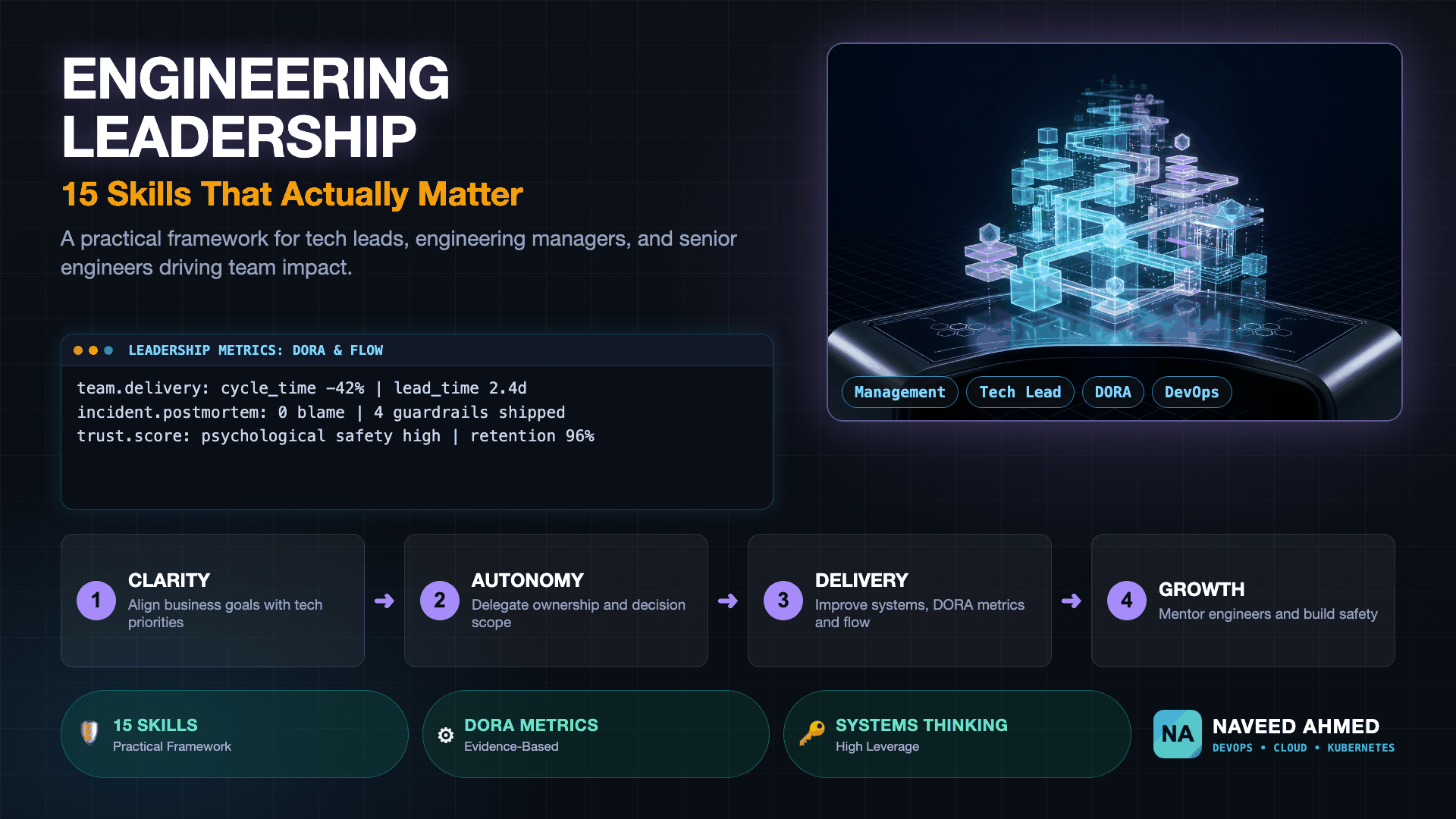
For most senior engineers and site reliability specialists, learning how to become a better engineering leader begins when you realize that technical excellence alone no longer scales. You spent years diagnosing race conditions, refactoring brittle monolithic services, tuning Kubernetes ingress controllers, and fixing broken database schema migrations at 2:00 AM. In that world, competence was tangible: clean code, green pipelines, zero-downtime deployments, and fast root-cause isolation. Then comes the promotion to tech lead, staff engineer, or engineering manager, and suddenly the operating model breaks. Success is no longer measured by how many pull requests you review or how many Terraform modules you author before lunch. Success now depends on team alignment, psychological safety, cross-functional prioritization, and creating systems that enable other developers to deliver high-quality software independently.
Making this transition requires shifting your mental model from personal code throughput to systemic team leverage. Technical competence earned your credibility, but technical skill alone does not teach you how to resolve architectural deadlocks, coach a struggling junior engineer, translate production risk to executive stakeholders, or lead an engineering team through a multi-region outage without finger-pointing. True engineering leadership is an intentional craft, grounded in proven organizational systems, clear decision boundaries, and repeatable communication habits.
What Does an Effective Engineering Leader Actually Do?
An effective engineering leader optimizes the socio-technical system of software delivery. Rather than acting as a heroic gatekeeper who personally reviews every line of code or makes every architectural decision, an engineering leader creates clarity, builds psychological safety, unblocks delivery pipelines, and helps engineers make sound technical decisions with autonomy and confidence.
Leadership in software organizations takes two distinct yet complementary forms, as highlighted in the GitLab Technical Leadership Handbook and the LeadDev Engineering Manager Handbook:
You do not need direct reports or management authority to be an impactful engineering leader. Individual contributor leaders (Tech Leads, Staff Engineers, Principal Engineers) lead through technical vision, architectural influence, and mentorship without running one-on-ones or managing compensation. Engineering Managers, conversely, focus on people operations, hiring, team health, and career progression. High-performing engineering organizations celebrate both paths as equally prestigious and impactful.
Regardless of title or whether you manage people or technical architecture, great engineering leaders consistently execute five core responsibilities:
- Provide strategic and technical clarity: Translate ambiguous business goals into focused technical priorities and explicit non-functional requirements.
- Cultivate psychological safety: Foster an operational culture where team members surface risks early, debate technical trade-offs openly, and learn from production outages without fear of blame.
- Empower team autonomy through delegation: Delegate problems and outcomes rather than micromanaging implementation steps or gatekeeping deployments.
- Optimize delivery systems: Remove friction from deployment pipelines, automate repetitive toil, and measure delivery performance using evidence-based DORA metrics rather than vanity velocity numbers.
- Invest continuously in developer growth: Actively coach junior engineers, sponsor senior contributors, and design clear career progression paths that prevent team stagnation and attrition.
The 970+ Incident Handbook & K8s Runbooks are exclusive to subscribers — unlock for FREE
Get battle-tested production runbooks, AWS architecture blueprints, and zero-downtime CI/CD post-mortems sent directly to your inbox. 100% free, no spam.
How to Become a Better Engineering Leader: 15 Core Skills
The following fifteen skills represent practical, battle-tested capabilities required to lead developers, SREs, and DevOps teams effectively in modern production environments.
1. Shift from Individual Output to Team Impact
The hardest psychological hurdle for newly promoted technical leaders is relinquishing the dopamine hit of closing tickets and writing features. In High Output Management, former Intel CEO Andrew S. Grove formulated the foundational principle of managerial leverage: a leader's output is the output of the organizational units under their supervision or influence. If you spend forty hours a week writing code, your maximum weekly output equals forty hours of engineering effort. But if you spend ten hours building a shared testing framework, creating automated CI templates, or unblocking three teammates, your leverage multiplies across the entire squad.
Camille Fournier echoes this in The Manager's Path: when leaders cling to individual contributor tasks, they inevitably become their team's single biggest bottleneck. Your job is no longer to be the fastest coder in the room; your job is to build a high-performing system where the entire team delivers sustained value without your constant manual intervention.
Realistic DevOps scenario: A tech lead on a cloud platform team noticed that engineers spent hours repeatedly writing boilerplate Terraform for Amazon Web Services (AWS) infrastructure. Instead of authoring all infrastructure modules personally, the lead designed a reusable, modular Terraform blueprint repository with automated validation tests and hosted an internal workshop. Within a month, deployment turnaround dropped by 65%, and squad engineers authored clean, compliant infrastructure code with zero handholding.
Practical actions to implement:
- Audit your calendar and track how much time you spend on direct implementation versus high-leverage activities like unblocking peers, improving CI/CD pipelines, and clarifying project specifications.
- Whenever you find yourself about to grab the most interesting, complex feature on the sprint board, deliberately assign it to a senior or mid-level engineer on your team and position yourself as their sounding board and reviewer.
- Measure your success by your team's collective delivery metrics, reduced operational toil, and developer satisfaction rather than your personal commit count.
Common mistake to avoid: Trying to write 30 hours of production code while simultaneously attending cross-functional planning meetings and running 1:1s. This leads directly to burnout, rushed code reviews, and missed organizational deadlines.
2. Build Trust and Psychological Safety
Psychological safety is the shared belief held by team members that the team is safe for interpersonal risk-taking. As demonstrated in Google's Project Aristotle and the landmark research in Accelerate by Dr. Nicole Forsgren, Jez Humble, and Gene Kim, psychological safety is the single strongest predictor of high software delivery performance, operational stability, and team retention. When engineers fear retribution or ridicule for admitting a mistake, they hide production anomalies, delay critical bug reports, and avoid proposing innovative architectural solutions.
Building trust requires demonstrable vulnerability from leaders. In Radical Candor, Kim Scott emphasizes that caring personally while challenging directly forms the basis of authentic leadership. When an engineer makes a mistake, an effective leader focuses relentlessly on the systemic safeguards that failed, not the human who initiated the command.
Realistic DevOps scenario: A mid-level engineer ran a production database schema migration that unexpectedly acquired exclusive table locks on a high-traffic table, triggering a cascade of HTTP 500 errors across the application gateway. Instead of reacting with anger or demanding to know who approved the pull request, the engineering lead stepped in to coordinate the rollback, shielded the engineer from frantic executive slack messages, and scheduled a blameless postmortem. During the review, the team discovered that staging lacked realistic row concurrency and added automated pre-deployment lock-detection tests in their deployment pipeline. By linking this incident response to disciplined operational procedures like those covered in our guide on how to think like an SRE during production triage, the leader turned a terrifying incident into a cultural milestone of collective resilience.
Practical actions to implement:
- Standardize blameless postmortems across your engineering group. Frame incident investigations around questions like "What information did the engineer have at the time?" and "What system guardrails failed to catch the regression?" rather than "Who did this?"
- Openly acknowledge your own past technical blunders and incorrect architectural assumptions in team meetings. Showing vulnerability sets the baseline for psychological safety.
- Actively solicit dissenting viewpoints during architecture reviews by asking, "What is the biggest operational risk with this design that we haven't spoken about yet?"
Common mistake to avoid: Confusing psychological safety with lack of accountability. Psychological safety does not mean tolerating negligence or avoiding rigorous technical standards; it means establishing high standards in an environment where people feel safe striving for them.
3. Communicate with Clarity and Context
Engineering leaders act as linguistic translators between business executives and technical teams. Product managers, marketing leads, and financial directors rarely care about Kubernetes custom resource definitions, database isolation levels, or memory garbage collection pauses. They care about customer churn, feature time-to-market, cloud expenditure, security vulnerabilities, and compliance deadlines.
In Become an Effective Software Engineering Manager, James Stanier underscores that communication is a leader's primary medium. Effective technical leaders practice context over control: instead of giving orders, they explain the broader business rationale, user pain points, and strategic trade-offs behind a project, enabling engineers to make sensible day-to-day decisions on their own.
Realistic DevOps scenario: When advocating to replace an aging, unsupported Redis caching cluster with a modern distributed key-value store, the tech lead avoided sending an architecture diagram full of low-level networking parameters. Instead, they wrote a one-page technical proposal highlighting that the current cluster suffered from memory fragmentation that caused thirty minutes of downtime during Black Friday, costing approximately $45,000 in lost revenue. Framing technical debt in terms of financial and customer risk secured immediate executive approval and budget.
Practical actions to implement:
- Adopt the "Context, Problem, Proposal, Impact" structure for all major technical proposals and executive status updates.
- Write down architectural decisions in lightweight Architectural Decision Records (ADRs) stored in version control alongside the application code.
- Before pitching technical debt remediation or infrastructure modernization, quantify the cost of inaction in terms of engineer hours wasted, SLA breach penalties, or cloud billing inflation.
Common mistake to avoid: Filtering out all business context and presenting engineers with disconnected task tickets. When engineers do not understand why a feature matters to customers, they build sub-optimal architectures that fail to satisfy real-world user workflows.
4. Master One-on-Ones, Feedback, and Coaching
The weekly or bi-weekly one-on-one (1:1) meeting is the fundamental building block of engineering management. Yet many engineering managers treat 1:1s as boring status updates that could have been an asynchronous Slack message. A status update checks on the project; a genuine 1:1 checks on the human being doing the work.
According to Will Larson in An Elegant Puzzle: Systems of Engineering Management, high-functioning 1:1s serve as an early-detection radar for organizational friction, burnout, interpersonal conflict, and career aspirations. Similarly, the LeadDev Engineering Manager Handbook recommends adopting a structured conversational cadence that prioritizes the direct report's agenda above all else.
First 10 minutes (Their Agenda): Let the engineer speak freely about what is top of mind: recent wins, frustrations, blockers, or team dynamics. Listen actively without interrupting.
Middle 10 minutes (Your Agenda & Feedback): Share organizational context, discuss upcoming technical roadmaps, and provide timely, actionable feedback (both praise and constructive guidance).
Final 10 minutes (Career & Future Growth): Discuss professional development, upcoming learning opportunities, quarterly goals, or mentorship aspirations.
Coaching requires shifting from an "answering" stance to an "inquiry" stance. When an engineer approaches you with an architecture dispute or a broken staging environment, resist the urge to provide the solution immediately. Ask open-ended questions: "What options have you evaluated so far?", "What are the trade-offs of each approach?", and "What would happen if this service experienced a 10x traffic spike?"
Practical actions to implement:
- Maintain a shared, collaborative document for every direct report where both of you can jot down topics throughout the week between meetings.
- Never cancel a 1:1 meeting. If an urgent production incident intervenes, immediately reschedule it for later in the week to signal that your engineers' growth is non-negotiable.
- Deliver constructive feedback within 48 hours of observing an issue. Never hoard constructive feedback for annual performance review cycles.
Common mistake to avoid: Turning 1:1s into an interrogation about ticket completion dates. When engineers dread 1:1s, they stop sharing honest feedback about team health, technical debt, and pending departures.
5. Delegate Ownership Instead of Micromanaging
Micromanagement is the hallmark of insecure technical leadership. When leaders dictate the exact function signatures, variable names, and deployment sequences for their engineers, they destroy autonomy, stifle creative problem-solving, and breed learned helplessness. If your team cannot ship a minor feature or debug a staging deployment without your explicit sign-off, you have not built a resilient team; you have built an echo chamber dependent on your individual presence.
True delegation means delegating ownership of problems and outcomes rather than discrete task checklists. When you delegate ownership, you define the desired business outcome, establish non-functional guardrails (such as latency budgets, security requirements, and budget limits), and trust the engineer to determine the implementation strategy.
Realistic DevOps scenario: A tech lead noticed that their team's GitHub Actions CI/CD pipelines were taking forty-five minutes to build and test Docker images. Instead of rewriting the workflows themselves over a weekend, the lead delegated the initiative to a mid-level platform engineer. The lead defined the outcome: "Reduce total CI runtime to under ten minutes, ensure all secrets remain rotated via AWS IAM OIDC, and keep cloud pipeline runners within our current monthly budget." The lead provided guidance during architectural reviews, but the engineer evaluated multi-stage caching, parallelized test suites, and presented the solution to the department, boosting their confidence and visibility.
Practical actions to implement:
- Use the "Delegation Poker" framework to clarify decision authority: Tell, Sell, Consult, Agree, Advise, Inquire, or Delegate. Make explicit whether you are asking for input or handing over full decision ownership.
- Establish objective guardrails up front: define test coverage expectations, latency SLAs, budget caps, and rollback criteria before work begins.
- Review pull requests for architecture, security, and maintainability rather than personal stylistic preferences that should be enforced by automated linters.
Common mistake to avoid: "Abdication" masquerading as delegation. Tossing a vague, high-stakes problem over the fence without providing background context, available tooling, or milestone check-ins sets the engineer up for failure.
6. Make Better Technical Decisions and Trade-Offs
Junior engineers debate which technology is "best"; mature engineering leaders analyze trade-offs, constraints, and operational ergonomics. Every architectural choice is a compromise between development velocity, operational complexity, financial cost, reliability, security, and maintainability. When leaders suffer from "Resume-Driven Development," they burden their organizations with complex distributed architectures when a boring, battle-tested solution would have solved the problem reliably.
In An Elegant Puzzle, Will Larson highlights that effective engineering managers manage organizations as complex technical systems. A key mental model for leadership decision-making is distinguishing between Type 1 (irreversible, high-stakes) and Type 2 (reversible, two-way-door) decisions. Most day-to-day technical choices—such as library selection, internal API payloads, and database indexing strategies—are reversible and should be made quickly by the engineers closest to the problem. Type 1 decisions—such as primary cloud provider migration, monolithic database decomposition, or adopting a new programming language—warrant deeper scrutiny, stakeholder alignment, and formal evaluation.
Realistic DevOps scenario: A squad of developers proposed deploying a multi-cluster Kubernetes environment to host a simple internal notification service that processed 500 requests per hour. The engineering leader stepped in and asked the team to evaluate the operational maintenance burden: who would manage control plane upgrades, node provisioning, CNI networking, and Prometheus alerting for an internal tool? By analyzing trade-offs, the team opted for AWS Lambda with Amazon SQS, eliminating operational overhead and saving the company dozens of hours in monthly cluster maintenance.
Practical actions to implement:
- Institutionalize the use of Architectural Decision Records (ADRs). Document the context, considered alternatives, chosen solution, and expected operational consequences in markdown files alongside the codebase.
- When evaluating new technologies, mandate a strict "total cost of ownership" assessment that includes on-call cognitive load, security patching requirements, and team learning curves alongside raw license fees.
- Set explicit deadlines for technical debates to avoid analysis paralysis. If the team remains split on a reversible decision after two meetings, make the call, document the reasoning, and commit to reviewing the outcome in three months.
Common mistake to avoid: Premature optimization and architectural over-engineering. Building distributed, microservice-based event-driven architectures for systems that handle modest transaction volumes introduces needless distributed failure modes.
7. Set Priorities and Align Engineering with Business Goals
Engineering leaders operate under perpetual constraint: there will always be more customer feature requests, bug reports, infrastructure upgrades, and refactoring desires than there are engineering hours in a quarter. Ineffective leaders try to satisfy everyone, resulting in overloaded teams, context-switching fatigue, and half-finished projects. For an in-depth analysis of the neurological and organizational damage caused by task fragmentation, explore our technical breakdown on why context-switching destroys engineering productivity.
Great engineering leaders are ruthless prioritizers who understand opportunity cost: saying "yes" to one initiative implicitly means saying "no" to five others. They bridge technical roadmaps with commercial realities, ensuring that infrastructure reliability work is framed as an enabler of business velocity rather than a cost center.
| Initiative Category | Primary Business Value | Typical Allocation | Risk If Neglected |
|---|---|---|---|
| Customer Features | Direct revenue, customer acquisition, retention | 50% – 60% | Product stagnation, loss of competitive market share |
| Technical Debt & Refactoring | Sustained development velocity, code readability | 15% – 20% | Exponential feature lead times, developer demoralization |
| Reliability & Infrastructure | SLA compliance, outage reduction, data durability | 15% – 20% | Severe production outages, customer churn, SLA penalties |
| Developer Experience (DevEx) | Fast test suites, frictionless CI/CD, local tooling | 10% – 15% | Slow feedback loops, talent attrition, build failures |
Practical actions to implement:
- Establish an explicit capacity allocation agreement with your product management partners (such as the 60/20/20 model: 60% new features, 20% architecture/infrastructure, 20% bugs and maintenance) and track adherence across quarters.
- Evaluate backlog candidates using an adapted RICE framework (Reach, Impact, Confidence, Effort) that accounts for operational reliability and developer toil alongside user impact.
- Protect your engineers' focus by batching non-urgent requests and creating designated on-call rotation shields that absorb ad-hoc stakeholder inquiries.
Common mistake to avoid: Treating technical debt as an invisible, second-class priority that only gets addressed after an embarrassing customer-facing outage forces executive attention.
8. Develop and Mentor Other Engineers
The ultimate test of an engineering leader is the trajectory of the people around them. If none of the engineers on your team have been promoted, taken on larger architectural responsibilities, or expanded their technical breadth during your tenure, your team is stagnating. In The Staff Engineer's Path, Tanya Reilly emphasizes that senior and staff-level engineers lead by multiplying others: creating opportunities for peers to step into leadership roles, speak at architecture forums, and own mission-critical subsystems.
Mentoring differs fundamentally based on seniority:
- Junior engineers require tactical coaching: code review feedback, debugging methodologies, navigation of unfamiliar codebases, and foundational software engineering principles.
- Mid-level engineers require architectural guidance: scoping complex projects, anticipating edge cases, collaborating cross-functionally, and designing reliable distributed interactions.
- Senior and Staff engineers require sponsorship: connecting them to high-visibility strategic initiatives, advocating for their promotion behind closed doors, and clearing political obstacles across departmental silos.
Realistic DevOps scenario: An application service began returning intermittent HTTP 504 Gateway Timeout errors under peak traffic. A junior engineer pinged the tech lead in panic. Instead of logging into the server via SSH and running `kubectl top` or inspecting TCP socket metrics directly, the lead paired with the junior engineer. The lead asked: "Where in the request pipeline could the delay originate? How can we check if the bottleneck is in the reverse proxy, the application pod, or the downstream database?" The lead guided the engineer through inspecting container CPU throttling and connection pool starvation. The junior engineer fixed the issue and subsequently authored a comprehensive runbook for the team, solidifying their understanding.
Practical actions to implement:
- Create explicit "stretch assignments" for team members that align with their personal career aspirations and next-level performance criteria.
- Pair experienced engineers with newer hires for complex on-call shifts and critical infrastructure deployments to transfer tacit operational knowledge.
- Build an internal knowledge-sharing rhythm: weekly lightning talks, architecture roundtables, or lunch-and-learn sessions where engineers showcase recent technical deep dives.
Common mistake to avoid: Hoarding high-profile architectural projects for yourself because "it will just take too long to explain it to someone else." Short-term speed creates long-term single-person organizational dependencies.
9. Handle Conflict and Difficult Conversations
Engineering teams are staffed by opinionated, intelligent professionals who care deeply about their craft. Technical disagreements over programming languages, framework choices, microservice boundaries, code formatting, and pull request reviews are inevitable. Unaddressed friction rarely dissipates; it calcifies into passive-aggressive pull request comments, siloed communication channels, and toxic team culture.
In Radical Candor, Kim Scott distinguishes between "Ruinous Empathy" (avoiding uncomfortable truths to spare feelings, leading to subpar results and sudden firings) and "Radical Candor" (challenging directly while demonstrating personal care). Effective engineering leaders step directly into difficult conversations with curiosity, clarity, and respect.
"I see that we have two competing architectural perspectives here: Option 1 focuses on rapid initial deployment, while Option 2 focuses on long-term horizontal scaling. Both perspectives come from a desire to build a great system. Let's list the core assumptions that must be true for each option to succeed, measure them against our current traffic projections and delivery deadlines, and agree on an objective decision framework by Thursday."
Practical actions to implement:
- Separate people from technical ideas. Remind the team that a critique of an architectural diagram or pull request is not a critique of the engineer's personal worth or intellectual capability.
- Establish clear "Disagree and Commit" mechanisms (popularized by Andy Grove). Once an informed technical decision is finalized after thorough debate, everyone on the team must rally behind its execution without passive resistance.
- Intervene immediately when pull request reviews become sarcastic or condescending. Guide engineers to use the Google Engineering Practices standard: ask questions rather than issuing demands, and explain the "why" behind every suggestion.
Common mistake to avoid: Allowing architectural debates to drag on indefinitely in hopes that consensus will magically emerge. When consensus cannot be reached, the leader must make the call and document the rationale.
10. Build Reliable DevOps and Incident-Response Practices
Production outages are the crucible where engineering leadership is tested. When core services fail, customer data is threatened, or automated pipelines break, a team looks to its leaders for calm, structured coordination. Panic, blame, or frantic commands from leadership exacerbate outage duration and demoralize responders.
High-performing organizations adopt the Incident Command System (ICS) to manage production crises cleanly, as detailed in our analysis of preventing rolling update outages during production database migrations. Clear operational roles ensure that everyone knows their exact responsibility during high-severity incidents:
- Incident Commander (IC): Owns the response process, coordinates responders, assigns investigation tasks, and maintains operational rhythm. The IC does not write code or run terminal commands during the incident.
- Technical Lead / Operations Resolver: Directly investigates metrics, analyzes logs, tests hypotheses, and executes remediation commands.
- Communications Lead: Drafts internal stakeholder alerts, updates customer status pages, and handles executive inquiries, shielding the technical resolvers from distraction.
# Check deployment rollout status and inspect recent replica events
kubectl rollout status deployment/order-service -n production --timeout=60s

# Inspect pod termination states and OOMKilled events
kubectl get pods -n production -l app=order-service \
  -o jsonpath='{range .items[*]}{.metadata.name}{"\t"}{.status.phase}{"\t"}{.status.containerStatuses[*].lastState.terminated.reason}{"\n"}{end}'

# Rapid rollback if recent release introduced runtime instability
kubectl rollout undo deployment/order-service -n production
Beyond immediate remediation, engineering leaders champion automated deployment safety, comprehensive observability, and on-call hygiene. When on-call engineers suffer from alert fatigue due to flaky, non-actionable alerts, leaders audit the alerting catalog and enforce Service Level Objectives (SLOs) backed by explicit error budget policies, as illustrated in our deep dive on error budget burn rate calculations and alerting rules.
Practical actions to implement:
- Conduct simulated incident drills (GameDays) every quarter to test your team's on-call runbooks, communication bridges, and rollback procedures in a safe environment.
- Enforce a strict "No Actionable Alert, No Page" policy. Any alert that wakes an engineer up at night must represent customer-impacting degradation requiring immediate human intervention.
- Track MTTR (Mean Time to Resolution) and MTBF (Mean Time Between Failures) as system-health indicators, prioritizing reliability backlog items whenever error budgets burn faster than planned.
Common mistake to avoid: Overriding the Incident Commander during an active outage. Executives or senior managers who drop into incident Slack channels and demand real-time technical explanations disrupt the resolution process and lengthen downtime.
11. Measure Outcomes Without Weaponizing Metrics
Few practices destroy engineering morale faster than tracking misleading individual metrics. When management tracks lines of code written, pull request velocity, or commit frequency, Goodhart's Law takes effect immediately: "When a measure becomes a target, it ceases to be a good measure." Developers split PRs into trivial changes, paste boilerplate code, and avoid complex refactoring work to optimize their scores.
Modern engineering management relies on evidence-based delivery frameworks: the four key DORA metrics outlined in Accelerate and updated in the DORA Metrics History, complemented by the multidimensional SPACE framework (Satisfaction, Performance, Activity, Communication, Efficiency) developed by GitHub, Microsoft, and the University of Victoria.
| Metric Category | What It Actually Measures | Healthy Leadership Application | Failure Mode If Weaponized |
|---|---|---|---|
| Deployment Frequency (DORA) | Batch size and delivery pipeline agility | Encourage smaller, safer, more frequent releases | Engineers deploy empty commits to artificially inflate counts |
| Lead Time for Changes (DORA) | Time from code commit to running in production | Identify bottlenecks in CI/CD, testing, or code review | Engineers bypass automated integration tests to shave hours |
| Change Failure Rate (DORA) | Release quality and pre-deployment testing efficacy | Invest in automated regression suites and canary deploys | Teams stop releasing code to avoid recording failed deployments |
| Failed Deployment Recovery Time (DORA) | Incident response, observability, and rollback capability | Refine automated rollback runbooks and alert latency | Responders close incident tickets prematurely before true recovery |
| Lines of Code / Commit Count | Raw typographic activity (largely meaningless) | None (avoid using for individual performance evaluations) | Promotes bloated codebases, copy-paste habits, and gaming |
Practical actions to implement:
- Use DORA metrics exclusively to diagnose team delivery systems and pipeline friction, never to stack-rank individual software developers.
- Combine objective telemetry with subjective developer sentiment surveys every quarter to detect developer friction, cognitive overload, and toolchain dissatisfaction early.
- Share delivery metrics transparently with the squad during bi-weekly retrospectives to celebrate improvements in deployment speed and reliability.
Common mistake to avoid: Evaluating individual engineers during annual performance cycles based on ticket counts or story point velocity. Story points are estimation tools, not currency.
12. Lead Remote and Cross-Functional Teams
Modern engineering leadership requires orchestrating teams across multiple time zones, cultures, and functional disciplines. The GitLab Engineering Management Handbook demonstrates that distributed engineering teams thrive when they embrace an asynchronous-first communication culture. When companies attempt to replicate synchronous office habits across eight time zones through back-to-back Zoom calls, developers spend their entire day in meetings and do deep engineering work after hours, driving burnout.
Cross-functional leadership also requires building strong relationships outside the engineering organization. Tech leads and managers must collaborate closely with product management, security, customer support, and sales engineering. In Team Topologies, Matthew Skelton and Manuel Pais explain how organizational boundaries, team interaction modes (collaboration, facilitating, x-as-a-service), and platform teams directly shape software architecture (Conway's Law). To learn how platform teams reduce developer cognitive load, read our guide on the transition from DevOps to platform engineering.
Practical actions to implement:
- Shift critical operational discussions from ephemeral Slack threads to persistent written artifacts: RFCs, GitLab/GitHub issues, and ADRs where everyone can contribute asynchronously.
- Establish core working overlap hours (e.g., three hours daily) for synchronous meetings and pair programming, keeping the remainder of the working day reserved for uninterrupted focus time.
- Invite product, QA, and customer support representatives to sprint reviews and postmortems to foster shared empathy across functional boundaries.
Common mistake to avoid: Treating remote workers as second-class citizens by making key architectural decisions in informal hallway chats and failing to document them asynchronously for distributed teammates.
13. Manage Technical Debt and Balance Speed with Quality
Every engineering organization accumulates technical debt. Some debt is deliberate: shipping an MVP quickly to validate market fit with the intention of refactoring later. Other debt is accidental: accumulated legacy frameworks, stale documentation, and patched workarounds. When technical debt goes unmanaged, the cost of modifying software rises asymptotically until even minor feature releases risk breaking production.
Martin Fowler's Technical Debt Quadrant categorizes debt along two axes: Deliberate vs Inadvertent, and Prudent vs Reckless. Prudent, deliberate debt is a sensible business trade-off; reckless, inadvertent debt is the consequence of shoddy craftsmanship and absent leadership. Effective engineering leaders make technical debt visible, measurable, and negotiable.
Realistic DevOps scenario: A high-throughput API gateway was built using an end-of-life framework that lacked native HTTP/2 support and connection pooling. The engineering team spent ten hours every week debugging socket leaks and memory spikes. The engineering lead created a dedicated technical debt ticket, measured the weekly engineering hours lost, and negotiated a two-sprint refactoring window with product leadership. The refactoring cut server compute costs by 35% and recovered valuable engineering capacity for new product features.
Practical actions to implement:
- Dedicate a continuous 15% to 20% of every sprint's engineering capacity to architectural maintenance, dependency upgrades, and refactoring.
- Enforce strict SLO error budget policies: if a service exhausts its monthly error budget due to infrastructure instability, pause non-critical feature deployments and redirect engineering effort to reliability improvements.
- Maintain a transparent "Tech Debt Registry" in your issue tracker, categorized by operational risk and expected developer velocity gain upon resolution.
Common mistake to avoid: Demanding a complete, multi-month "ground-up rewrite" of the entire system. Complete rewrites almost always take twice as long as estimated, halt business feature delivery, and introduce an entirely new set of unknown bugs. Prefer incremental, strangler-fig refactoring.
14. Guide Responsible AI Adoption in Engineering
The rapid proliferation of Large Language Models (LLMs) and AI coding assistants has transformed software development workflows. However, engineering leaders must separate vendor marketing from production reality. The DORA 2025 AI-Assisted Software Development Report uncovered a foundational empirical finding: AI adoption amplifies existing organizational maturity. Teams with mature automated testing, comprehensive CI/CD pipelines, and disciplined code review standards experience meaningful productivity gains with AI tools. Conversely, teams with weak testing infrastructure and chaotic deployment processes find that AI-generated code introduces subtle defects, increases rework, and destabilizes production delivery.
Furthermore, the LeadDev 2026 Engineering Leadership Report surveyed 600 engineering leaders and revealed striking concerns: 84% of surveyed leaders worried that AI coding tools will make it harder for junior developers to build foundational problem-solving intuition and advance in the profession. In addition, 37% of leaders reported taking on more hands-on technical work to review and verify complex AI-generated systems. While survey respondents in the Jellyfish 2026 State of Engineering Management perceived developer velocity improvements, these perceptions must be grounded in rigorous automated testing and architectural accountability.
Human accountability remains absolute: An AI assistant cannot be on call, attend a postmortem, or accept responsibility for a security breach. The engineer who reviews and merges code owns that code completely, regardless of who or what drafted the syntax.
Shift verification left: High-volume AI code generation demands comprehensive unit testing, automated mutation testing, static security analysis (SAST), and strict architectural boundaries.
Protect junior engineer skill development: Encourage junior engineers to understand underlying system mechanics, debugging methodologies, and algorithmic trade-offs before leaning on automated syntax generation.
Practical actions to implement:
- Establish explicit organizational policies regarding IP, licensing, and security boundaries when using AI tools with internal codebases.
- Upgrade code review guidelines: reviewers must verify that AI-suggested code includes comprehensive test cases covering boundary conditions, security sanitization, and error handling.
- Pair junior engineers with senior staff to review AI-generated pull requests, ensuring newer developers develop deep critical-thinking skills rather than accepting AI outputs passively.
Common mistake to avoid: Treating AI coding tools as a substitute for architectural discipline or senior engineering judgment. Fast generation of poorly architected code simply creates technical debt at machine speed.
15. Create a Personal Leadership Improvement System
Leadership is not an innate trait; it is a discipline developed through deliberate practice, self-reflection, and continuous feedback. Just as elite athletes review game tape and software teams run sprint retrospectives, effective engineering leaders cultivate personal feedback loops to evaluate their own managerial effectiveness.
In Become an Effective Software Engineering Manager, James Stanier advocates for building a personal productivity and reflection system. When leaders fail to reflect, they repeat the same communication blunders, misjudge priorities, and react impulsively to daily emergencies.
Every Friday afternoon, take fifteen minutes to review your leadership week against these five questions:
1. Leverage check: Did I spend my time on high-leverage activities, or did I get pulled into tactical tasks I should have delegated?
2. Unblocking check: Are any of my engineers currently blocked by pending decisions, PR reviews, or cross-functional dependencies?
3. Feedback check: Did I provide specific, sincere praise for good work and timely constructive feedback for observed issues this week?
4. Psychological safety check: Did anyone on my team voice a contrarian opinion, ask for help, or admit a mistake without hesitation?
5. System health check: Did our team improve one automated tool, CI/CD pipeline, runbook, or testing process this week?
Practical actions to implement:
- Request anonymous upward feedback from your team every six months using a lightweight survey focused on clarity, psychological safety, and delegation.
- Find an external peer mentor or join an engineering leadership community (such as LeadDev or Rands Leadership Slack) to discuss managerial dilemmas outside your immediate corporate hierarchy.
- Keep a personal "decision log" where you record the context, assumptions, and predicted outcomes of major decisions, reviewing them six months later to refine your judgment.
Common mistake to avoid: Operating in reactive fire-fighting mode week after week without scheduling dedicated time for strategic planning and self-reflection.
Engineering Manager vs Tech Lead vs DevOps Lead
Engineering leadership manifests in diverse organizational roles. The table below delineates the primary responsibilities, technical requirements, people management scope, and core challenges across key leadership positions:
| Role | Primary Responsibility | Technical Involvement | People Management | Key Challenges | Primary Success Signals |
|---|---|---|---|---|---|
| Engineering Manager (EM) | People growth, team health, delivery execution, hiring, performance reviews | High-level architecture, system awareness; rarely writes production code | Yes (direct reports, 1:1s, career ladders, compensation) | Balancing stakeholder demands with team burnout; handling underperformance | High retention, strong DORA delivery metrics, smooth cross-functional collaboration |
| Tech Lead (TL) | Technical execution within a squad, code review standards, system design | Hands-on; writes code (30%–60%), authors RFCs, conducts code reviews | No direct reports; leads through influence and peer credibility | Avoiding becoming a code review bottleneck; balancing coding with coordination | Architectural resilience, low defect rate, high developer velocity |
| DevOps / SRE Lead | Platform reliability, CI/CD pipelines, infrastructure as code, incident response | Deep infrastructure focus (Kubernetes, AWS/GCP, Terraform, observability) | Varies (can be people manager or Staff SRE individual contributor) | Managing alert fatigue; balancing feature speed with strict reliability SLOs | Low MTTR, zero-downtime deployments, high platform adoption across squads |
| Staff+ Engineer (IC Track) | Cross-team technical strategy, multi-year architectural roadmaps, mentorship | Deep architectural design, prototypes, cross-system integration standards | No direct reports; exercises broad organizational influence | Navigating organizational politics; driving consensus across independent teams | Solving company-wide technical bottlenecks, mentoring emerging tech leads |
Common Engineering Leadership Mistakes to Avoid
Even seasoned technical leaders stumble into predictable traps. Recognizing these twelve common failure modes allows you to correct course before organizational harm occurs:
- 1. Micromanaging every implementation detail: When you dictate exact coding patterns, you alienate senior developers and train junior engineers to stop thinking critically. Alternative: Define clear acceptance criteria and operational guardrails, then grant autonomy over the implementation.
- 2. Acting as the heroic bottleneck: If you are the only person who can approve production deployments, debug critical database locks, or configure cloud infrastructure, your team cannot scale. Alternative: Document your knowledge in runbooks, automate manual steps, and cross-train peers.
- 3. Avoiding uncomfortable feedback conversations: Delaying feedback out of a desire to be liked allows minor performance issues to metastasize into major team crises. Alternative: Apply Radical Candor—deliver clear, empathetic feedback within 48 hours of observing an issue.
- 4. Neglecting consistent 1:1 meetings: Canceling 1:1s signals to your team that their professional well-being and career growth are disposable priorities. Alternative: Treat 1:1s as unshakeable commitments; reschedule rather than cancel.
- 5. Delegating tasks instead of ownership: Handing off mechanical ticket items without explaining the strategic context leaves engineers disengaged and unable to handle unexpected edge cases. Alternative: Delegate entire problems and outcomes.
- 6. Overloading top performers: Assigning every critical production bug and emergency feature to your best engineer drives them directly toward burnout while denying growth opportunities to others. Alternative: Distribute high-stakes projects and pair strong performers with junior colleagues.
- 7. Allowing technical debt to compound invisibly: Never advocating for refactoring or dependency updates leads directly to brittle architectures and catastrophic outages. Alternative: Quantify technical debt in terms of lost velocity and financial risk, allocating 20% of continuous capacity to remediation.
- 8. Weaponizing velocity metrics against individuals: Stack-ranking developers by lines of code, PR counts, or story points incentivizes gaming and destroys teamwork. Alternative: Measure delivery system health using DORA metrics and team satisfaction indicators.
- 9. Neglecting team psychological safety: Responding with irritation or blame when an outage occurs ensures that future failures will be hidden until they cause public embarrassment. Alternative: Conduct transparent, blameless postmortems focused on system defenses.
- 10. Overpromising delivery deadlines to executives: Agreeing to unrealistic launch dates to please stakeholders forces your team into unsustainable overtime, cutting corners on testing and security. Alternative: Communicate realistic trade-offs—if delivery dates are fixed, negotiate scope or resource allocation.
- 11. Creating single-person deployment bottlenecks: Requiring your personal manual approval for every deployment pipeline slows velocity and paralyzes the squad when you take vacation. Alternative: Build automated CI/CD guardrails, automated rollback mechanisms, and peer review policies.
- 12. Treating AI adoption as a substitute for engineering judgment: Assuming AI coding assistants eliminate the need for architectural planning, code reviews, or fundamental computer science foundations results in unmaintainable codebases. Alternative: Insist on human accountability, rigorous automated testing, and active junior developer mentorship.
A Practical 30-60-90 Day Engineering Leadership Plan
When stepping into a new engineering leadership role—whether through internal promotion or joining a new organization—the first three months set the trajectory for your long-term success. The table below outlines a structured roadmap to build trust, understand the socio-technical landscape, and deliver lasting improvements:
| Phase | Strategic Focus | Key Activities & Initiatives | Concrete Deliverables | Observable Success Signals |
|---|---|---|---|---|
| Days 1–30 | Listen, Map, and Build Trust |
• Conduct 1:1 listening tours with all team members, product partners, and key stakeholders. • Review recent incident postmortems, architecture diagrams, and deployment pipelines. • Shadow on-call engineers to observe real operational friction firsthand. • Avoid making immediate sweeping architectural or organizational changes. |
• Team Landscape Document (strengths, risks, operational bottlenecks). • Established recurring 1:1 cadence with collaborative agendas. • Personal 30-day reflection log. |
Team members speak openly during 1:1s; engineers feel heard without fear of premature disruption. |
| Days 31–60 | Clarify Ownership and Unblock Flow |
• Identify top two developer friction points in CI/CD or local environment setups and initiate fixes. • Clarify team decision boundaries, code review expectations, and on-call rotation policies. • Partner with product management to establish clear quarterly prioritization rhythms. • Begin coaching engineers on project ownership and delegation. |
• Team Working Agreement & Code Review Standard document. • First measurable reduction in pipeline friction or CI wait times. • Initial career development goals mapped for direct reports. |
Fewer PRs sit idle for days; engineers take clear ownership of sprint deliverables without handholding. |
| Days 61–90 | Build Systems and Scale Impact |
• Benchmark baseline DORA metrics and establish realistic improvement targets. • Institute structured blameless postmortem workflows and recurring GameDay drills. • Sponsor senior engineers to lead high-visibility architectural initiatives. • Create a sustainable quarterly capacity allocation model (features vs tech debt vs reliability). |
• Established Team DORA Dashboard and error budget tracking. • Quarterly engineering capacity roadmap agreed with business leadership. • Formal 90-day review presentation delivered to executive leadership. |
Team operates smoothly during your absence; technical decisions are made autonomously within agreed guardrails. |
Best Books and Resources for Engineering Leaders
Deepening your engineering leadership knowledge requires studying foundational literature from seasoned practitioners who have navigated organizational scale, system failures, and human dynamics. The eight books below constitute the definitive reading list for technical leaders:
- 1. The Manager's Path: A Guide for Tech Leaders Navigating Growth and Change by Camille Fournier.
Problem it solves: Clarifies the evolving expectations at every step of technical management, from mentoring an intern to serving as a CTO.
Who should read it: Tech leads, aspiring engineering managers, and directors.
Key actionable takeaway: Never stay in the critical path of individual technical execution once you lead a team; your responsibility is to cultivate engineers who can replace you. - 2. An Elegant Puzzle: Systems of Engineering Management by Will Larson.
Problem it solves: Addresses organizational design, sizing engineering teams, managing technical debt, and navigating hypergrowth using systems thinking.
Who should read it: Engineering managers, directors, and staff-plus engineers.
Key actionable takeaway: Treat engineering organizations as dynamic systems with stocks and flows: fix organizational friction by altering the system of work rather than demanding more hours from individuals. - 3. High Output Management by Andrew S. Grove.
Problem it solves: Explains how to maximize managerial leverage, conduct productive meetings, and establish operational indicators.
Who should read it: Every manager and senior leader across technology.
Key actionable takeaway: A leader's output is measured by the output of their organization. Focus your finite energy strictly on high-leverage activities that create long-term compounding benefits. - 4. Become an Effective Software Engineering Manager by James Stanier.
Problem it solves: Provides tactical, day-one habits, templates, and frameworks for first-time engineering managers.
Who should read it: Newly promoted engineering managers and tech leads transitioning into people leadership.
Key actionable takeaway: Maintain a rigorous weekly review system and treat the 1:1 meeting as an engineer-led space for coaching rather than a project status check. - 5. The Staff Engineer's Path: A Guide for Individual Contributors Navigating Growth and Change by Tanya Reilly.
Problem it solves: Demonstrates how senior individual contributors exercise profound technical leadership, define strategy, and influence organizations without management authority.
Who should read it: Senior, Staff, and Principal software engineers, as well as the managers who support them.
Key actionable takeaway: Staff engineers lead through clarity: writing clear technical visions, aligning disparate teams around shared architectural patterns, and stepping into organizational gaps without needing formal permission. - 6. Accelerate: The Science of Lean Software and DevOps by Nicole Forsgren, Jez Humble, and Gene Kim.
Problem it solves: Provides rigorous, scientifically validated evidence connecting software delivery performance (DORA metrics), continuous delivery, and culture to commercial success.
Who should read it: Tech leads, engineering directors, CTOs, and DevOps architects.
Key actionable takeaway: High-performing engineering teams do not sacrifice stability for speed; teams that deploy smaller changes more frequently experience fewer production failures and recover significantly faster when outages occur. - 7. Team Topologies: Organizing Business and Technology Teams for Fast Flow by Matthew Skelton and Manuel Pais.
Problem it solves: Solves organizational design gridlock by defining four team types (Stream-aligned, Platform, Enabling, Complicated-subsystem) and three interaction modes to reduce cognitive load.
Who should read it: Engineering leaders, software architects, and platform engineering managers.
Key actionable takeaway: Design your team boundaries to respect team cognitive load and align with your target software architecture (Conway's Law). - 8. Radical Candor: Be a Kick-Ass Boss Without Losing Your Humanity by Kim Scott.
Problem it solves: Helps leaders deliver direct, constructive feedback while maintaining deep personal care and trust.
Who should read it: Anyone responsible for providing feedback, managing peers, or leading teams.
Key actionable takeaway: Criticize privately and immediately; praise specifically and publicly. Never let "Ruinous Empathy" prevent you from telling an engineer the clear truth about their performance.
Beyond these foundational texts, bookmark these outstanding free, publicly maintained industry resources:
- LeadDev Engineering Manager Handbook: Practical, community-curated articles covering onboarding, 1:1s, delegation, and career paths.
- GitLab Engineering Management & Technical Leadership Handbooks: An open, comprehensive blueprint of remote-first engineering management, performance standards, and career development.
- DORA Guides & Research: Evidence-based capabilities, metrics histories, and operational assessments for continuous delivery and organizational performance.
- Google Engineering Practices Guide: Industry-standard guidelines for code review etiquette, code maintainability, and collaborative engineering communication.
Frequently Addressed Leadership Dilemmas
Beyond broad managerial frameworks, technical leaders regularly encounter tactical dilemmas in their day-to-day operations. Here are direct, practitioner-tested answers to the most common challenges:
In teams of four to eight engineers, an engineering manager can comfortably contribute 10% to 20% of their time to non-critical bug fixes, internal developer tooling, or documentation. However, engineering managers should never take on mission-critical features on the critical path of a sprint. If an urgent production outage or personnel issue arises, coding tasks are immediately abandoned, blocking the rest of the team.
Acknowledge the change directly and transparently. Hold an individual conversation with each former peer to reset boundaries, listen to their expectations, and emphasize that your primary role is now to unblock their work, advocate for their growth, and remove organizational friction. Avoid the temptation to prove your authority through sudden top-down mandates.
During reorgs or shifting company strategies, prioritize radical transparency over false reassurance. Share what you know, openly admit what remains uncertain, and shield the team from speculative executive rumors. Focus the team on tangible, high-impact deliverables within their direct control, celebrating small wins and maintaining predictable operational rhythms.
Final Thoughts: Becoming the Leader Your Team Needs
Learning how to become a better engineering leader is not a destination or a badge of honor; it is an ongoing practice of empathy, systems thinking, and humility. Great engineering leaders do not strive to be the smartest or most technically dominant person in the room. They measure their worth by the clarity they bring to complex problems, the psychological safety they build within their squads, and the sustainable success of the engineers they support.
If you take one concrete action this week to elevate your leadership, do this: audit your upcoming schedule, identify one high-stakes technical decision or interesting architectural task currently sitting on your desk, and deliberately delegate full ownership of it to an engineer on your team. Provide the context, set the boundaries, step back into an advisory role, and watch your team grow into the resilient, autonomous unit you know they can be.
Frequently Asked Questions
Direct answers to frequent engineering questions regarding AI coding agent disruptions, entry-level career outlooks, computer science degree value, and the changing landscape of software development roles in production environments.
What makes a good engineering leader?
A good engineering leader creates clarity, builds psychological safety, and provides systemic leverage. Rather than acting as a heroic individual problem solver, they cultivate an environment where software engineers, SREs, and DevOps practitioners make sound technical trade-offs independently, learn from outages without fear, and consistently align technical architecture with business priorities.
Can you become an engineering leader without being a people manager?
Yes. Individual contributor (IC) technical leadership paths such as Tech Lead, Staff Engineer, and Principal Engineer allow practitioners to exercise significant organizational leadership without direct line-management responsibilities. As detailed in Tanya Reilly's The Staff Engineer's Path, technical leaders influence architecture across teams, mentor engineers, set coding standards, and guide technical strategy through credibility and consensus rather than managerial authority.
What is the key difference between a tech lead and an engineering manager?
A Tech Lead is primarily responsible for technical execution, system architecture, code review standards, and technical risk mitigation within a squad. An Engineering Manager is responsible for the people, team operations, career development, hiring, performance reviews, and organizational health. While tech leads focus on how systems are built, engineering managers focus on who builds them and how the team functions as a sustainable unit.
How do you measure engineering leadership effectiveness?
Measure leadership effectiveness through team-level outcomes rather than individual activity metrics. The most reliable signals combine DORA metrics (Deployment Frequency, Lead Time for Changes, Change Failure Rate, Failed Deployment Recovery Time), SPACE framework indicators (developer satisfaction, system performance, collaboration), low voluntary team turnover, and the speed at which post-incident systemic improvements are implemented.
How is AI changing the role of engineering leaders in 2026?
AI coding assistants accelerate syntax drafting and boilerplate generation, but DORA 2025 research reveals that AI amplifies existing organizational maturity: teams with weak testing, unclear architecture, and poor CI/CD experience heightened delivery instability when adopting AI tools. Engineering leaders in 2026 spend more time establishing rigorous verification guardrails, architecting review workflows, preventing junior developer skill erosion, and managing systemic code quality.