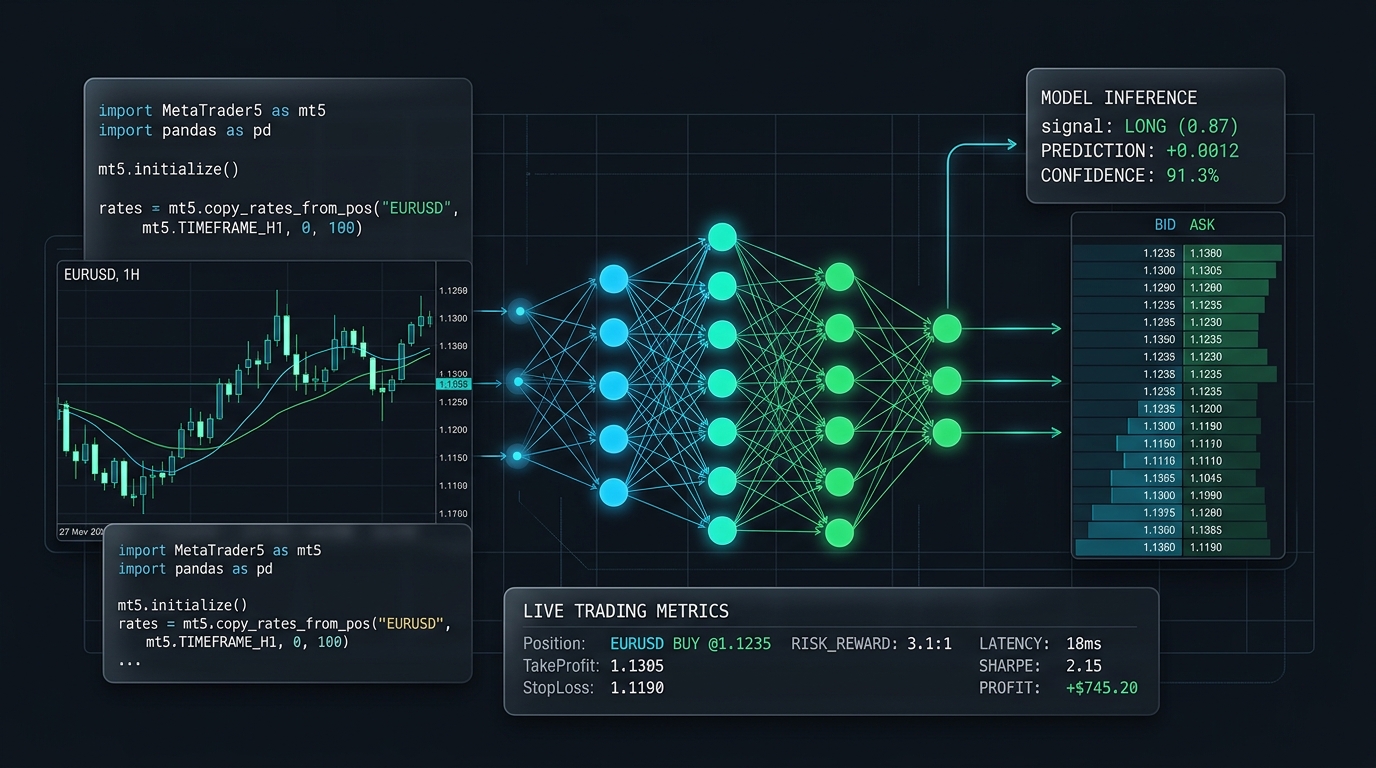
1. The Fatal Flaws of Retail Bots vs. Institutional AI Architecture
Almost 95% of retail algorithmic traders who purchase off-the-shelf Expert Advisors (EAs) or download indicator-based bots blow their accounts within 90 days. The reason is not bad luck—it is architectural suicide:
- Lagging Indicator Traps: Strategies built on RSI oversold conditions or MACD crossovers fail during sustained institutional trends. In a 500-pip Gold (XAUUSD) expansion, RSI can stay "oversold" for days while retail accounts get liquidated.
- Martingale & Grid Averaging: Commercial EAs hide losing trades by doubling down as price goes against them. This produces smooth equity curves for two months until one black-swan event triggers an unrecoverable 100% drawdown.
- Monolithic MQL5 Scripts: Writing execution logic, machine learning inference, and risk controls in a single
.mq5file leaves you with no external observability, no failover circuit breakers, and zero automated logging.
To solve this, our production system—which powers both the Morpheus Analysis platform and our automated execution engine at morpheus.naveedkumbhar.com—uses a decoupled, three-tier architecture that isolates market data extraction, AI cognitive evaluation, and broker execution.
Never let an LLM or an indicator hold direct broker API keys without a mathematical risk proxy sitting in the middle. The execution engine must strictly reject any order that violates maximum position risk or daily drawdown thresholds, regardless of AI confidence scores.
The 970+ Incident Handbook & K8s Runbooks are exclusive to subscribers — unlock for FREE
Get battle-tested production runbooks, AWS architecture blueprints, and zero-downtime CI/CD post-mortems sent directly to your inbox. 100% free, no spam.
2. System Architecture: Decoupling the Model from Execution
Here is the production architecture running across our Linux orchestration cluster and Windows execution hosts:
1. MT5 Python Bridge
A headless FastAPI / Uvicorn worker running alongside MetaTrader 5 on an AWS EC2 instance, exposing tick feeds and accepting validated orders via JSON RPC.
2. Analysis & Tool Orchestrator
A Node.js / Python daemon evaluating multi-timeframe candle structure, Asian session liquidity pools, and Candle Range Theory (CRT) setups.
3. AI Confirmation Gate
A structured GPT-4o / DeepSeek R1 tool-calling gate that cross-examines setups against macroeconomic calendars, USD DXY bias, and spread anomalies.
4. Deterministic Risk Gatekeeper
A zero-trust execution gate that calculates exact lot sizing for a 1% risk limit and enforces a hard 2.5% daily stop for prop firm compliance.
For background on how this evolved from an initial automated setup into a full product surface, see our companion article Building an Autonomous 3 AM AI Trading Assistant and review the interactive lab at lab.naveedkumbhar.com/morpheus.
3. Step 1: Building the Python to MetaTrader 5 IPC Bridge
MetaTrader 5 provides an official Python library (MetaTrader5) that communicates via local Inter-Process Communication (IPC) with the 64-bit MT5 desktop client.
First, install the required packages on your Windows execution instance:
pip install MetaTrader5 pandas numpy fastapi uvicorn pydantic python-dotenvHere is a production-hardened initialization module that handles terminal verification, automated reconnection, and trading permissions:
import MetaTrader5 as mt5
import logging
import os
from pydantic import BaseModel

logging.basicConfig(level=logging.INFO, format="%(asctime)s [%(levelname)s] %(message)s")

class MT5Client:
    def __init__(self, account: int, password: str, server: str, path: str = None):
        self.account = account
        self.password = password
        self.server = server
        self.path = path or r"C:\Program Files\MetaTrader 5\terminal64.exe"

    def connect(self) -> bool:
        if not mt5.initialize(path=self.path):
            logging.error(f"MT5 initialize failed: {mt5.last_error()}")
            return False

        authorized = mt5.login(login=self.account, password=self.password, server=self.server)
        if not authorized:
            logging.error(f"Login failed for account {self.account}: {mt5.last_error()}")
            mt5.shutdown()
            return False

        terminal = mt5.terminal_info()
        if not terminal.trade_allowed:
            raise RuntimeError("Algorithmic Trading is disabled in MT5 options!")

        logging.info(f"Connected to MT5 broker: {self.server} (Ping: {terminal.ping_last} us)")
        return True

    def get_account_balance(self) -> float:
        account_info = mt5.account_info()
        if account_info is None:
            raise RuntimeError(f"Failed to fetch account info: {mt5.last_error()}")
        return account_info.balance, account_info.equity
4. Step 2: Multi-Timeframe Order Flow & Liquidity Extraction
Rather than feeding raw prices into machine learning models, institutional systems compress price action into structural features:
- Asian Range Boundaries: Calculating the high and low established between 00:00 UTC and 07:00 UTC. In London open, market makers frequently sweep these levels to capture retail stop orders.
- Fair Value Gaps (FVG): Detecting 3-candle imbalances where buyer or seller aggression left unfilled liquidity.
- Candle Range Theory (CRT): Identifying whether the prior 4H candle's high or low has been manipulated before reversing back inside the range.
Here is how to extract and compute these liquidity markers in Python:
from datetime import datetime, timezone
import pandas as pd

def fetch_multi_timeframe_rates(symbol: str, count: int = 100):
    """Fetch M5, H1, and H4 candles for structural analysis."""
    timeframes = {
        "M5": mt5.TIMEFRAME_M5,
        "H1": mt5.TIMEFRAME_H1,
        "H4": mt5.TIMEFRAME_H4,
    }
    data = {}
    for tf_name, tf_code in timeframes.items():
        rates = mt5.copy_rates_from_pos(symbol, tf_code, 0, count)
        df = pd.DataFrame(rates)
        df['time'] = pd.to_datetime(df['time'], unit='s', utc=True)
        data[tf_name] = df
    return data

def calculate_asian_session_range(df_m5: pd.DataFrame):
    """Compute Asian high and low liquidity pools (00:00 - 07:00 UTC)."""
    asian_candles = df_m5[
        (df_m5['time'].dt.hour >= 0) & (df_m5['time'].dt.hour < 7)
    ]
    asian_high = asian_candles['high'].max()
    asian_low = asian_candles['low'].min()
    return {"asian_high": asian_high, "asian_low": asian_low}
To explore interactive trade setups generated with this method across Gold, Forex, and Crypto, read our comprehensive Gold (XAUUSD) Trading Bot Guide and the Smart Money Concepts Bot Guide.
5. Step 3: Implementing GPT-4o Tool Calling & Trade Confirmation
Instead of using general chat models, modern AI trading agents use structured tool calling with strictly enforced JSON schemas. The model acts as an analytical filter, verifying that the proposed setup meets institutional criteria before an order is placed:
from openai import OpenAI
import json

client = OpenAI()

trade_evaluation_tools = [
    {
        "type": "function",
        "function": {
            "name": "evaluate_trade_setup",
            "description": "Evaluate multi-timeframe liquidity setup for execution approval",
            "parameters": {
                "type": "object",
                "properties": {
                    "decision": {
                        "type": "string",
                        "enum": ["EXECUTE", "REJECT"],
                        "description": "Approval decision based on liquidity sweep validation"
                    },
                    "risk_percent": {
                        "type": "number",
                        "description": "Risk percentage allocated (capped at 1.0%)"
                    },
                    "invalidation_price": {
                        "type": "number",
                        "description": "Exact Stop Loss level behind the manipulation wick"
                    },
                    "take_profit_1": {
                        "type": "number",
                        "description": "Target at 1:1 risk-reward for partial close"
                    },
                    "reasoning": {
                        "type": "string",
                        "description": "Detailed justification citing session bias and FVG confirmation"
                    }
                },
                "required": ["decision", "risk_percent", "invalidation_price", "take_profit_1", "reasoning"]
            }
        }
    }
]
6. Step 4: The 1% Dynamic Position Sizing & Prop Firm Guard
The core reason institutional bots survive while retail bots fail is dynamic position sizing. Fixed lot sizes (e.g. trading a flat 1.0 lot on every setup) are fatal because a 40-pip stop on Gold represents four times the monetary risk of a 10-pip stop.
Our dynamic lot sizing formula ensures that regardless of stop distance, the maximum potential loss is exactly 1% of account equity:
def calculate_lot_size(symbol: str, stop_loss_price: float, risk_percent: float = 1.0) -> float:
    """Calculate exact lot size to ensure risk never exceeds risk_percent."""
    account_info = mt5.account_info()
    equity = account_info.equity
    tick_info = mt5.symbol_info_tick(symbol)
    symbol_info = mt5.symbol_info(symbol)

    current_price = tick_info.ask
    risk_amount = equity * (risk_percent / 100.0)
    stop_distance_points = abs(current_price - stop_loss_price) / symbol_info.point

    # Calculate tick value in account currency
    tick_value = symbol_info.trade_tick_value
    tick_size = symbol_info.trade_tick_size
    point = symbol_info.point

    # Point value per lot
    point_value_per_lot = (tick_value / tick_size) * point
    calculated_lots = risk_amount / (stop_distance_points * point_value_per_lot)

    # Normalize to broker lot step
    lot_step = symbol_info.volume_step
    normalized_lots = round(calculated_lots / lot_step) * lot_step
    clamped_lots = max(symbol_info.volume_min, min(symbol_info.volume_max, normalized_lots))

    return round(clamped_lots, 2)
For prop firm evaluation accounts (such as FTMO, FundedNext, or The5ers), our system integrates an automated 2.5% Daily Drawdown Circuit Breaker. If daily realized plus unrealized losses reach 2.5%, the bot immediately liquidates open exposure and locks order routing until the next trading day.
Read our detailed breakdown in the FTMO Prop Firm Bot Rules & Drawdown Compliance Guide.
7. Step 5: Containerized Production Deployment & Systemd
In production, we run the orchestration backend on Linux using Docker Compose, while the MT5 execution worker runs under a managed Windows task or Wine-isolated container.
Here is our production Docker Compose topology:
services:
  morpheus-orchestrator:
    image: node:20-alpine
    container_name: morpheus-orchestrator
    restart: always
    environment:
      - NODE_ENV=production
      - MT5_BRIDGE_URL=http://47.129.125.172:5000
      - OPENAI_API_KEY=${OPENAI_API_KEY}
      - ANALYSIS_ONLY=1
    ports:
      - "3001:3001"
    depends_on:
      - postgres

  postgres:
    image: postgres:16-alpine
    container_name: morpheus-postgres
    restart: always
    environment:
      - POSTGRES_DB=morpheus
      - POSTGRES_PASSWORD=${DB_PASSWORD}
    volumes:
      - pgdata:/var/lib/postgresql/data

volumes:
  pgdata:
For infrastructure teams managing high-reliability cloud architectures, explore our real-world tutorials on Optimizing Docker Build Speed & Layer Caching and Deploying Kubernetes on AWS.
8. Production Checklist & Key Architectural Takeaways
- Decouple Model from Execution: Never allow an LLM or indicator to execute trades without an independent mathematical risk proxy enforcing stop losses and balance caps.
- Dynamic 1% Position Sizing: Hardcode position sizing to calculate exact lots based on pip distance to stop-loss, keeping dollar risk constant across volatile instruments.
- Enforce Prop Firm Circuit Breakers: Set a hard 2.5% daily drawdown shutdown threshold to safeguard funded accounts from consecutive losses or market news slippage.
- Trade Liquidity, Not Indicators: Institutional edges come from understanding session liquidity pools (Asian highs/lows) and Candle Range Theory (CRT), not lagging oscillators.
- Full Audit Logging: Record every signal, execution timestamp, entry price, and R-multiple outcome in a persistent database for ongoing performance calibration.
To test these automated setups live with real-time institutional liquidity maps and paper trading, sign up for free at morpheus.naveedkumbhar.com or read the dedicated technical documentation in our Python MT5 Trading Bot Guide.