1. The Death of the "DevOps Team" Silo
To understand why people are declaring DevOps dead, you have to look at what enterprises did to it over the last decade.
When Patrick Debois coined the term in 2009 and John Allspaw delivered the legendary "10+ Deploys Per Day" presentation at Velocity, DevOps was defined as a cultural imperative: tearing down the literal and figurative wall between developers who ship features and sysadmins who protect uptime. The foundation was codified in the CALMS framework:
- Culture: Shared operational accountability across functional disciplines.
- Automation: Eliminating repetitive toil in pipelines and provisioning.
- Lean: Small batch sizes, low work-in-progress (WIP), and fast handoffs.
- Measurement: Objective telemetry (DORA metrics: deployment frequency, lead time, change failure rate, MTTR).
- Sharing: Blameless postmortems and mutual visibility into system behavior.
None of these principles mentioned a job title. Yet within five years, executive management committed the ultimate organizational anti-pattern: they created a dedicated "DevOps Department".
“When you take a culture intended to eliminate handoffs and turn it into a dedicated silo with its own Jira queue, you haven’t adopted DevOps—you’ve merely rebranded your operations bottleneck with cooler stickers on their MacBooks.”
Instead of developers learning how their code behaved in production, they opened tickets: “Please provision a PostgreSQL RDS instance,” or “Please write a Jenkins pipeline for my repo.” The DevOps engineers became human proxies between product teams and cloud APIs. They spent their days juggling conflicting pull requests, untangling 8,000-line Jenkins Groovy scripts, and manually editing Terraform state files.
This model was doomed to fail. It burnt out infrastructure engineers, frustrated product teams waiting three weeks for an S3 bucket, and created the very delivery paralysis DevOps was invented to dismantle. That ticket-taking silo is dead. Good riddance.
The 970+ Incident Handbook & K8s Runbooks are exclusive to subscribers — unlock for FREE
Get battle-tested production runbooks, AWS architecture blueprints, and zero-downtime CI/CD post-mortems sent directly to your inbox. 100% free, no spam.
2. Cognitive Load: Why "You Build It, You Run It" Cracked Under Pressure
In 2006, Amazon CTO Werner Vogels coined the immortal phrase: “You build it, you run it.” The premise was sound: when developers are on call for their own services, they write better, more resilient code.
However, between 2015 and 2024, the cloud-native ecosystem exploded into an overwhelming labyrinth. Look at the Cloud Native Computing Foundation (CNCF) landscape today: over 1,400 discrete projects spanning service meshes, eBPF observabilities, GitOps controllers, policy engines, and container runtimes.
Expecting a product engineer whose job is to ship a React front-end or a payment settlement service to also master Istio mTLS, NetworkPolicies, Karpenter provisioners, Terraform state locks, and Prometheus recording rules is an architectural failure. High cognitive load doesn't empower developers—it paralyzes them.
In practice, "You build it, you run it" without proper platform abstractions meant that every product team reinvented the wheel:
- Team A wrote their own bespoke Helm chart with 45 optional toggles that nobody understood.
- Team B copy-pasted a 4-year-old Terraform module with hardcoded security group rules (
0.0.0.0/0on port 5432). - Team C accidentally starved cluster capacity by configuring Pod requests equal to limits without Horizontal Pod Autoscaling, causing widespread node eviction storms.
During incidents, developers were confronted with cryptic container exit codes like OOMKilled (Exit 137) or complex CNI ipam exhaustion. If your engineers spend 40% of their mental bandwidth debugging Docker overlays and AWS IAM role trusts instead of writing business logic, your delivery pipeline is actively bleeding enterprise value.
For a step-by-step breakdown of how production memory limits trigger out-of-memory kernel kills, review the OOMKilled Memory Limits vs. Requests Triage Guide.
3. The Evolution Across Three Distinct Eras (2009–2026)
DevOps did not suddenly perish; it evolved through three distinct evolutionary eras. Understanding these phases reveals why today’s changes are natural maturation, not obsolescence.
In Era 1, we solved manual server building with code. In Era 2, we solved scale with containers and declarative manifests, but burdened every human with configuration management. In Era 3, we build platforms as products to shield developers from unnecessary complexity while preserving absolute architectural governance.
4. Platform Engineering: DevOps With an Interface
The prevailing online narrative pits Platform Engineering as the mortal enemy of DevOps. In reality, Platform Engineering is simply DevOps scaled to enterprise maturity.
If DevOps is the philosophy that software delivery should be continuous, automated, and collaborative, Platform Engineering is the delivery mechanism. A Platform Team does not build applications for customers; their customers are the internal software engineering squads. Their product is the Internal Developer Platform (IDP).
Golden Paths vs. Golden Cages
The defining paradigm of modern platform architecture is the Golden Path (or paved road). A Golden Path is an opinionated, supported, self-service route to build, deploy, and observe a service without submitting a ticket or wrestling with raw YAML.
Crucially, Golden Paths must never become Golden Cages:
- If a developer stays on the Golden Path: They get automated zero-trust TLS, instant continuous reconciliation via GitOps, automated SLO alerts, and seamless compliance audits for free.
- If a developer goes off the Golden Path: They are free to do so, but they inherit full operational accountability for their bespoke infrastructure, including vulnerability patching and incident response.
Under the Hood: Backstage + Crossplane in Action
Consider how modern platform engineering replaces 10 manual Jira handoffs with a declarative custom resource. Instead of a developer learning the intricacies of AWS VPC peering, subnets, and KMS envelope encryption, they interact with a Backstage Software Template that publishes a lightweight Kubernetes Custom Resource (CR):
# Modern Developer Intent: A simple, declarative database claim
apiVersion: database.platform.naveedkumbhar.com/v1alpha1
kind: PostgreSQLInstance
metadata:
  name: billing-ledger-db
  namespace: billing-prod
spec:
  parameters:
    storageGB: 100
    highAvailability: true
    engineVersion: "16.2"
  writeConnectionSecretToRef:
    name: billing-db-credentials
Under the hood, a Crossplane Composition managed by the platform team translates that simple 15-line claim into a fully hardened, multi-AZ Amazon RDS cluster, provisioned inside the correct private subnet tier, encrypted with AWS KMS customer-managed keys, wired with automated snapshots, and connected via Kubernetes External Secrets Operator:
# The developer checks status directly via kubectl or Backstage UI
$ kubectl get postgresqlinstance billing-ledger-db -n billing-prod
NAME                 READY   SYNCED   AGE   ENDPOINT
billing-ledger-db    True    True     4m    rds-pg-prod-priv.internal.naveedkumbhar.com

# Verify that configuration drift is continuously reconciled by GitOps
$ argocd app get billing-ledger-app --refresh
GROUP               KIND               STATUS    HEALTH   HOOK  MESSAGE
platform.naveedkumbhar PostgreSQLInstance Synced    Healthy        postgresqlinstance.database.platform... created
apps                Deployment         Synced    Healthy        deployment.apps/billing-api updated
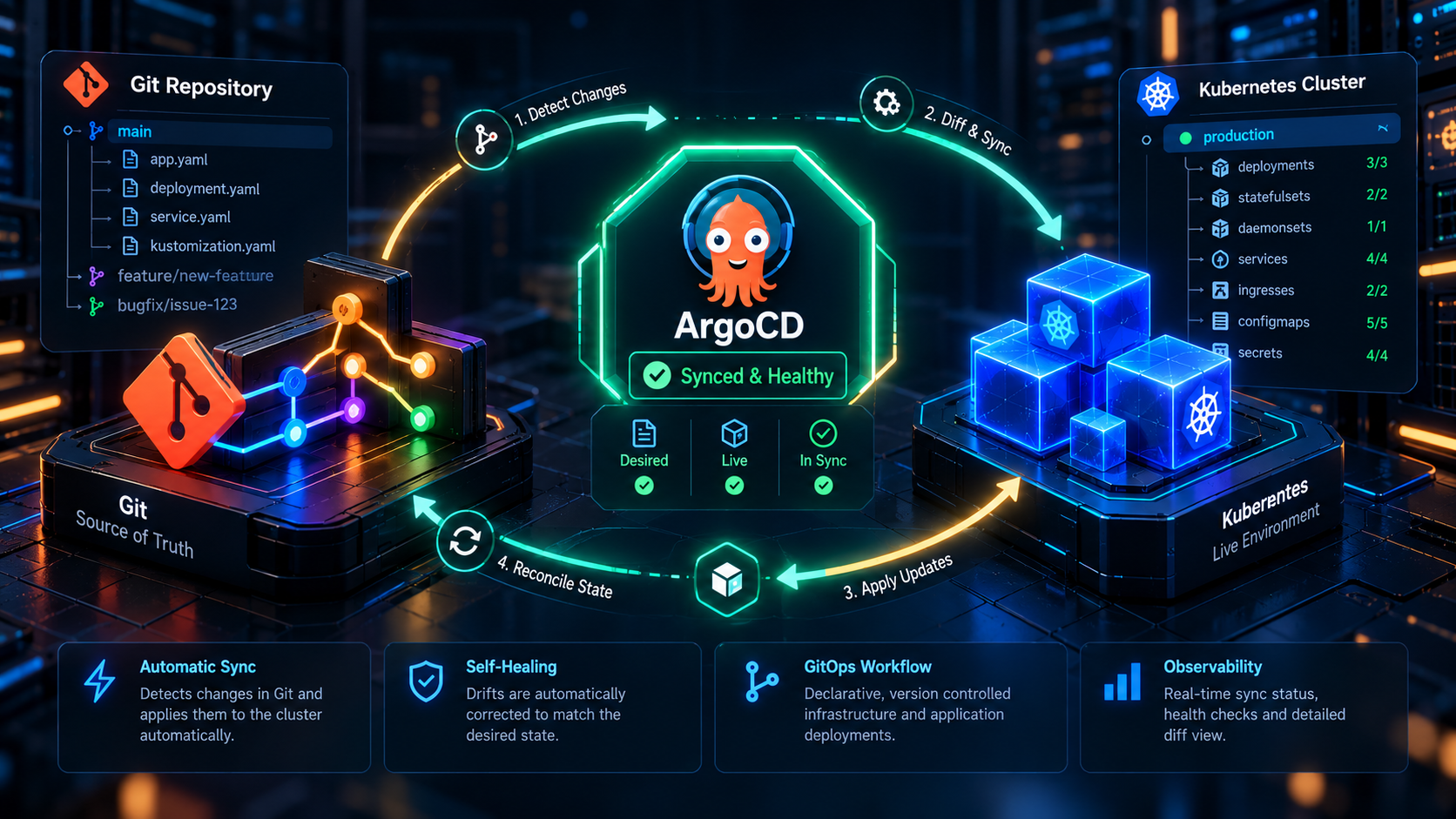
For an architectural deep dive into stopping configuration drift in Kubernetes clusters with continuous reconciliation and self-healing policies, reference our comprehensive guide on GitOps with ArgoCD: Eliminating Configuration Drift.
5. Will AI Replace DevOps Engineers? The 3 AM Incident Test
With the advent of autonomous AI agents, GitHub Copilot, and LLM-assisted coding, another sensationalist claim has gained traction: “AI will write all infrastructure code and resolve outages automatically. You won’t need DevOps or SRE engineers by 2027.”
Let's look at the facts based on real-world production incident response.
Modern AI excels at synthesizing high-entropy telemetry: correlating 10,000 Datadog alerts into a single incident summary, drafting complex PromQL recording queries, translating legacy Bash scripts into Go operators, and generating baseline Terraform boilerplate.
Now consider what happens during a severe, non-deterministic 3 AM Production Outage.
The 3 AM Production Incident Reality
Imagine a distributed multi-region Kubernetes cluster running an e-commerce platform during Black Friday. Suddenly, API gateway 504 Gateway Timeouts surge by 1,400%.
Here is the actual root-cause cascade:
- An AWS IMDSv2 token renewal loop on worker nodes triggers kernel socket exhaustion.
- The CNI plugin fails to allocate IP addresses to newly autoscaling pods.
- Etcd experiences Raft proposal timeouts due to write amplification on underlying EBS gp3 IOPS throttling.
- The Kubernetes Control Plane drops leader election, causing cascading Pod CrashLoopBackOff states.
If you feed those raw error logs into a generic LLM agent without deterministic domain constraints, what does it suggest?
“Try restarting kube-apiserver and executing kubectl rollout restart deployment across the namespace.”
Executing that recommendation in production would immediately terminate 2,000 healthy running pods, overload etcd completely, and cause catastrophic state corruption across every transactional database connection pool.
AI cannot negotiate customer SLAs, decide which microservice to shed during an overload shedding policy, or shoulder legal accountability for a HIPAA or SOC 2 blast radius. AI automates execution; human systems engineers provide architectural judgment.
As explored in our technical breakdown on How AI Agents Automate DevOps Runbooks Safely and Why AI Is DevOps' Greatest Ally, the future is not AI replacing engineers. It is senior engineers operating as Agent Supervisors, using deterministic guardrails to orchestrate autonomous tools.
6. Hard Market Evidence: Job Demand, DORA Metrics & Salaries
If DevOps were dying, the job market would show an unmistakable collapse in hiring demand and plummeting compensation. What do the numbers actually show?
1. Job Title Migration vs. Skill Demand
Data from platforms like LinkedIn, Indeed, and Dice reveals a notable nuance:
- Pure listings for generic “DevOps Engineer” titles have plateaued or decreased by ~8% over the past 24 months.
- Concurrently, listings for “Platform Engineer”, “Site Reliability Engineer (SRE)”, and “Cloud Infrastructure Architect” surged by over 42% year-over-year.
Organizations haven't stopped hiring infrastructure specialists; they are refining their requirements. They no longer want a sysadmin who writes Jenkins bash scripts. They want engineers who understand Kubernetes internals, distributed systems reliability, and developer experience.
2. Compensation Realities in 2026
Market compensation data paints a stark contrast between two classes of practitioners:
- Superficial "Click-Ops" Admins: Engineers whose primary skill set is manually clicking through the AWS/Azure console, writing basic shell scripts, or managing legacy CI tools are experiencing wage stagnation ($85,000 – $115,000 USD).
- Platform & Distributed Systems Architects: Engineers who master Kubernetes operators, Go/Rust tooling, eBPF telemetry, Crossplane control planes, and FinOps cloud efficiency command top-tier compensation ($175,000 – $260,000+ USD base, with total compensation exceeding $350,000 in enterprise tech hubs).
To test your real-world readiness for high-stakes platform engineering and SRE technical interviews, practice scenario-based challenges on the Production SRE Interview Scenario Hub.
7. Architectural Comparison: Legacy DevOps vs. Modern Platform Engineering
The table below provides a side-by-side architectural comparison illustrating how key operational domains have shifted from legacy DevOps practices to modern platform-centric delivery:
| Operational Dimension | Legacy DevOps (2016–2022) DYING | Modern Platform Engineering (2026+) THRIVING |
|---|---|---|
| Primary Operating Model | Centralized "DevOps Team" responding to ad-hoc Jira tickets | Dedicated Platform Team treating the Internal Developer Platform as a Product |
| Infrastructure Provisioning | Developers submit requests; DevOps manually runs terraform apply |
Self-service Developer Portals (Backstage) powered by Crossplane & GitOps |
| Continuous Delivery (CD) | Push-based CI runners executing imperatively with cluster admin credentials | Pull-based declarative GitOps (ArgoCD/Flux) with automated self-healing drift detection |
| Developer Interaction | Raw YAML manifests, hundreds of Helm values flags, direct cloud consoles | Curated "Golden Paths", unified CLI tooling, and abstracted service templates |
| Security & Governance | Late-stage security gate audits blocking Friday releases | Continuous Policy-as-Code (Kyverno / OPA Gatekeeper) and automated SLSA supply-chain signing |
| Incident Response | Manual log grepping, alert storm triage, heroic 3 AM firefighter debugging | AI-assisted telemetry correlation, automated runbooks with human approval, SLO burn alerts |
| North Star Metric | Number of tickets closed; raw deployment counts | Time-to-First-Hello-World (TTFHW), Developer Net Promoter Score (DevNPS), DORA metrics |
8. Five Critical Anti-Patterns to Eliminate in 2026
If your organization is navigating this transition, watch out for these five pervasive failure modes:
1. The "Ivory Tower" Platform Team
Platform engineers who retreat into an isolation chamber for nine months to build a monolithic developer portal without talking to product engineers always fail. If your platform doesn't solve real developer pain on Day 30, developers will route around it with rogue cloud accounts and shadow IT.
2. Mandating the Golden Path as a Dictatorship
Forcing teams onto a platform by executive fiat breeds deep resentment and exposes production to unmanaged risks. The best platforms win through product excellence. The Golden Path must be so smooth, reliable, and frictionless that choosing anything else feels irrational.
3. Multi-Cluster Configuration Drift
Relying on developers or scripts running imperative kubectl apply commands across multiple clusters creates catastrophic silent drift. In production, Git must remain the single source of truth, backed by automated reconciliation controllers like ArgoCD that overwrite unauthorized live mutations within seconds.
4. "Shift-Left" as Unfunded Cognitive Debt
Telling developers to "shift security left" by dumping 400 raw vulnerability scanner alerts into their pull requests does not improve security—it causes alert fatigue and cynicism. A true platform team curates base images, automates dependency remediation via pull requests, and provides secure-by-default runtime primitives.
5. Ungoverned Autonomous AI Agents in Production
Granting autonomous AI agents write permissions to your Kubernetes production control plane or AWS IAM policies is a disaster waiting to happen. Agents must always operate within sandboxed blast radiuses, with mandatory human-in-the-loop signoff for state-mutating actions.
9. The 2026 Career Survival Blueprint: What You Must Master Today
If you are currently a DevOps engineer, cloud administrator, or SRE, how do you position yourself for the next decade of infrastructure engineering?
- Master Declarative Control Planes & GitOps: Stop writing imperative bash deployment scripts. Learn how to write Kubernetes Custom Resource Definitions (CRDs), operators in Go, and Crossplane Compositions. Master ArgoCD self-healing workflows.
- Internalize Systems Fundamentals: Frameworks and tools change; kernel and networking fundamentals do not. Understand Linux cgroups v2, network namespaces, eBPF, TCP socket buffers, and CIDR subnet math. Explore our free interactive DevOps Networking Tools to sharpen your mental math on AWS VPC subnet calculations.
- Adopt Product Thinking for Platforms: Learn user research, user journey mapping, and how to measure developer friction using the SPACE framework (Satisfaction, Performance, Activity, Communication, Efficiency) alongside DORA metrics.
- Enforce Shift-Left Security as Code: Master Kyverno and OPA Gatekeeper for declarative admission control, Cosign for cryptographic image signing, and Trivy for container scanning.
- Become an Agentic Infrastructure Supervisor: Learn how to safely integrate AI agents into operational runbooks. Understand prompt architecture, retrieval-augmented generation (RAG) over internal runbooks, and strict policy boundaries for automated incident triage.
For hands-on practice across 180+ real-world Kubernetes failure scenarios—from pod scheduling deadlocks to etcd split-brain recoveries—explore our interactive Kubernetes Mastery Quizzes & Certification Engine.
10. Frequently Asked Questions
A: No. The core philosophical pillars of DevOps—continuous delivery, automated feedback loops, cross-functional collaboration, and systems thinking—are more critical than ever. What is dying is the legacy anti-pattern of the siloed "DevOps Team" acting as a glorified ticket-taking operations proxy, as well as the expectation that every product developer must personally master the labyrinth of raw Kubernetes and cloud infrastructure.
A: DevOps is a cultural philosophy and operational framework aimed at unifying software development and delivery. Platform Engineering is the practical discipline of designing and running Internal Developer Platforms (IDPs) that deliver self-service infrastructure and golden paths as a product. Platform Engineering does not replace DevOps; it is the modern evolutionary mechanism that makes DevOps scalable without overwhelming developers.
A: AI will not replace engineers who understand complex distributed systems, but engineers leveraging AI will rapidly replace those doing repetitive, manual ticket-taking. While LLMs excel at log summarization, anomaly clustering, and boilerplate generation, they fail fundamentally at high-stakes, non-deterministic 3 AM production incidents—such as etcd Raft quorum drops, network partition split-brains, and multi-tenant security blast radius negotiations.
A: The early cloud-native era forced developers to become accidental infrastructure specialists. Expecting a full-stack engineer shipping customer features to also master Helm templating, Istio service meshes, Terraform state locking, NetworkPolicies, Karpenter provisioners, and Prometheus recording rules led directly to burnout, slower deployment velocity, and dangerous misconfigurations in production.
A: Engineers should focus on Platform-as-a-Product capabilities (Backstage, Port, developer experience), declarative control planes (Crossplane, ArgoCD, GitOps), deep systems fundamentals (Linux namespaces, eBPF, Cilium, networking), supply-chain security (Kyverno, OPA, Cosign), and AI-augmented operations (safe runbook automation with deterministic human-in-the-loop guardrails).