Production infrastructure teams woke up to an emergency security advisory known as NGINX2root, a critical disclosure chain led by CVE-2026-123007 that exposes NGINX web servers to unauthenticated remote code execution. Unlike application-layer vulnerabilities that target isolated microservices, NGINX2root strikes the foundational reverse proxy layer that terminates public internet traffic across millions of enterprise clouds, API gateways, and Kubernetes Ingress clusters. Carrying a critical CVSS score of 9.2, this vulnerability allows external attackers to send crafted HTTP/2 frames that corrupt worker process memory and chain local privilege escalation to seize root privileges on host servers. SREs and platform engineers must immediately determine affected versions, avoid common operational patching traps, and execute zero-downtime mitigations.
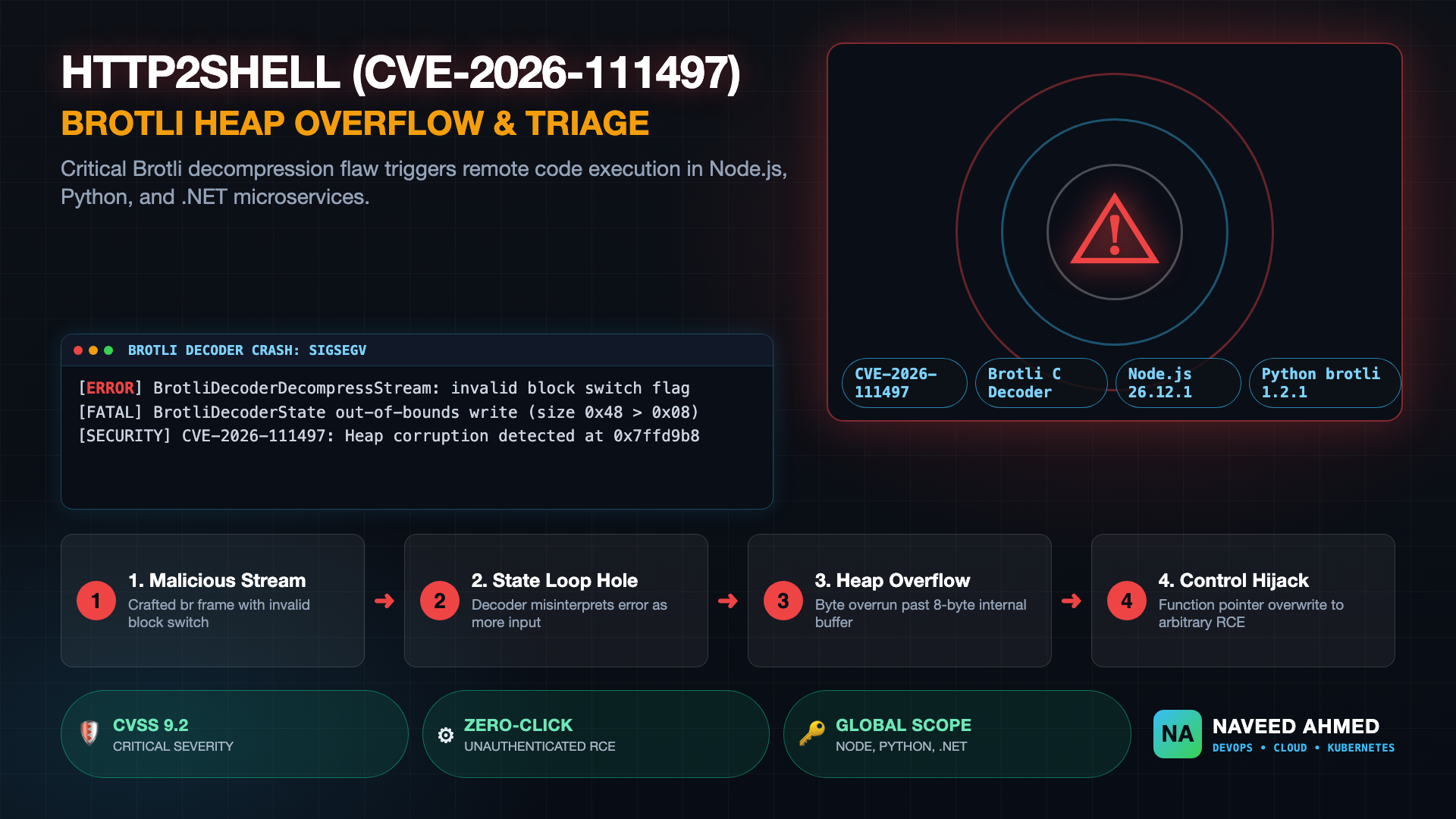
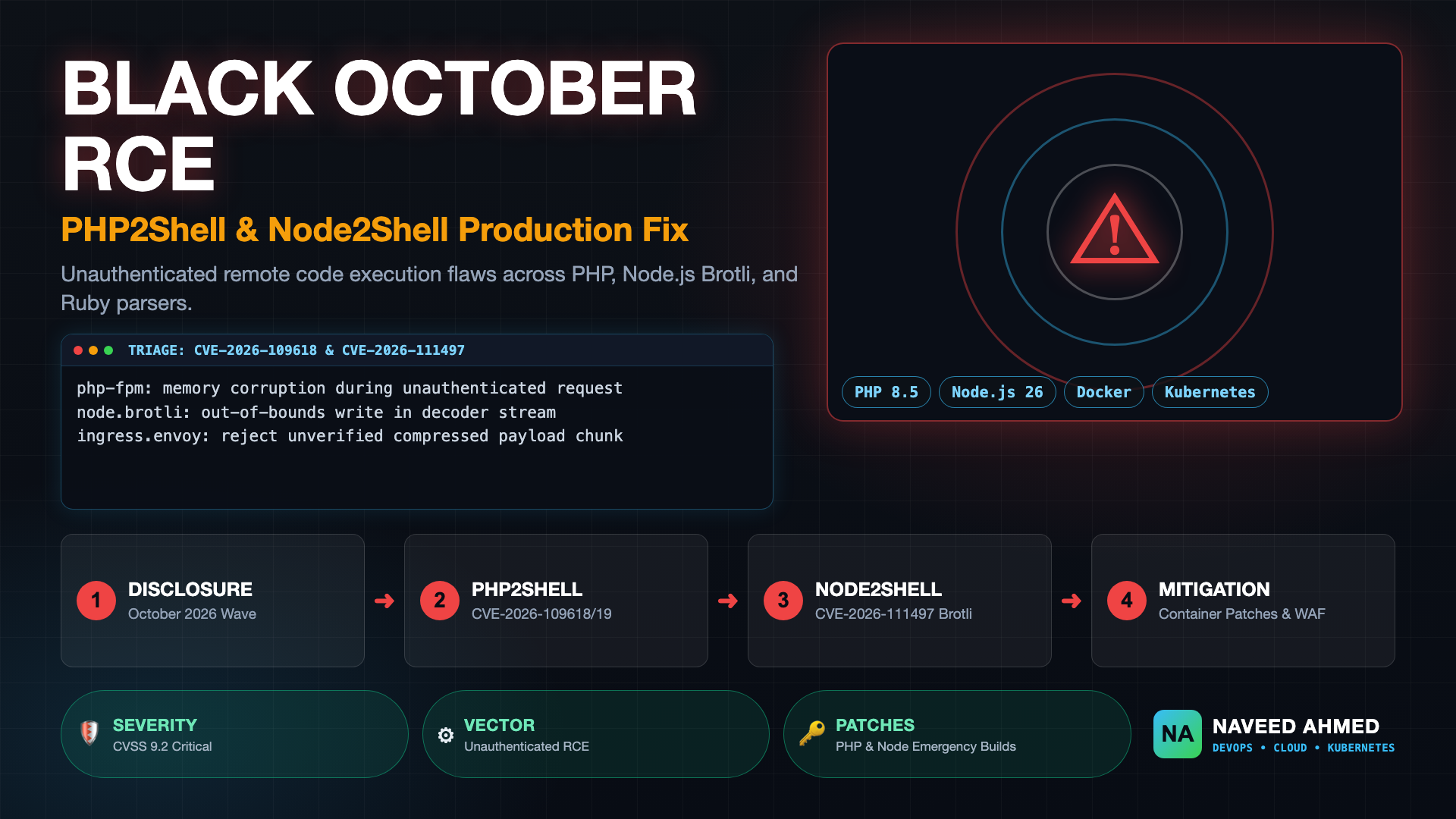
The severity of NGINX2root mirrors recent protocol-level emergencies such as the HTTP2Shell Brotli buffer overflow and the broader Black October vulnerabilities wave. However, because NGINX acts as the public perimeter for downstream backends, an unauthenticated perimeter compromise bypasses internal zero-trust network boundaries. When orchestrating emergency security rollouts across infrastructure fleets, engineers should review how to review terraform plans without destroying production and verify container health using our guide on Kubernetes CrashLoopBackOff troubleshooting. For architectures evaluating resilient, memory-safe alternatives to legacy reverse proxies, explore our Caddy web server migration guide.
What Is NGINX2root and How Does the HTTP/2 RCE Exploit Work?
NGINX2root is a critical multi-vulnerability chain centered on CVE-2026-123007, an integer underflow and heap buffer overflow in NGINX's HTTP/2 protocol module (ngx_http_v2_module). Disclosed by Qualys and security research teams, the flaw allows an unauthenticated remote attacker to send crafted HTTP/2 flow control frames that corrupt worker heap memory, execute arbitrary shell code in the worker process, and chain an unpatched Linux kernel vulnerability to achieve full host root access.
To understand the mechanics of this flaw, we must examine how NGINX handles HTTP/2 stream multiplexing and flow control. In HTTP/2, both client and server negotiate independent stream bandwidth using WINDOW_UPDATE frames. These frames inform the remote peer how many bytes of data it is permitted to transmit without saturating receiver buffers.
Within NGINX's native C codebase (specifically src/http/v2/ngx_http_v2.c and ngx_http_v2_filter_module.c), the handler function responsible for parsing stream window increments failed to perform safe boundary validation against integer underflow conditions:
/* Vulnerable pattern in ngx_http_v2_state_window_update */
static u_char *
ngx_http_v2_state_window_update(ngx_http_v2_connection_t *h2c, u_char *pos, u_char *end)
{
    size_t   window;
    ngx_http_v2_node_t  *node;

    window = ngx_http_v2_parse_uint32(pos);

    /* Missing threshold check for negative or wrapped delta values */
    node->recv_window += window;

    if (node->recv_window > NGX_HTTP_V2_MAX_WINDOW) {
        /* Integer underflow during rapid window decrement */
        ngx_http_v2_connection_error(h2c, NGX_HTTP_V2_FLOW_CONTROL_ERROR);
        return ngx_http_v2_state_save(h2c, pos, end);
    }

    return ngx_http_v2_state_complete(h2c, pos, end);
}
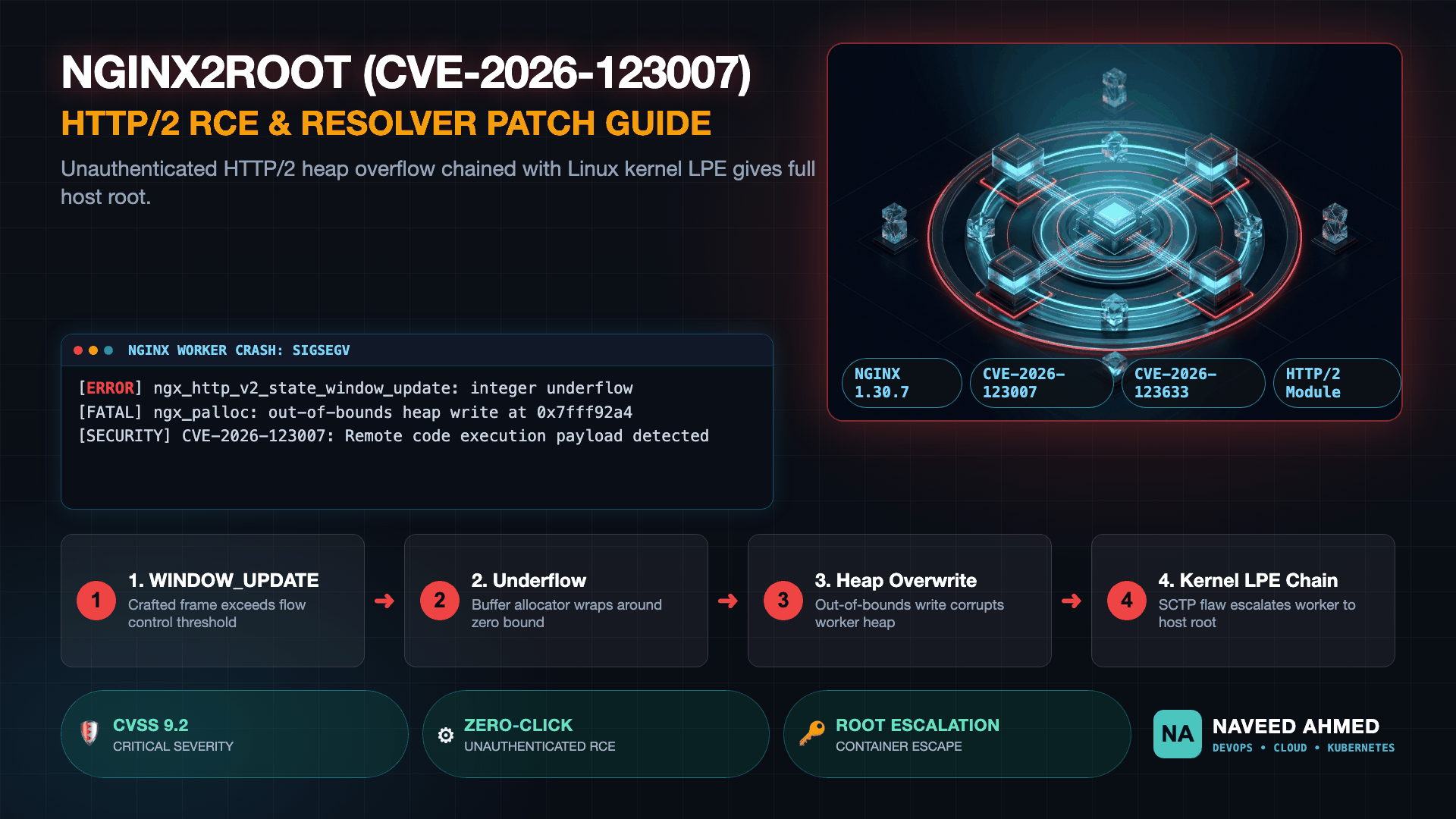
When an attacker pipelines a series of rapid, contradictory stream window advertisements alongside interleaved payload frames, the internal calculation for available buffer space wraps around zero. This integer underflow leads the internal buffer allocation routine (ngx_palloc) to allocate an undersized memory region while the frame ingestion loop continues copying incoming bytes. The resulting out-of-bounds heap write overwrites neighboring heap structures, specifically corruption of connection state pointers and function dispatch vectors.
Malformed Frames
Unauthenticated client delivers crafted HTTP/2 WINDOW_UPDATE frames designed to trigger flow control boundary wrap.
Heap Corruption
Integer underflow in window calculation results in out-of-bounds heap write past allocated pool chunk boundaries.
Code Execution
Overwritten function pointer tables redirect execution flow, running arbitrary shell payload under the nginx worker user.
Root Escalation
Worker process invokes a local Linux kernel SCTP socket use-after-free, escaping container sandboxes to capture root.
What elevates this disclosure from an unauthenticated worker crash into the full "NGINX2root" moniker is the chained local privilege escalation (LPE). Once attackers achieve remote code execution inside the unprivileged nginx or nobody worker process, they trigger a dormant Linux kernel vulnerability in SCTP socket buffer processing, escalating privileges to root on the host operating system.
The 970+ Incident Handbook & K8s Runbooks are exclusive to subscribers — unlock for FREE
Get battle-tested production runbooks, AWS architecture blueprints, and zero-downtime CI/CD post-mortems sent directly to your inbox. 100% free, no spam.
Which Versions of NGINX Are Vulnerable to NGINX2root?
Any NGINX deployment configured with HTTP/2 enabled on listening sockets is vulnerable across all Open Source versions from 1.9.5 up to 1.30.6 (Stable) and 1.31.0 up to 1.31.8 (Mainline). The vulnerability has existed in the NGINX codebase for eleven years, ever since HTTP/2 support was merged into mainline releases in September 2015.
Infrastructure engineers must inspect their fleet against the official patch matrix below to confirm whether running containers and edge instances are exposed:
| Distribution Branch | Vulnerable Versions | Patched Release | Primary Vulnerability Surface | Remediation Action |
|---|---|---|---|---|
| NGINX Open Source Stable | 1.9.5 through 1.30.6 |
1.30.7 |
HTTP/2 flow control (CVE-2026-123007) & UAF (CVE-2026-123633) | Upgrade binary + restart daemon |
| NGINX Open Source Mainline | 1.31.0 through 1.31.8 |
1.31.9 |
HTTP/2 flow control & stream state corruptions | Upgrade binary + restart daemon |
| NGINX Plus (R34 - R37) | All releases prior to patch builds | 37.0.8.1 / 37.3.0.1 |
Enterprise HTTP/2 modules & upstream dynamic resolution | Apply vendor repository update |
| Kubernetes Ingress-NGINX | Controller images prior to v1.12.2 |
v1.12.2+ |
Ingress listener pods with use-http2: "true" |
Update controller image tag & rollout pods |
| Linux Host Kernel | Kernels with unpatched SCTP subsystem | Vendor kernel updates | Local privilege escalation chain to root | Apply distro kernel security updates & reboot |
Notice that if your configuration only serves HTTP/1.1 or HTTP/3 without HTTP/2 directives enabled, the primary CVE-2026-123007 code path is not compiled into active connection listeners. However, companion vulnerabilities in the advisory package require additional scrutiny.
The Companion Vulnerabilities: CVE-2026-123633 and the Dynamic Resolver Bug
While CVE-2026-123007 represents the lead remote code execution vector, the NGINX2root advisory encompasses four additional security defects discovered across protocol handling routines:
1. CVE-2026-123633: HTTP/2 Connection Draining Use-After-Free
This vulnerability occurs during graceful connection termination. When an NGINX worker initiates connection draining (such as during graceful worker shutdown or when reaching worker_connections limits) while actively establishing an upstream connection, an asynchronous event timer can reference a freed HTTP/2 connection structure. Threat actors flood connection pools to trigger race conditions that yield arbitrary memory reads or code execution.
2. CVE-2026-123634: Dynamic Resolver Heap Corruption
Many microservice architectures configure NGINX to route requests to dynamic upstreams using variables in proxy_pass directives:
# Dynamic upstream resolution pattern triggering CVE-2026-123634
location /api/ {
    resolver 10.96.0.10 valid=10s;
    set $backend_upstream "backend-service.internal.corp";
    proxy_pass http://$backend_upstream$request_uri;

    # Vulnerability triggers if SSI or mirror directives are enabled
    mirror /internal-telemetry;
}
When combined with Server-Side Includes (SSI) or the mirror module, malformed DNS response packets returned by upstream resolvers corrupt NGINX's internal domain name resolution buffers. If internal DNS servers can be spoofed or if attackers control resolved hostnames, this flaw allows heap manipulation without requiring HTTP/2.
Dynamic upstreams with resolver directives are common in service discovery setups where backend container IP addresses change frequently. If you use variable-based proxy_pass, auditing your DNS resolver configurations is just as important as upgrading HTTP/2 listeners.
The "Graceful Reload" Trap: Why nginx -s reload Leaves Fleets Exposed
One of the most dangerous operational traps during this incident is relying on nginx -s reload or systemctl reload nginx. Under normal maintenance conditions, SREs issue reloads to apply configuration changes without dropping client connections. In the context of NGINX2root, this practice creates a false sense of security.
When you update the NGINX binary package via apt-get upgrade nginx or yum update nginx and issue a reload:
- The master process reads the new binary and configuration file.
- New worker processes are spawned using the updated binary.
- The master sends
SIGQUITto old worker processes, instructing them to finish serving current client requests before exiting.
Because HTTP/2 connections are multiplexed and designed to remain open indefinitely (persisted via keep-alive and long-polling streams), the old worker processes running the vulnerable, unpatched binary continue executing in memory. Attackers targeting existing HTTP/2 TCP streams can exploit the running processes hours after an administrator assumed the patch was applied.
# Detect stale, unpatched NGINX worker processes still executing in memory
ps aux | grep nginx | grep "worker process is shutting down"

# Check the memory mapped executable of running workers
ls -l /proc/$(pgrep -f "nginx: worker" | head -n 1)/exe
If the output shows (deleted) next to the binary path, an older vulnerable executable is still running in memory. Remediating NGINX2root strictly requires a full process termination:
# On standard Linux systemd hosts:
sudo systemctl restart nginx

# Verify that all active workers are running the patched build:
nginx -v
ss -tulpn | grep nginx
Kubernetes Ingress-NGINX Triage Runbook
In Kubernetes clusters, Ingress-NGINX controllers represent the primary ingress perimeter. Simply patching nodes or restarting controller pods without verifying the underlying image leaves the gateway vulnerable.
Step 1: Audit Ingress-NGINX Controller Versions
# Identify all running NGINX ingress controller pods and their image tags
kubectl get pods -A -l app.kubernetes.io/name=ingress-nginx \
  -o jsonpath='{range .items[*]}{.metadata.namespace}{"\t"}{.metadata.name}{"\t"}{.spec.containers[*].image}{"\n"}{end}'
Step 2: Inspect Whether HTTP/2 Is Enabled
By default, Ingress-NGINX enables HTTP/2. You can verify whether the cluster ConfigMap or Ingress annotations enforce HTTP/2 listeners:
# Check cluster-wide Ingress ConfigMap settings
kubectl get configmap -n ingress-nginx ingress-nginx-controller \
  -o jsonpath='{.data.use-http2}'
Step 3: Perform an Immediate Pod Eviction & Rollout
Once you update your Helm values or deployment manifest to the patched Ingress controller image (e.g. v1.12.2 or higher), execute a rolling restart to eliminate any persistent connections running unpatched code:
# Execute rolling restart across ingress controller daemonset or deployment
kubectl rollout restart deployment/ingress-nginx-controller -n ingress-nginx

# Monitor rollout status
kubectl rollout status deployment/ingress-nginx-controller -n ingress-nginx --timeout=180s
Emergency Zero-Downtime Mitigations Before Upgrading
If base container image rebuilds, vendor security approvals, or maintenance windows prevent immediate binary upgrades, platform teams can neutralize the primary RCE vector in minutes by temporarily disabling HTTP/2 on public listeners.
Option 1: Disable HTTP/2 in Standalone NGINX Configurations
In your server block definitions (typically located in /etc/nginx/sites-available/ or /etc/nginx/conf.d/), modify listening directives:
# BEFORE (Vulnerable configuration)
server {
    listen 443 ssl http2;
    server_name api.company.com;
    ...
}

# AFTER (Mitigated configuration: HTTP/2 disabled, falls back to HTTP/1.1)
server {
    listen 443 ssl;
    http2 off;
    server_name api.company.com;
    ...
}
After updating the configuration, test and restart:
sudo nginx -t && sudo systemctl restart nginxOption 2: Disable HTTP/2 Across Kubernetes Ingress-NGINX
You can globally disable HTTP/2 at the cluster perimeter by setting use-http2: "false" in the controller ConfigMap:
# Patch ConfigMap to disable HTTP/2 globally across all ingress paths
kubectl patch configmap ingress-nginx-controller -n ingress-nginx \
  --type merge \
  -p '{"data":{"use-http2":"false"}}'

# Verify the configuration change automatically reloads
kubectl logs -n ingress-nginx -l app.kubernetes.io/name=ingress-nginx --tail=50
Disabling HTTP/2 forces connecting clients (browsers, mobile applications, microservices) to fall back gracefully to HTTP/1.1. While this incurs a minor performance penalty for high-volume multiplexed static assets, it completely blocks the ngx_http_v2_module memory corruption vector while your team prepares production patch deployments.
Key Takeaways for SREs and Platform Engineers
- Vulnerability Scope: NGINX2root (CVE-2026-123007) is an unauthenticated, zero-click remote code execution flaw in HTTP/2 flow control parsing affecting NGINX versions 1.9.5 through 1.30.6 and 1.31.0 through 1.31.8.
- Privilege Escalation Risk: The attack chain couples worker memory corruption with a local Linux kernel SCTP flaw to escalate privileges to host
root, threatening container breakouts. - Patched Builds: Upgrade immediately to NGINX Open Source 1.30.7 (Stable) or 1.31.9 (Mainline), and NGINX Plus 37.0.8.1 / 37.3.0.1.
- Avoid the Reload Trap: Never rely solely on
nginx -s reload. Persistent HTTP/2 client connections keep unpatched worker processes active in memory. Perform a full systemd restart or Kubernetes pod rollout. - Instant Mitigation: If binary patching cannot be performed immediately, disable HTTP/2 by setting
http2 off;or changinguse-http2: "false"in Ingress ConfigMaps to eliminate the attack surface.
Frequently Asked Questions
Direct answers to frequent engineering questions regarding AI coding agent disruptions, entry-level career outlooks, computer science degree value, and the changing landscape of software development roles in production environments.
What is NGINX2root and how does CVE-2026-123007 work?
NGINX2root is a critical multi-vulnerability disclosure affecting NGINX web servers. The primary flaw (CVE-2026-123007, CVSS 9.2) is an integer underflow and heap buffer overflow in the ngx_http_v2_module. When an unauthenticated remote attacker sends crafted HTTP/2 WINDOW_UPDATE frames exceeding allowable thresholds, NGINX miscalculates flow control bounds, writing arbitrary bytes past heap boundaries to execute code in the worker context.
Which versions of NGINX are affected by NGINX2root?
All NGINX Open Source Stable branches from 1.9.5 through 1.30.6, Mainline branches from 1.31.0 through 1.31.8, and NGINX Plus releases prior to 37.0.8.1 and 37.3.0.1 are vulnerable if HTTP/2 is enabled. Fixes are available in NGINX Open Source 1.30.7 (Stable) and 1.31.9 (Mainline).
Why does 'nginx -s reload' fail to patch NGINX2root?
A graceful reload (nginx -s reload or SIGHUP) instructs the master process to spawn new workers with updated configurations, but long-lived HTTP/2 TCP connections keep existing worker processes alive with the unpatched binary loaded in active memory. Remediating NGINX2root strictly requires a full service restart (systemctl restart nginx) or rolling pod recreation in Kubernetes.
How can teams mitigate NGINX2root immediately without rebuilding containers?
Teams unable to upgrade immediately can neutralize the primary RCE vector by disabling HTTP/2 on listening ports. In nginx.conf, change 'listen 443 ssl http2;' to 'listen 443 ssl;' or configure 'http2 off;' in server blocks. While this drops client connections to HTTP/1.1, it immediately stops HTTP/2 heap overflow payloads.