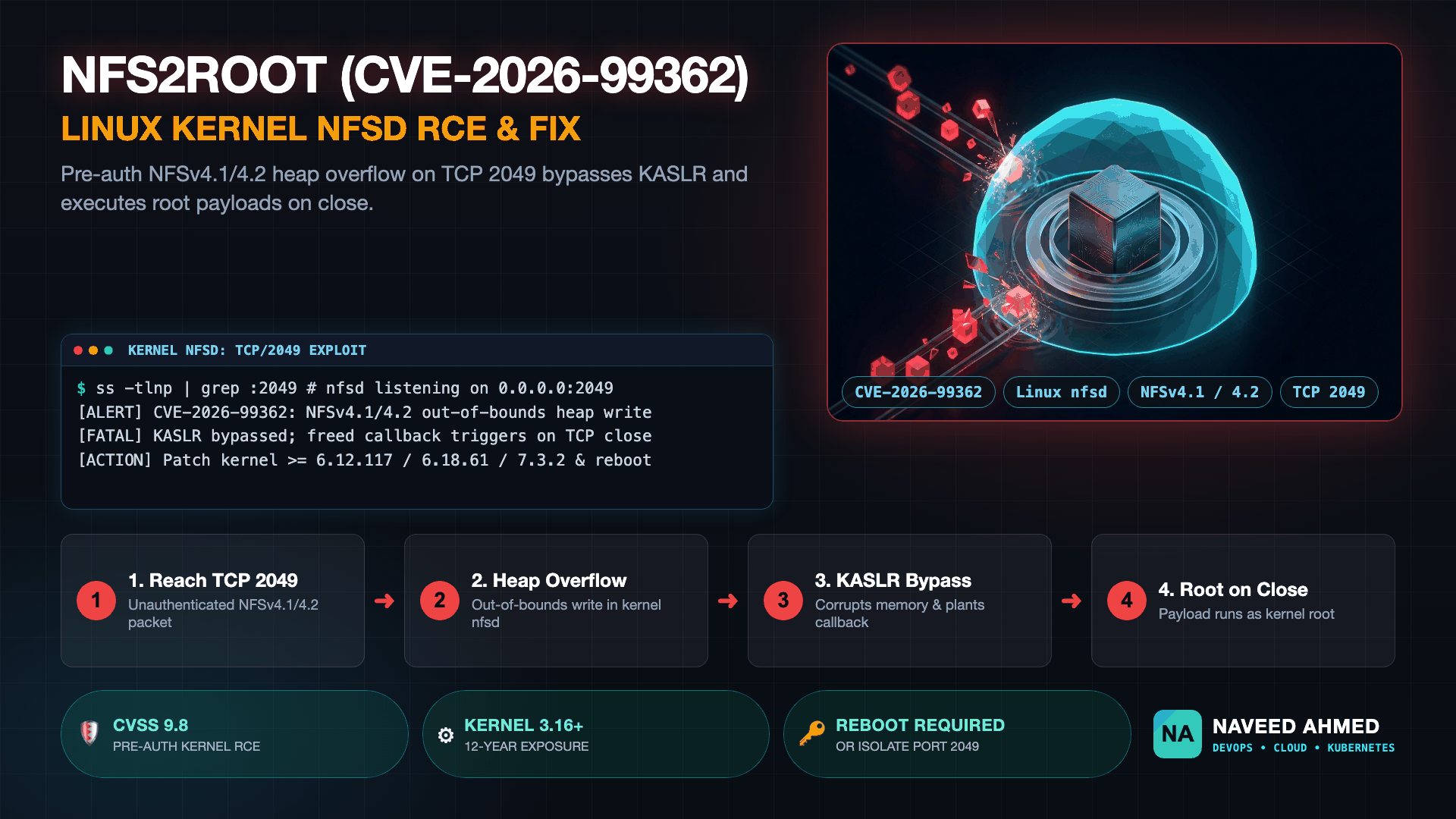
Most critical infrastructure CVEs target user-space daemons where a compromise still leaves an attacker trapped inside an unprivileged service account or container. NFS2ROOT (tracked as CVE-2026-99362) skips user space altogether. It sits inside the Linux kernel Network File System server (nfsd) and allows an unauthenticated remote attacker who can reach TCP port 2049 to corrupt kernel heap memory, bypass KASLR, and execute arbitrary commands as kernel root the moment the TCP session closes.
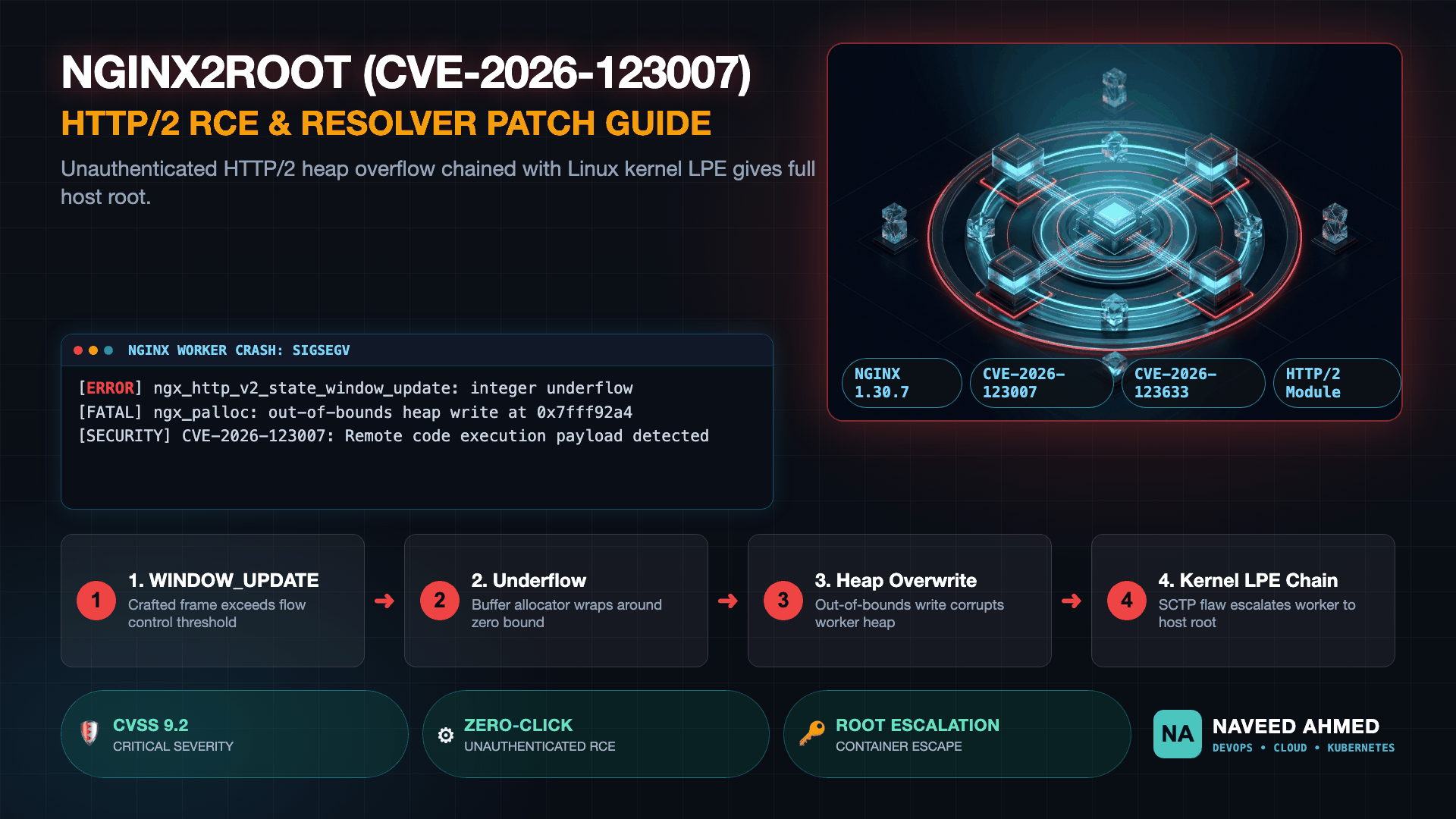
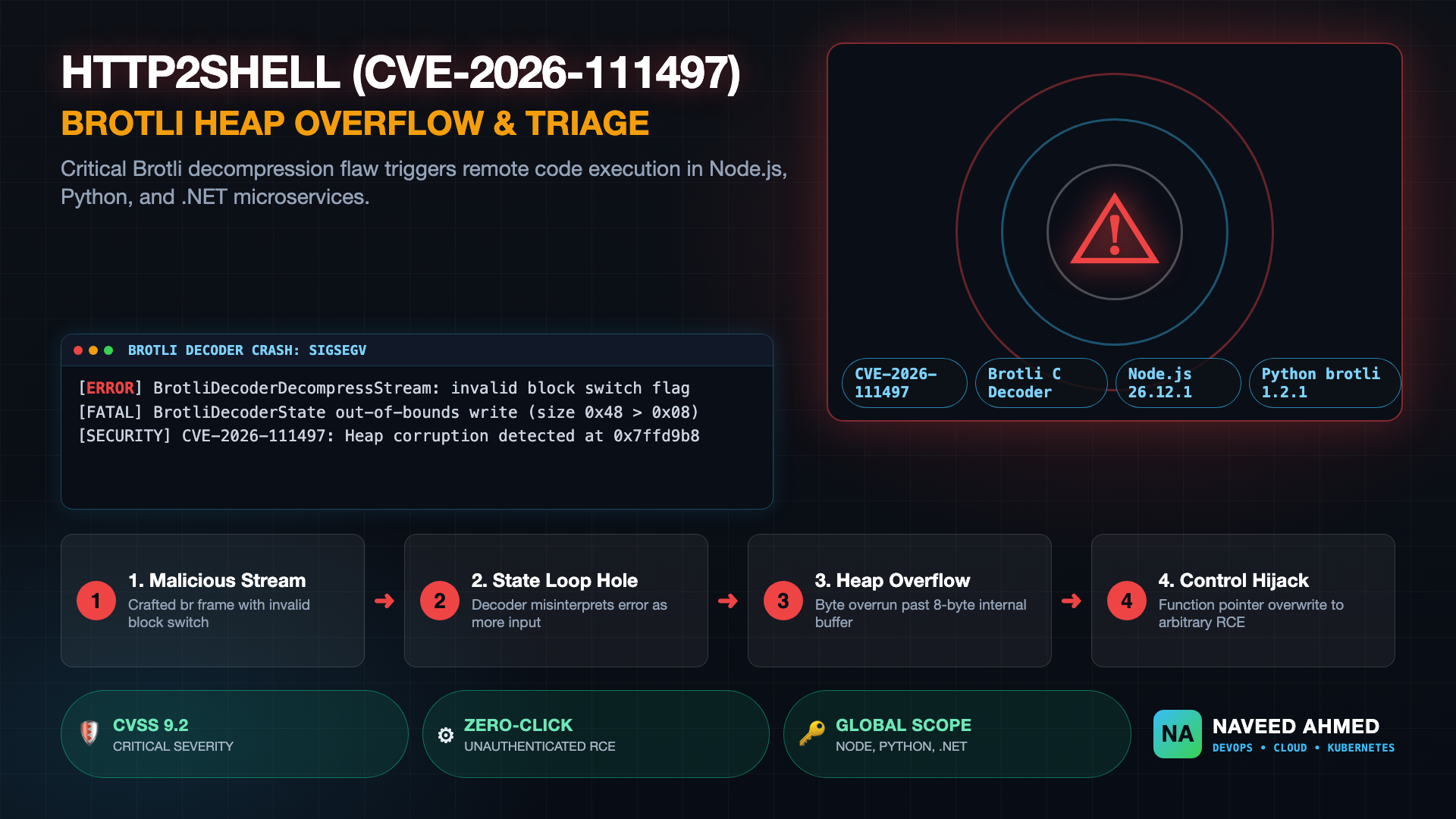
If your team recently triaged NGINX2root (CVE-2026-123007) HTTP/2 RCE and root escalation or HTTP2Shell (CVE-2026-111497) Brotli heap buffer overflow, treat nfs2root with even higher urgency. Because nfsd runs in kernel space, there is no container boundary or secondary privilege escalation step between network packet and host root.
What Is the NFS2ROOT Vulnerability (CVE-2026-99362)?
NFS2ROOT (CVE-2026-99362) is a CVSS 9.8 pre-authentication remote code execution and privilege escalation flaw in the Linux kernel nfsd subsystem, specifically affecting NFSv4.1 and NFSv4.2 request handling. Introduced upstream in March 2014 (Linux kernel 3.16, commit 47ee52986472), this Linux NFS vulnerability went undetected for 12 years until ANSSI researcher Jérémy Jean filed a KASAN report in August 2026 and cybersecurity firm OpenSec independently built a single-connection root exploit in September 2026 before public disclosure on November 25, 2026.
An attacker does not need valid NFS credentials, a mounted share, or an exported directory readable by their IP. Reachability to TCP port 2049 on a Linux host running nfsd with NFSv4.1 or NFSv4.2 enabled is enough to trigger the kernel heap overflow.
The 970+ Incident Handbook & K8s Runbooks are exclusive to subscribers — unlock for FREE
Get battle-tested production runbooks, AWS architecture blueprints, and zero-downtime CI/CD post-mortems sent directly to your inbox. 100% free, no spam.
How the NFS2ROOT Exploit Chain Works (nfsd4_sequence Root Cause)
Unlike Ruby2Shell remote code execution, which exploits application-layer parsing, NFS2ROOT corrupts kernel slab memory directly inside the NFSv4.1 session SEQUENCE handler (nfsd4_sequence()). During session setup, a client can negotiate the maximum cached reply size (ca_maxresponsesize_cached) down to the protocol minimum (NFSD_MIN_HDR_SEQ_SZ), forcing nfsd4_alloc_slot() to allocate zero-length reply buffers (sl_data[]).
By sending a crafted COMPOUND request with a padded tag, the attacker causes nfsd4_sequence() to narrow the reply buffer before checking whether the full response fits. The encoder runs out of room right at the SEQUENCE opcode boundary without returning an error, and the server copies the full RPC header, COMPOUND header, and tag into the zero-length slot buffer. That produces an out-of-bounds write of roughly 80 bytes (about 61 bytes past the heap object). OpenSec showed how this primitive chains into a 3.8 KB kernel heap leak to defeat KASLR, followed by a controlled free and forged NFS callback reclamation that runs arbitrary root commands when the TCP socket closes.
Attacker opens a raw TCP connection to port 2049 without authentication.
nfsd writes past an allocated kernel heap buffer boundary.
Memory corruption defeats KASLR and plants a function pointer in freed memory.
Closing the TCP socket triggers the planted callback with full kernel root.
Affected Systems, Distro Advisories, and Linux Kernel Patch Matrix
Upstream fixed CVE-2026-99362 in Linux kernel commit 35ff1a7a7e38 and backported the patch across every active LTS branch. Any Linux host, Network-Attached Storage (NAS) appliance, or Kubernetes storage node running kernel 3.16 or newer with nfsd active on NFSv4.1 or NFSv4.2 is exposed until patched.
| Kernel Branch / Distro | Vulnerable Range | Fixed Version / Status | Action Required |
|---|---|---|---|
| Linux 5.10 / 5.15 LTS | Up to 5.10.274 / 5.15.225 | 5.10.275 / 5.15.226 |
Upgrade kernel package and reboot |
| Linux 6.1 / 6.6 LTS | Up to 6.1.192 / 6.6.162 | 6.1.193 / 6.6.163 |
Upgrade kernel package and reboot |
| Linux 6.12 / 6.18 LTS | Up to 6.12.116 / 6.18.60 | 6.12.117 / 6.18.61 |
Upgrade kernel package and reboot |
| Linux 7.3 / 7.4 Mainline | 7.3.0 to 7.3.1 / early RC | 7.3.2 / 7.4-rc1 |
Upgrade kernel package and reboot |
| Ubuntu (Canonical) | 20.04, 22.04, 24.04 LTS | Critical USN kernel updates | Run apt-get upgrade and reboot |
| Debian (Bookworm / Trixie) | Unpatched 6.1 / 6.12 kernels | Debian Security Tracker DSA | Apply vendor backport and reboot |
| Red Hat Enterprise Linux | RHEL hosts running nfsd |
Critical RHSA advisory (off by default) | Patch active NFS servers and reboot |
How to Check If Your Hosts and Kubernetes Nodes Are Exposed
Before scheduling maintenance windows, audit which servers actually run the kernel NFS daemon and listen on TCP port 2049. Many cloud images and storage appliances leave NFS enabled from older setups.
# 1. Check the running Linux kernel version
uname -r

# 2. Check if nfsd is listening on TCP port 2049
ss -tlnp | grep 2049

# 3. Verify active NFS protocol versions (look for version 4 / 4.1 / 4.2)
cat /proc/fs/nfsd/versions
rpcinfo -p localhost | grep nfs
If ss -tlnp returns nothing on port 2049 and lsmod | grep nfsd is empty, the host is not running the NFS server kernel module and is not remotely reachable via NFS2ROOT.
Check NAS Appliances and Cloud Storage Gateways
Do not limit your audit to general-purpose Linux servers. Commercial and open-source Network-Attached Storage (NAS) systems, backup appliances, and self-managed file gateways frequently run embedded Linux kernels with NFSv4.1 or NFSv4.2 enabled by default. Managed cloud services like AWS EFS handle kernel patching on the provider side, whereas self-managed NFS servers on EC2, bare-metal storage nodes, and hyperconverged appliances leave kernel patching entirely to your operations team.
Hunt for Post-Exploitation Indicators
If TCP port 2049 was exposed to untrusted subnets before you patched, inspect host logs for signs of failed or successful kernel exploitation:
- Search kernel ring buffers (
dmesg -Torjournalctl -k) for unexpectednfsdslab corruption warnings, kernel panics, or general protection faults. - Verify
/etc/exportsandexportfs -vto confirm no shares were mounted or modified outside change control. - Audit
/root/.ssh/authorized_keys, newly created systemd units, and unexpected outbound connections from storage hosts, because successful NFS2ROOT exploitation runs directly as kernel root.
How to Fix NFS2ROOT (CVE-2026-99362) in Production
Patching the kernel is the permanent fix. Because kernel modules like nfsd stay loaded in memory until the operating system restarts, installing the updated package alone leaves you vulnerable until a full reboot completes.
1. Apply Vendor Kernel Patches and Reboot
# Ubuntu / Debian
sudo apt-get update && sudo apt-get install --only-upgrade linux-image-generic
sudo reboot

# RHEL / Rocky / AlmaLinux / Amazon Linux
sudo dnf update kernel -y
sudo reboot

# Verify the patched kernel is active after reboot
uname -r
2. Emergency Mitigations When Rebooting Must Wait
If a production database or NAS appliance cannot reboot immediately, cut off the attack vector at the service or network layer:
# Option A: Stop and disable nfs-server completely if NFS is unused
sudo systemctl disable --now nfs-server

# Option B: Restrict TCP 2049 to trusted client subnets only (ufw example)
sudo ufw deny 2049/tcp
sudo ufw allow from 10.20.0.0/16 to any port 2049 proto tcp

# Option C: Disable NFSv4.1 and NFSv4.2 in /etc/nfs.conf (if only NFSv3/4.0 is needed)
# Add under [nfsd]:
# vers4.1=n
# vers4.2=n
sudo systemctl restart nfs-server
3. Isolate Kubernetes NFS Storage Nodes
In Kubernetes clusters backed by external or in-cluster Linux NFS servers, a compromised application pod can reach TCP port 2049 over the cluster network unless egress is restricted. Lock down port 2049 with a NetworkPolicy so only designated storage namespaces or CSI driver pods can reach NFS endpoints, and drain-and-reboot worker/storage nodes on a rolling schedule.
apiVersion: networking.k8s.io/v1
kind: NetworkPolicy
metadata:
  name: deny-untrusted-nfs-egress
  namespace: default
spec:
  podSelector: {}
  policyTypes:
    - Egress
  egress:
    - ports:
        - protocol: TCP
          port: 2049
      to:
        - namespaceSelector:
            matchLabels:
              kubernetes.io/metadata.name: storage-system
For broader cluster hardening and incident triage checklists across your fleet, review our Black October infrastructure vulnerabilities breakdown and the Kubernetes Production Scenario Handbook.
NFS2ROOT vs NGINX2root vs HTTP2Shell: Triage Comparison
Platform teams often need to prioritize patching across multiple high-severity disclosures in the same sprint. Here is how NFS2ROOT compares to recent infrastructure CVEs:
| Vulnerability | Subsystem | CVSS | Primary Remediation |
|---|---|---|---|
NFS2ROOT (CVE-2026-99362) |
Linux kernel nfsd (TCP 2049) |
9.8 | Kernel upgrade (6.12.117+ / 6.18.61+ / 7.3.2+) and reboot |
NGINX2root (CVE-2026-123007) |
NGINX HTTP/2 worker + kernel LPE | 9.2 | Upgrade NGINX 1.30.7+ / 1.31.9+ and full restart |
HTTP2Shell (CVE-2026-111497) |
Brotli C decoder in Node, Python, .NET | 9.2 | Patch runtimes and strip Content-Encoding: br |
Key Takeaways
- NFS2ROOT (CVE-2026-99362) is a CVSS 9.8 unauthenticated kernel heap overflow in Linux
nfsdaffecting NFSv4.1 and NFSv4.2 on kernels 3.16 and newer. - Because exploitation runs inside the kernel, a single crafted request to TCP port 2049 grants host root without needing credentials or a mounted share.
- Patch Linux kernels to 6.12.117, 6.18.61, 7.3.2, or your distro vendor equivalent, and reboot every host so the patched kernel takes effect.
- If you cannot reboot immediately, block TCP port 2049 from untrusted subnets, disable NFSv4.1/4.2 in
/etc/nfs.conf, or stopnfs-serverentirely. - Audit Kubernetes storage nodes and enforce
NetworkPolicyrules so application pods cannot open raw TCP connections to port 2049.
Frequently Asked Questions
Direct answers to frequent engineering questions regarding AI coding agent disruptions, entry-level career outlooks, computer science degree value, and the changing landscape of software development roles in production environments.
What is the NFS2ROOT vulnerability (CVE-2026-99362)?
NFS2ROOT (CVE-2026-99362) is a critical CVSS 9.8 heap-based buffer overflow and out-of-bounds write in the Linux kernel NFS server (nfsd) affecting NFSv4.1 and NFSv4.2. An unauthenticated attacker who can reach TCP port 2049 can bypass KASLR, corrupt kernel memory, and execute arbitrary commands as root when the connection closes.
Which Linux kernel versions are affected and which versions fix NFS2ROOT?
Linux kernels from version 3.16 (released in 2014) up to versions older than 6.12.117, 6.18.61, 7.3.2, and 7.4-rc1 are vulnerable when running nfsd with NFSv4.1 or NFSv4.2 enabled. You must upgrade to a patched vendor kernel and reboot the host so the new kernel loads into memory.
How can I fix or mitigate NFS2ROOT if I cannot reboot immediately?
Block TCP port 2049 from untrusted networks using host firewalls or Kubernetes NetworkPolicies, disable NFSv4.1 and NFSv4.2 in /etc/nfs.conf if only NFSv3 or NFSv4.0 is needed, or stop and disable nfs-server completely with sudo systemctl disable --now nfs-server on hosts that do not serve NFS.
Are Kubernetes clusters affected by NFS2ROOT?
Yes, if your cluster runs Linux-based NFS storage servers, in-cluster NFS provisioners with host kernel nfsd, or worker nodes exposing TCP port 2049. Any compromised pod or network neighbor that can open a TCP connection to port 2049 on an unpatched storage node can escalate directly to host root.
How does NFS2ROOT compare to NGINX2root and HTTP2Shell?
HTTP2Shell (CVE-2026-111497) and NGINX2root (CVE-2026-123007) target user-space decompression and HTTP/2 reverse proxy workers, whereas NFS2ROOT lives directly inside the Linux kernel nfsd subsystem. Exploiting NFS2ROOT grants immediate kernel-level root privileges without needing a secondary local privilege escalation chain.