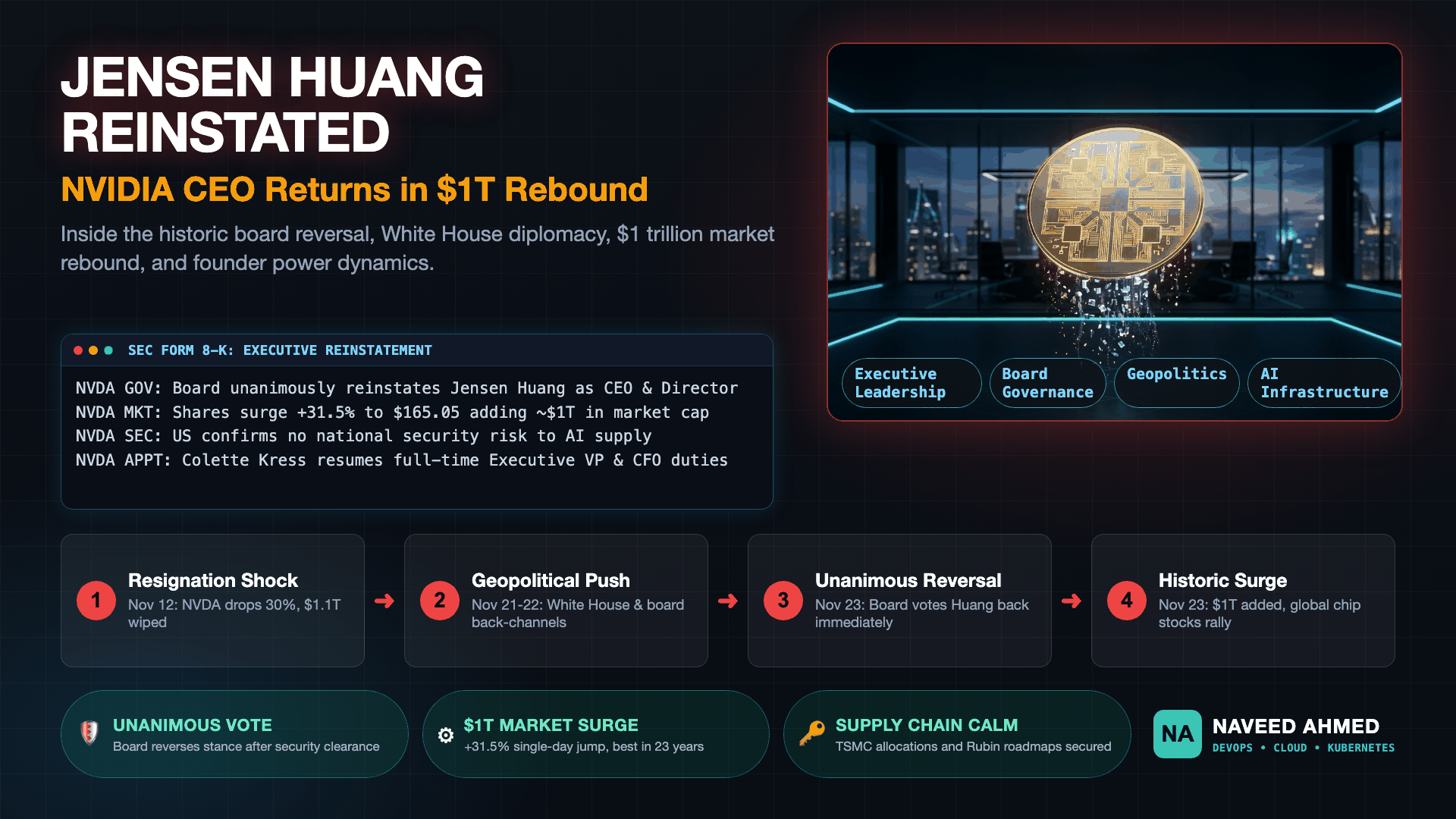
In one of the most astonishing corporate reversals in modern technology history, Jensen Huang reinstated as Chief Executive Officer and President of NVIDIA on Monday, November 23, 2026. The decision, passed unanimously by NVIDIA's board of directors, concluded an eleven-day leadership void that wiped out more than 1.1 trillion dollars in market value, sent shockwaves through global semiconductor supply chains, and triggered emergency consultations inside the United States federal government.
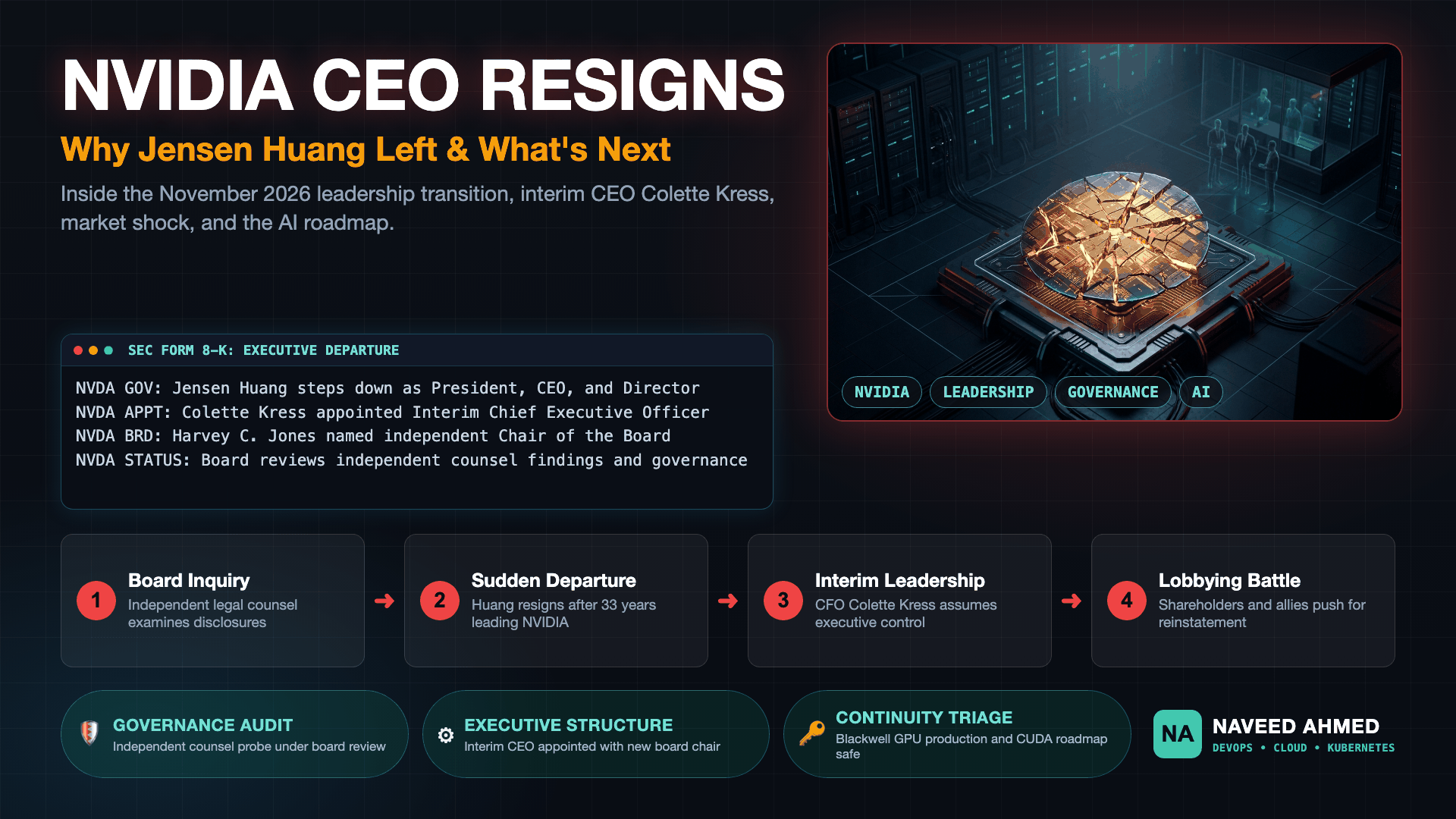
Less than two weeks earlier, on November 12, 2026, Huang abruptly resigned following an internal governance probe into undisclosed personal relationships and potential conflict-of-interest violations. As documented in our earlier investigation into why Jensen Huang resigned, the immediate market reaction was brutal: NVIDIA shares collapsed by roughly thirty percent, and the entire artificial intelligence infrastructure complex stumbled into paralysis.
However, the boardroom drama took an unprecedented turn over the November 21 weekend. Facing direct diplomatic pressure from political leadership, vocal institutional shareholder revolts, and explicit confirmation from national security officials that Huang's continued leadership posed zero risk to American intellectual property, the board made an abrupt about-face. Huang returned to NVIDIA headquarters in Santa Clara to standing ovations, while Wall Street witnessed an explosive, record-breaking single-day market surge.
The 11-Day Coup and Board Reversal: Why Jensen Huang Reinstated as CEO
When Jensen Huang stepped down on November 12, NVIDIA's newly appointed independent Board Chair, Harvey C. Jones, announced that Chief Financial Officer Colette Kress would steer daily operations as interim CEO. At the time, board representatives suggested that NVIDIA had initiated an external executive search to find a permanent successor, emphasizing that governance rules applied equally to corporate founders.
The reality on the ground proved far more chaotic. Within seventy-two hours of Huang's departure, institutional asset managers representing over forty percent of NVIDIA's outstanding common stock communicated serious reservations to the board. Without Huang's personal relationships, multi-year foundry negotiations with Taiwan Semiconductor Manufacturing Company (TSMC), hyperscaler capital expenditure guarantees with Microsoft, Google, and Amazon, and sovereign AI commitments across Europe and Asia suddenly entered legal ambiguity.
"Following extensive evaluations, direct discussions regarding executive stewardship, and receipt of formal communications from senior levels of the United States government, the Board of Directors has unanimously voted to reinstate Jensen Huang as President, Chief Executive Officer, and member of the Board, effective immediately. The Board is satisfied with Mr. Huang's candor, his enduring vision, and his singular ability to lead NVIDIA through the next chapter of global computing infrastructure."
In his own public acceptance statement, Huang struck a balance between personal contrition and technical determination:
"I am honored to return to NVIDIA and lead one of the most consequential technology companies in the world at the beginning of a new industrial revolution. I accept this responsibility with deep humility, renewed discipline, and unyielding commitment to our employees, partners, and shareholders."
Under the reinstatement agreement, Colette Kress resumed her full-time executive responsibilities as Chief Financial Officer and Executive Vice President. Harvey Jones retained the role of independent Board Chair, establishing an ongoing structural separation between the CEO position and board oversight for the first time in NVIDIA's thirty-three-year history. The formal announcement confirming Jensen Huang reinstated as leader immediately halted an accelerating slide in customer contract negotiations.
The 970+ Incident Handbook & K8s Runbooks are exclusive to subscribers — unlock for FREE
Get battle-tested production runbooks, AWS architecture blueprints, and zero-downtime CI/CD post-mortems sent directly to your inbox. 100% free, no spam.
The Financial Earthquake: From a $1.1 Trillion Crash to a +31.5% Relief Surge
The financial fallout of Jensen Huang's departure demonstrated the immense concentration of enterprise value tied directly to a single corporate leader. Between November 12 and November 21, NVIDIA stock (NASDAQ: NVDA) plummeted from 182 dollars to an intraday low near 125 dollars. This thirty-one percent drawdown vaporized approximately 1.1 trillion dollars in shareholder equity, marking the fastest loss of corporate market capitalization recorded in financial history.
The panic quickly spread through the broader semiconductor ecosystem:
- TSMC (Foundry Partner): Taiwan Semiconductor Manufacturing Company saw its American Depositary Receipts (ADRs) drop fourteen percent. Investors feared that without Huang's relentless negotiation, CoWoS (Chip-on-Wafer-on-Substrate) advanced packaging quotas and pricing models for next-generation Vera Rubin chips might be renegotiated or delayed.
- Interconnect & Networking Peers: Broadcom (AVGO), Marvell Technology (MRVL), and ARM Holdings experienced seven to twelve percent selloffs as analysts modeled reduced deployment velocity for 800G and 1.6T InfiniBand switches.
- Server Assemblers & AI Cloud Providers: Supermicro (SMCI) and Dell Technologies tumbled on concerns over enterprise cancelations, while specialized GPU clouds such as CoreWeave and Nebius witnessed brief freezes in debt syndication for data center expansions.
| Company | Ticker | Resignation Drawdown | Reinstatement Surge (Nov 23) | Primary Strategic Dependency |
|---|---|---|---|---|
| NVIDIA Corporation | NVDA |
-31.2% ($1.1T loss) | +31.5% (+$980B gain) | Core platform, CUDA ecosystem, GPU roadmap |
| Taiwan Semiconductor (TSMC) | TSM |
-14.3% | +8.4% | Exclusive CoWoS packaging & 3nm/2nm foundry lines |
| Broadcom Inc. | AVGO |
-11.8% | +11.2% | Ethernet fabric co-development & custom silicon |
| ARM Holdings plc | ARM |
-12.6% | +12.1% | Grace and Vera CPU architectural licenses |
| Advanced Micro Devices | AMD |
-7.4% | +8.1% | Industry-wide AI hardware capital expenditure beta |
| Super Micro Computer | SMCI |
-16.1% | +15.7% | Liquid-cooled rack integration & HGX assemblies |
On Monday, November 23, 2026, the announcement of Huang's reinstatement triggered an unprecedented relief rally. NVIDIA stock rocketed thirty-one point five percent in a single trading session to close at 165.05 dollars. Once traders verified that Jensen Huang reinstated with full board backing, nearly one trillion dollars of market value was restored in less than seven hours of open market trading, representing NVIDIA's strongest single-day rally since 2003. Peer semiconductor manufacturers, neoclouds, and Asian supply-chain equities followed in locked step, recouping their weekly losses before the closing bell.
The Anatomy of Founder Leverage: 5 Takeaways from Jensen Huang Reinstated
How did Jensen Huang reverse a formal board dismissal in just eleven days? For technology executives, engineering directors, and cloud architects, the mechanics behind how Jensen Huang reinstated offer masterclasses in structural leverage, stakeholder alignment, and executive indispensability.
1. Structural Asymmetry and Full-Stack Monopolistic Knowledge
Most corporate chief executives function primarily as financial allocators and public relations figureheads. Jensen Huang operated as NVIDIA's Chief Architect. For three decades, Huang drove architectural decisions across hardware, software, compilers, networking, and cluster infrastructure.
When interim management faced complex customer inquiries regarding multi-rack GPU infrastructure deployment loops, InfiniBand fabric congestions, or Multi-Instance GPU (MIG) slicing on Kubernetes, the absence of Huang's technical intuition became immediately apparent. True executive leverage is built upon irreplaceable operational depth: when no committee or management consultancy can replicate your technical synthesis, the organization remains fundamentally dependent on your command.
2. The Real-Time Financial Referendum ($1.1 Trillion Leverage)
Corporate boards answer ultimately to fiduciary duty and shareholder value. When the board accepted Huang's resignation, they anticipated a temporary five to ten percent market contraction. The actual loss of 1.1 trillion dollars transformed corporate governance into an existential financial crisis. Major institutional investors made it clear to the board that while personal impropriety warranted severe compliance controls, forcing out the visionary behind the company's multi-trillion-dollar run was unacceptable. The market executed an immediate, brutal referendum that the board could not ignore.
3. Geopolitical Alignment and Sovereign Backing
In 2026, advanced semiconductor manufacturing is not simply a business sector; it is the cornerstone of national defense and geopolitical supremacy. During the weekend prior to the reversal, United States President Donald Trump issued public statements on Truth Social urging NVIDIA's directors to resolve the matter and bring Huang back. Private phone calls between administration officials and board members emphasized that American competitiveness against foreign AI state programs depended on uninterrupted execution across NVIDIA's foundry partnerships.
Crucially, senior national security officials conducted expedited reviews of the allegations concerning potential foreign intelligence contacts. When intelligence liaisons confirmed to the board that no classified technology, trade secrets, or national security vulnerabilities had been compromised, the board gained the political and regulatory clearance necessary to vote for reinstatement.
4. Internal Loyalty and Founder Gravitas
A third deciding factor was internal cohesion. Within NVIDIA, Huang maintained exceptional loyalty among veteran engineering fellows and senior vice presidents. Reports confirmed that key architectural leads signaled reluctance to commit to long-term roadmaps under non-technical interim stewards. Furthermore, external candidates approached by search committees recognized the poisoned chalice of attempting to replace a living founder whose personal stamp permeates every silicon product line. When internal talent refuses to rally around a replacement, the board's options narrow rapidly.
5. Strategic Compromise and Diplomatic Candor
Reinstatement rarely happens without compromise. A leader seeking to reclaim their post after a governance crisis must give the board a path to preserve dignity. Huang did not mount a hostile proxy fight or attack the directors publicly. Instead, he engaged in intensive, closed-door negotiations, demonstrated transparency regarding his personal disclosures, accepted independent legal review protocols, and conceded the Board Chairmanship to Harvey Jones. By accepting structural checks and balances, Huang allowed the board to frame his return as an act of responsible corporate leadership rather than unconditional surrender.
What Changes Now with Jensen Huang Reinstated as NVIDIA CEO?
While Jensen Huang is firmly back at the helm, NVIDIA does not return to business as usual. With Jensen Huang reinstated, the company will navigate elevated scrutiny across corporate governance, regulatory oversight, and technical execution throughout 2027:
- Separation of Chair and CEO Roles: For thirty-three years, Huang held both the Chairman and Chief Executive titles. That era is over. Harvey Jones remains independent Board Chair, establishing formal oversight over executive compliance, auditor communications, and enterprise risk management.
- Congressional and SEC Inquiries: The House Select Committee on Strategic Competition and the Securities and Exchange Commission maintain open inquiries into NVIDIA's foreign partner disclosures and commercial filings. Huang and Kress are scheduled to provide confidential briefings to congressional leaders in Washington early next year.
- Supply Chain and Roadmap Continuity: For platform engineers and cloud architects building on Kubernetes and enterprise AI platforms, the return of Huang ensures continuity for the Vera Rubin NVL72 architecture, Quantum-X switches, and enterprise CUDA runtime support. Foundry allocations with TSMC remain locked, averting potential production bottlenecks for commercial cloud providers.
Engineering teams designing infrastructure pipelines can rely on automated tooling such as our Kubernetes YAML Generator to structure container workloads, or review structured career trajectories across our Platform Engineering & SRE Roadmaps.
- For Investors & Executives: True founder indispensability stems from structural knowledge asymmetry and full-stack operational control that cannot be replaced by generic management.
- For Cloud Architects & SREs: Blackwell and Vera Rubin delivery schedules remain on track. Hyperscaler capital expenditure cycles have stabilized following the resolution of the executive vacancy.
- For Corporate Governance: The incident demonstrates that in strategic industries like AI semiconductors, corporate board decisions are increasingly constrained by real-time market value and sovereign national interest.
Jensen Huang's eleven-day exile and historic comeback will be analyzed in business schools and boardrooms for decades. The unprecedented speed with which Jensen Huang reinstated proves that when a founder successfully fuses engineering genius, strategic supplier networks, and national geopolitical relevance, they build an enterprise whose value cannot easily survive their absence.
Frequently Asked Questions
Direct answers to frequent engineering questions regarding AI coding agent disruptions, entry-level career outlooks, computer science degree value, and the changing landscape of software development roles in production environments.
When was Jensen Huang reinstated as NVIDIA CEO?
NVIDIA's board of directors voted unanimously to reinstate Jensen Huang as President, Chief Executive Officer, and member of the Board on Monday, November 23, 2026, ending an 11-day interim leadership period.
Why did NVIDIA's board reverse its decision and bring Jensen Huang back?
The board reversed its stance after direct consultations with senior United States government officials confirmed that Huang's reinstatement posed no national security risk. Continued investor panic, an estimated 1.1 trillion dollar loss in market capitalization, and strategic intervention by President Donald Trump expedited the unanimous decision.
How much did NVIDIA stock rise after Jensen Huang was reinstated?
NVIDIA shares surged 31.5 percent in a single trading session on November 23, 2026, closing at 165.05 dollars. The rally added nearly 1 trillion dollars in market capitalization, marking the stock's highest single-day percentage gain in over 23 years.
Who was interim CEO during Jensen Huang's absence?
Chief Financial Officer Colette Kress served as Interim Chief Executive Officer from November 12 to November 23, 2026. Following Huang's reinstatement, Kress resumed her full-time duties as Executive Vice President and Chief Financial Officer, while Harvey Jones remains independent Board Chair.
How did other semiconductor and AI stocks react to the reinstatement?
Supply chain partners and AI infrastructure stocks staged a sharp recovery. TSMC ADRs gained over 8 percent, Broadcom rose 11 percent, AMD climbed 8 percent, and private GPU cloud providers such as CoreWeave saw enterprise contract inquiries normalize after steep drawdowns during the resignation.