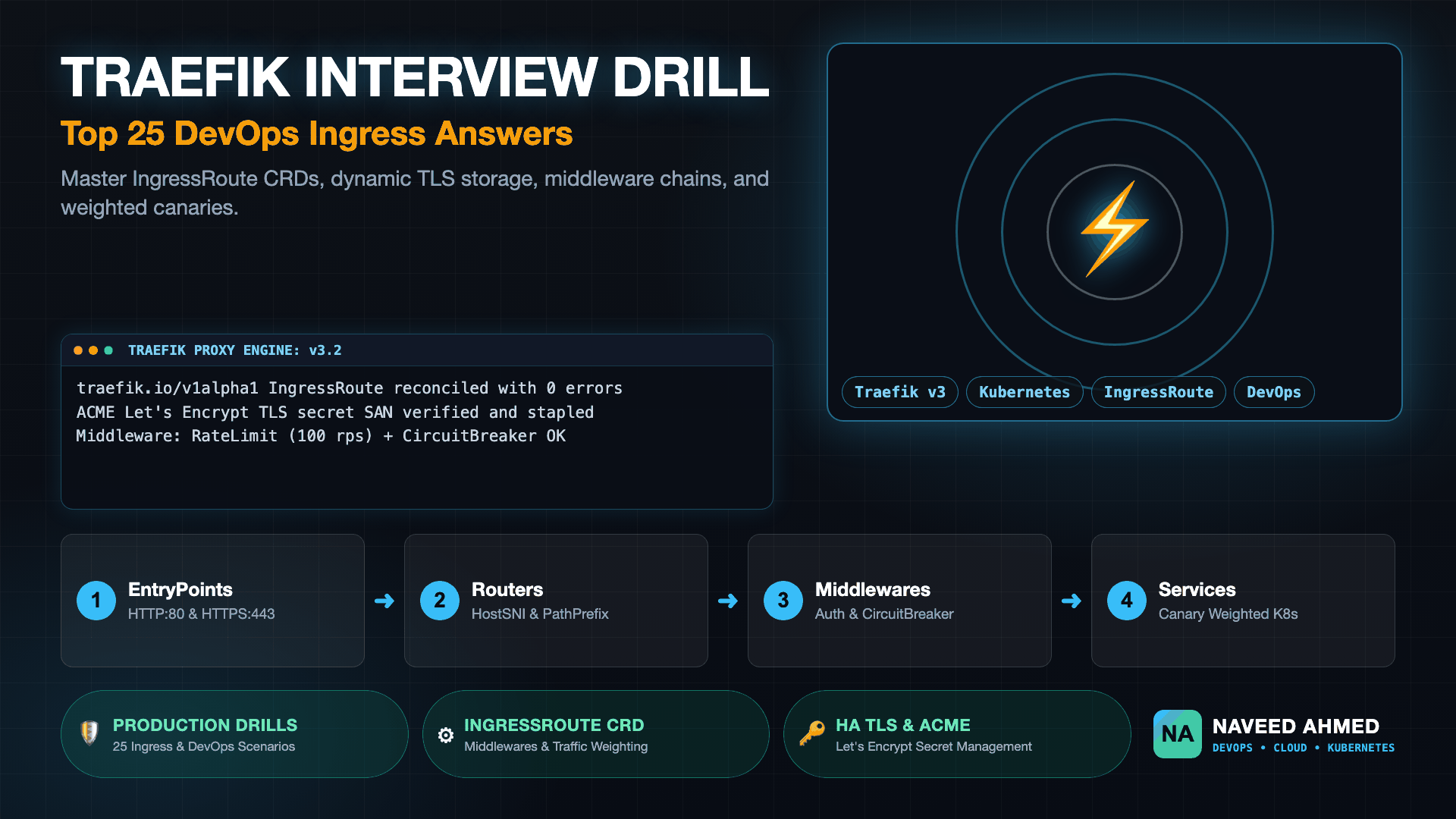
Mastering traefik interview questions requires far more than reciting syntax definitions from a cheat sheet. In modern platform engineering and SRE interviews, hiring teams evaluate how candidates design, secure, and debug edge traffic in production Kubernetes clusters. Interviewers test your practical knowledge of Traefik's routing primitives, IngressRoute custom resource definitions (CRDs), automated Let's Encrypt ACME storage pitfalls, circuit breaker failure modes, and weighted canary rollouts. This guide provides 25 production-tested scenario questions and detailed architectural answers to prepare you for senior infrastructure and DevOps interviews in 2026.
Traefik Architecture Core: EntryPoints, Routers, Middlewares, and Services
Answer Capsule: Traefik processes inbound network traffic through a strict pipeline composed of EntryPoints (network listeners), Routers (rule matchers), Middlewares (request and response modifiers), and Services (upstream load balancers). Unlike legacy proxies that require static file generation and worker restarts, Traefik natively discovers services from providers like Kubernetes and Docker, dynamically constructing in-memory routing graphs without packet drops.
When preparing for traefik interview questions, candidates must demonstrate an exact understanding of how Traefik routes a packet from a client socket to a backend pod. The table below compares Traefik with traditional edge proxies commonly discussed in DevOps architectural rounds:
| Dimension | Traefik Proxy (v2/v3) | NGINX Ingress Controller | Envoy / Istio Gateway |
|---|---|---|---|
| Configuration Paradigm | Native dynamic provider discovery with CRDs and labels | Static template rendering (nginx.conf) plus Lua plugins | Dynamic gRPC Discovery Services (xDS APIs) |
| Reload Mechanism | In-memory atomic pointer swaps; zero process restarts | Worker process reload via SIGHUP (risks connection resets) | Real-time thread configuration updates via ADS |
| ACME / Let's Encrypt | Built-in native client (HTTP-01, TLS-ALPN-01, DNS-01) | Requires external Cert-Manager and Secret controllers | Requires external Cert-Manager or SDS secrets agent |
| Operational Complexity | Low to medium; single lightweight Go binary | Medium; complex Lua scripts and regex annotations | High; steep learning curve with control-plane overhead |
Question 1: What is Traefik Proxy and how does its architecture differ from NGINX?
Traefik is a modern HTTP reverse proxy and ingress controller written in Go. NGINX was built during the era of static server environments where backend IPs rarely changed. In dynamic Kubernetes clusters where pods scale up and down continuously, NGINX traditionally generates an updated nginx.conf file and triggers an asynchronous worker process reload. During high churn, frequent reloads can cause CPU spikes and brief socket drops.
In contrast, Traefik was designed specifically for microservices. It listens directly to orchestration APIs (Kubernetes API server, Docker socket, Consul, or Nomad). When an endpoint changes, Traefik's internal Go routines calculate a new routing DAG (Directed Acyclic Graph) in memory and swap the routing table atomically without restarting any listener threads.
Question 2: Explain EntryPoints, Routers, Middlewares, and Services.
Interviewers expect you to break down Traefik's four primary primitives cleanly:
- EntryPoints define network-level listening sockets such as port 80 for HTTP and port 443 for HTTPS.
- Routers analyze request paths, headers, and host rules to match incoming traffic against destinations.
- Middlewares modify requests or responses before they reach backends, enforcing authentication, rate limits, and header rewrites.
- Services represent upstream targets that balance network traffic across healthy backend pods.
Question 3: What is the difference between Static Configuration and Dynamic Configuration?
A fundamental Traefik interview question tests your ability to distinguish static parameters from dynamic configurations:
- Static configuration sets startup flags, entryPoints, log levels, and provider connections that require process restarts to update.
- Dynamic configuration governs routing rules, middlewares, services, and TLS certificates updated directly in memory from cluster providers.
Question 4: How does Traefik connect to the Kubernetes API Server?
Traefik runs an in-cluster controller that establishes a watch on Kubernetes custom resource definitions (CRDs) and standard Ingress resources. Using standard Kubernetes client-go informers, Traefik maintains a local cache of endpoints, secrets, and routes. When a new pod or IngressRoute is created or modified, the informer triggers a reconciliation loop that recalculates the internal routing state.
The 970+ Incident Handbook & K8s Runbooks are exclusive to subscribers — unlock for FREE
Get battle-tested production runbooks, AWS architecture blueprints, and zero-downtime CI/CD post-mortems sent directly to your inbox. 100% free, no spam.
Kubernetes IngressRoute CRD vs Standard Ingress: Traefik Interview Questions
Answer Capsule: The standard Kubernetes Ingress resource suffers from lowest-common-denominator limitations, forcing platform teams to rely on non-standard annotations for advanced routing. Traefik's IngressRoute CRD provides first-class declarative syntax for multi-service traffic weighting, cross-namespace middleware sharing, granular TLS options, and TCP/UDP routing directly within Kubernetes manifests.
DevOps interview panels frequently explore why a team would adopt custom CRDs over native Ingress resources. For a dedicated scenario drill, review our deep dive on Traefik IngressRoute CRD vs Kubernetes Ingress. The table below highlights the operational trade-offs:
| Capability | Kubernetes Ingress (networking.k8s.io/v1) | Traefik IngressRoute (traefik.io/v1alpha1) |
|---|---|---|
| Middleware Composition | Fragile CSV annotations (e.g. traefik.ingress.kubernetes.io/router.middlewares) |
Declarative list of typed Middleware references |
| Cross-Namespace Routing | Strictly prohibited; Ingress can only point to services in its own namespace | Supported natively across namespaces with explicit RBAC permissions |
| Weighted Traffic Splitting | Requires multiple overlapping Ingress objects with custom annotations | Built-in services[].weight attribute inside a single manifest |
| TCP / UDP Protocol Routing | Not supported (HTTP/HTTPS only) | Supported via IngressRouteTCP and IngressRouteUDP |
Question 5: Walk through a production IngressRoute manifest.
Interviewers will often ask you to whiteboard or explain an IngressRoute specification. Point out the entryPoints, match rule, middleware reference, and service port mapping:
apiVersion: traefik.io/v1alpha1
kind: IngressRoute
metadata:
  name: payment-api-route
  namespace: finance
spec:
  entryPoints:
    - websecure
  routes:
    - match: Host(`api.naveedkumbhar.com`) && PathPrefix(`/v2/payments`)
      kind: Rule
      middlewares:
        - name: rate-limit-middleware
        - name: strip-prefix-v2
      services:
        - name: payment-service
          port: 8080
  tls:
    secretName: payment-tls-cert
Question 6: How do you declare cross-namespace routing with Traefik?
By default, Traefik isolates namespaces to prevent one team from intercepting another team's traffic. When a central platform gateway needs to route to services across different namespaces, you must enable the --providers.kubernetescrd.allowcrossnamespace=true static configuration flag in your Traefik deployment. In the IngressRoute manifest, backends in other namespaces are referenced explicitly using namespace: team-b under the service definition.
Question 7: How does Traefik route non-HTTP protocols using IngressRouteTCP?
For protocols such as PostgreSQL, Redis, or Kafka, Traefik uses IngressRouteTCP. Routing decisions are made using Server Name Indication (SNI) via HostSNI(`db.example.com`) when TLS is enabled, or wildcard HostSNI(`*`) when handling plain TCP sockets dedicated to a distinct EntryPoint port.
Question 8: What is the difference between Path and PathPrefix matchers in Traefik?
A frequent point of interview confusion involves route matching precision:
Path(`/orders`)matches the exact URI/ordersonly. A request to/orders/123will return a 404 error.PathPrefix(`/orders`)matches/orders,/orders/, and any nested sub-path like/orders/items/456. In modern Traefik v2 and v3, PathPrefix operates with strict delimiter awareness to prevent accidental route bleeding.
Question 9: How does Traefik support the Kubernetes Gateway API?
Traefik supports the official Kubernetes Gateway API (SIG-Network). Platform administrators define a Gateway resource that binds to entryPoints and IP addresses, while application teams define granular HTTPRoute and GRPCRoute resources. This decouples infrastructure provisioning from developer routing policies cleanly without custom vendor annotations.
Automated TLS & Let's Encrypt Storage in Traefik: SRE Production Scenarios
Answer Capsule: Traefik features built-in ACME certificate automation. However, in high-availability multi-pod clusters, storing TLS certificates in a local acme.json file leads to data corruption due to concurrent write contention. Production SRE teams solve this by delegating certificate lifecycle management to Cert-Manager with Kubernetes Secret storage, reserving Traefik strictly for data-plane TLS termination.
One of the most critical operational scenario questions in traefik interview questions centers around certificate storage. For detailed troubleshooting patterns, consult our runbook on Traefik ACME Let's Encrypt Persistent Storage.
Question 10: How does Traefik acquire and renew Let's Encrypt TLS certificates?
Traefik communicates directly with ACME certificate authorities (Let's Encrypt, ZeroSSL). When a new router with tls.certResolver is detected, Traefik initiates a challenge (HTTP-01, TLS-ALPN-01, or DNS-01). After the challenge is validated, the CA issues the signed X.509 certificate and private key, which Traefik loads into memory and schedules for automatic renewal 30 days before expiration.
Question 11: Why is acme.json dangerous when running multiple Traefik replicas?
Traefik Community Edition persists certificates into a single JSON file (typically /data/acme.json). If you deploy three Traefik pods behind a cloud load balancer and mount a ReadWriteMany (RWX) volume across them, multiple pods attempt to write certificate updates concurrently. Because the community edition lacks distributed locking mechanisms, concurrent writes corrupt the JSON file or trigger race conditions that exceed Let's Encrypt rate limits.
Question 12: How do production Kubernetes architectures solve high-availability TLS in Traefik?
Production platform teams implement one of three proven architectural patterns:
- Delegate certificate orders to Cert-Manager and store keys in native Kubernetes Secrets consumed directly by IngressRoutes.
- Run a single primary ingress replica for ACME challenges while routing read replicas handle edge traffic.
- Use Traefik Enterprise with Raft consensus storage to synchronize certificates across cluster nodes without file locking conflicts.
Question 13: How do you configure TLS Passthrough in Traefik?
When an internal microservice requires end-to-end encryption or handles sensitive mTLS client validation, Traefik must not terminate the TLS handshake. This is achieved using an IngressRouteTCP with tls.passthrough: true:
apiVersion: traefik.io/v1alpha1
kind: IngressRouteTCP
metadata:
  name: secure-vault-passthrough
  namespace: security
spec:
  entryPoints:
    - websecure
  routes:
    - match: HostSNI(`vault.internal.net`)
      services:
        - name: vault-backend
          port: 8200
  tls:
    passthrough: true
Traffic Management: Canary Deployments, Weighting, and Circuit Breakers
Answer Capsule: Traefik enables gradual canary releases through integer service weighting directly inside IngressRoutes or TraefikServices. Combined with native Circuit Breaker middlewares that monitor error ratios and latency percentiles, Traefik dynamically protects downstream services from cascading collapse during partial outages.
For an in-depth review of canary routing rules, consult our production guide on Traefik Circuit Breaker and Canary Weighting.
Question 14: How do you configure a 90/10 Canary Split in Traefik?
In standard Kubernetes Ingress, canary deployments require complex duplicate objects and ingress-specific annotations. In Traefik, you declare multiple services under a single route with proportional weights:
apiVersion: traefik.io/v1alpha1
kind: IngressRoute
metadata:
  name: checkout-canary-route
  namespace: ecommerce
spec:
  entryPoints:
    - websecure
  routes:
    - match: Host(`shop.example.com`) && PathPrefix(`/checkout`)
      kind: Rule
      services:
        - name: checkout-v1-stable
          port: 8080
          weight: 90
        - name: checkout-v2-canary
          port: 8080
          weight: 10
Question 15: How does Traefik's Circuit Breaker middleware work?
A circuit breaker tracks upstream metrics over a sliding window. When health metrics breach a defined threshold, the circuit trips from Closed to Open, immediately rejecting subsequent requests with an HTTP 503 error before they overwhelm failing pods. After a cooldown interval, it enters Half-Open to test upstream recovery.
Traefik expresses circuit breaker conditions using logical expressions such as NetworkErrorRatio() > 0.20 || ResponseCodeRatio(500, 600, 0, 600) > 0.15.
Question 16: How do active health checks work in Traefik?
Traefik services can configure active health checks that send periodic HTTP requests to an upstream path (e.g. /healthz). If a backend pod fails consecutive probes, Traefik removes its IP from the active load balancing pool without waiting for client requests to fail. Once healthy responses resume, the pod is automatically restored.
Question 17: How do you configure Session Stickiness?
When stateful applications require clients to maintain affinity with a specific backend pod, you configure sticky sessions on the Traefik service by setting sticky.cookie: true. Traefik injects an encrypted cookie containing the server hash into client responses, directing subsequent requests from that user back to the identical pod.
Traefik Security Hardening: Middleware Pipelines, Rate Limiting, and Mutual TLS
Answer Capsule: Traefik's middleware architecture enables declarative security hardening at the cluster edge. By chaining rate limiting, IP allowlists, security headers (HSTS, CSP), and ForwardAuth middlewares, platform teams enforce enterprise zero-trust controls before requests touch application code.
Interviewers frequently test candidate knowledge of middleware chaining. The table below summarizes key production security middlewares in Traefik:
| Middleware Type | CRD Kind | Production SRE Use Case |
|---|---|---|
| RateLimit | spec.rateLimit |
Defend login and public search APIs against brute-force DDoS attacks |
| IPAllowList | spec.ipAllowList |
Restrict admin dashboards and internal endpoints to corporate VPN CIDRs |
| ForwardAuth | spec.forwardAuth |
Authenticate requests against Keycloak, Authelia, or Okta prior to upstream proxying |
| Headers | spec.headers |
Enforce HSTS preload, frame-ancestors, and X-Content-Type-Options nosniff |
Question 18: In what sequence does Traefik execute middleware pipelines?
Middlewares are executed sequentially in the exact order listed under the router's middlewares array for incoming requests, and in reverse order for outgoing responses. For example, if your list is [ip-allowlist, rate-limit, auth, stripprefix], Traefik first verifies whether the client IP is allowed. If blocked, the request terminates immediately with an HTTP 403, saving CPU cycles on downstream authentication and upstream proxying.
Question 19: How do you configure edge rate limiting in Traefik?
Traefik implements token-bucket rate limiting via the Middleware CRD:
apiVersion: traefik.io/v1alpha1
kind: Middleware
metadata:
  name: api-rate-limiter
  namespace: prod
spec:
  rateLimit:
    average: 100
    burst: 50
    period: 1m
    sourceCriterion:
      ipStrategy:
        depth: 1
The ipStrategy.depth: 1 directive ensures that Traefik inspects the real client IP forwarded by external cloud load balancers via X-Forwarded-For rather than rate limiting the load balancer's private subnet IP.
Question 20: How do you configure Mutual TLS (mTLS) in Traefik?
Mutual TLS requires defining a TLSOption resource that references a Kubernetes secret containing the trusted client Certificate Authority (CA) bundle. You set clientAuth.clientAuthType: RequireAndVerifyClientCert. When a client connects, Traefik validates the client certificate against the CA before routing the request.
Question 21: How does ForwardAuth secure internal APIs?
Traefik's ForwardAuth middleware delegates authentication to an external service. For every incoming request, Traefik copies the request headers and queries the authentication endpoint. If the auth service responds with HTTP 200 OK, Traefik forwards the request to the upstream application. If the auth service responds with HTTP 401 or 302, Traefik halts the request and redirects the client to a login portal.
Observability, High Availability, and Troubleshooting Traefik in Production
Answer Capsule: Diagnosing Traefik incidents requires systematically validating EntryPoint listeners, informer caches, DNS resolution, and backend endpoint readiness. By enabling Prometheus metrics, structured JSON access logs, and distributed OpenTelemetry tracing, engineering teams isolate whether an HTTP 502 or 404 originates within Traefik or the downstream application.
Question 22: How do you export Prometheus metrics from Traefik?
In your static configuration, enable the Prometheus metrics provider on an internal EntryPoint (such as metrics on port 9100). Traefik exposes standard Prometheus metrics including traefik_entrypoint_requests_total, traefik_router_request_duration_seconds, and traefik_service_open_connections. Platform teams configure a Prometheus ServiceMonitor to scrape these endpoints continuously.
Question 23: An IngressRoute returns HTTP 404 Not Found. How do you triage it?
Follow this field-tested SRE diagnostic runbook:
- Check the Traefik dashboard or internal API to verify router status and surface syntax errors.
- Inspect entryPoint bindings to confirm requests sent to port 80 are not routed to HTTPS-only configurations.
- Verify host and path delimiters to avoid mismatches between Path and PathPrefix directives.
- Review debug logs to see exact rule evaluation traces and identify skipped matches.
Question 24: Upstream services report HTTP 502 Bad Gateway. What is the root cause?
An HTTP 502 from Traefik indicates that Traefik successfully matched the route but failed to establish or maintain a TCP connection with upstream backend pods. Common root causes include:
- Mismatches between the IngressRoute target port and the backend container listening port.
- Failing Kubernetes readiness probes that leave zero healthy endpoints in the service pool.
- Keep-alive race conditions where upstream backends close idle sockets before Traefik finishes forwarding packets.
Question 25: How do you execute zero-downtime upgrades of Traefik in Kubernetes?
Deploy Traefik using a rolling update strategy with at least two replicas and a PodDisruptionBudget (minAvailable: 1). Configure graceful shutdown parameters by setting --lifeCycle.graceTimeout=30s. When a pod receives SIGTERM, Traefik deregisters from the cloud load balancer, stops accepting new connections, and allows in-flight HTTP requests to complete cleanly before exiting.
Key Takeaways & Traefik Interview Cheat Sheet
Answer Capsule: To excel in Traefik technical interviews, demonstrate deep knowledge across three core pillars: declarative Kubernetes CRD architectures, multi-replica Let's Encrypt TLS operational safety, and resilient traffic shaping with canary weighting and circuit breakers.
When interviewing for senior DevOps, Kubernetes, or SRE roles, remember these architectural rules of thumb:
- Avoid acme.json files in multi-replica environments by delegating certificate issuance to Cert-Manager.
- Prefer IngressRoute CRDs over standard Ingress to leverage type-safe middleware chaining without fragile annotations.
- Pair canary deployments with circuit breakers to safeguard production releases against cascading upstream failures.
- Explore our ecosystem resources: strengthen your broader infrastructure knowledge with our Kubernetes Interview Questions (100 Scenarios), our Helm Interview Questions Guide, our Caddy Web Server Tutorial, and interactive utilities on our Caddyfile Generator Tool.
Frequently Asked Questions
Direct answers to frequent engineering questions regarding AI coding agent disruptions, entry-level career outlooks, computer science degree value, and the changing landscape of software development roles in production environments.
What is Traefik and how does its architecture differ from Nginx?
Traefik is a modern HTTP reverse proxy and ingress controller written in Go. Unlike Nginx, which historically relies on static configuration files and process reloads, Traefik features dynamic configuration discovery. It continuously polls providers like Kubernetes, Docker, or Consul to hot-reload routes in-memory with zero packet drops or socket interruptions.
What is the difference between Kubernetes Ingress and Traefik IngressRoute CRD?
Standard Kubernetes Ingress (networking.k8s.io/v1) is a lowest-common-denominator specification requiring vendor-specific annotations for advanced capabilities. Traefik's IngressRoute CRD (traefik.io/v1alpha1) provides native Kubernetes-first custom resources supporting multi-service canary weighting, cross-namespace routing, declarative middleware chaining, and granular TCP/UDP routing.
How does Traefik manage automated Let's Encrypt TLS in a multi-replica Kubernetes cluster?
Traefik Community Edition stores ACME certificates in a single local JSON file (acme.json), which cannot be safely shared across multiple concurrent pods without file locking race conditions. In multi-replica Kubernetes clusters, production teams either run Traefik Enterprise (with distributed key-value storage), integrate external Cert-Manager with Kubernetes Secret storage, or pin single-replica ingress for TLS termination.
How do you implement canary traffic weighting and circuit breakers in Traefik?
In Traefik, canary weighting is declared directly inside an IngressRoute or TraefikService by defining multiple backend services with explicit integer weights (for example, service A at 90 and service B at 10). Circuit breakers are configured via custom Middleware CRDs that evaluate error ratios (such as NetworkErrorRatio() > 0.20) and temporarily trip traffic before backends cascade into cascading failures.
How does Traefik handle zero-downtime dynamic configuration reloads?
Traefik separates static configuration (startup parameters like EntryPoints, logs, and provider bindings) from dynamic configuration (routers, middlewares, services, and TLS certificates). When dynamic configuration changes, Traefik's internal engine computes a new routing tree in memory and atomically swaps pointers, preserving all existing TCP connections without dropping active requests.